Mass and arbitrary detentions continue across various Iranian cities following the recent nationwide protests in January. The escalating crackdown on protesters, imposition of harsh sentences, and prolonged detentions of women and young girls left in legal limbo expose the clerical regime’s security strategy—a desperate attempt driven by deep-seated panic over the reignition of public fury and the outbreak of another nationwide revolt.
Amid this crackdown, denying prisoners the right to a fair trial, withholding adequate medical care, and cutting off access to family visits and phone calls have become systemic tools to exert maximum pressure on protesters and civil rights activists.
The following report details the latest wave of detentions and the status of prisoners currently sentenced to prison terms.
Sentences Handed Down and Executed Against Protesters
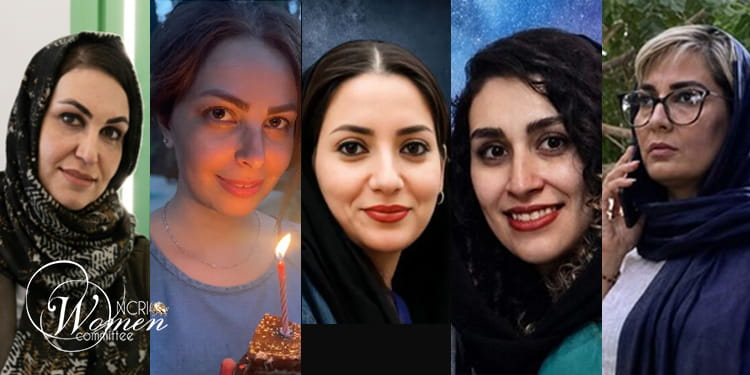
The judiciary has continued to hand down heavy prison sentences to those captured during the crackdown. Among them are sisters Samira and Mina Kouchaki, detainees from the 2026 nationwide uprising, who are currently serving their sentences in Evin Prison. The Revolutionary Court sentenced the sisters to a combined total of 10 years in prison. Samira is a mother of one, and Mina is a mother of two; both had previously been arrested during the 2022 protests. Similarly, Parnian (Fatemeh) Hashempour, another detainee from the 2026 uprising, is serving a five-year sentence in Evin Prison following a prior arrest in 2022 where she was held in Qarchak Prison.
In other provinces, Branch 1 of the Izeh Revolutionary Court has sentenced Shaghayegh Makvandi to two years and one day in prison following her arrest by security forces on January 8, 2026. Meanwhile, Sarina (Marzieh) Aghalar, a political prisoner from Isfahan, is serving a sentence of three years and six months in Evin Prison on charges stemming entirely from her online activities.
The crackdown has also heavily impacted families; Zahra Shahidi, a 48-year-old single mother and the sole provider for her household, was sentenced to two years in prison following her arrest during the 2026 uprising and is currently held in Evin.
Prison authorities are also deploying punitive measures within the facilities. Arezoo Azarm-Sefat, a political prisoner held in Evin since August 26, 2024, has been punitively stripped of her rights to phone calls and family visits. Initially sentenced to five years for alleged cooperation with an opposition group, her term was reduced to three years and nine months after she waived her right to appeal.
The plight of foreign nationals has also raised grave concerns. Homeira Sharifi, an Afghan national arrested during the January protests, was transferred from Qarchak Prison to Evin Prison on February 16, 2026, to serve a five-year sentence. Sharifi has since attempted suicide twice. Despite severe concern voiced by her cellmates, prison authorities continue to deny her effective medical and psychological care.
In Mashhad, Soheila Hosseini, a visual artist, was recently transferred back to Vakilabad Prison from the IRGC Intelligence detention center. However, her husband, Ahmad Rahimi—an IT professor and former university faculty member—remains in solitary confinement at the IRGC facility. The couple was arrested at home on March 18, 2026, targeted for providing humanitarian aid to wounded protesters during the 2026 uprising and facing further allegations of utilizing Starlink satellite internet.
Prolonged Pre Trial Detentions and Legal Limbo
A key component of the regime’s security apparatus is the widespread use of indefinite temporary detentions, leaving political prisoners in a state of exhausting legal limbo. Among them is Shadi (Khadijeh) Shadman, who remains trapped in legal limbo in the women’s ward of Evin Prison five months after her arrest. Detained by security forces during the January 2026 nationwide protests, Shadman spent a month in a security detention facility in eastern Tehran before being transferred to Evin on January 29; her case remains completely unresolved.
Similarly, Mozhdeh Hashemi Bazargani has spent over two months in legal limbo at Qazvin Prison following her arrest by security forces at her home in Alvand on April 4, 2026, with no judicial decision made on her case.
The crackdown has also heavily targeted professionals and legal defenders. Fatemeh Rouhandeh, a defense attorney, has been held in limbo since her arrest by security forces in Kerman in mid May. Authorities detained her for allegedly “violating an online activity ban” after she posted content supporting detainees of the January 2026 protests, and she now faces charges of “spreading falsehoods.” Meanwhile, in Vakilabad Prison in Mashhad, Maliheh Timaji has been left in judicial limbo for over 40 days. Arrested in connection with the January protests, she faces charges of “assembly and collusion to disrupt national security,” yet her case remains entirely abandoned by the judiciary.
Religious minorities continue to face systematic targeting under this framework. In Yazd, authorities extended the temporary detention of Flora Samadani, a Baha’i woman, for another month, marking 35 days of unresolved confinement. Security forces arrested her on May 3, 2026, holding her in a Ministry of Intelligence detention center for a week before transferring her to the central prison. In Shiraz, Sara Sepeheri has spent 57 days in legal limbo at Adelabad Prison. In April, security forces violently broke down the door of the home she shares with her disabled mother, ransacking and confiscating their digital devices and personal belongings before arresting her. Sepeheri is suffering from medical issues and is being denied access to proper healthcare.
For many, the limbo spans more than half a year. Masoumeh (Anahita) JanAlizadeh has spent over six months (207 days) in the women’s ward of Evin Prison without any information being released regarding her judicial process or the exact charges against her.
In Mashhad, Azadeh (Masoumeh) Yaghoubi, a detainee from the 2026 nationwide uprising, has been held in limbo at Vakilabad Prison for more than four months. Despite suffering from Crohn’s disease and enduring deteriorating health, Yaghoubi is being strictly denied transfers to specialized medical facilities outside the prison.
Even minor online activity or digital surveillance has led to indefinite detentions. Faezeh Salehabadi has been held without a verdict in Vakilabad Prison for nearly four months following her arrest in Mashhad. Her case was opened over a single Instagram story, and she now faces severe charges of “insulting Islamic sanctities,” “propaganda against the state,” and “insulting the Supreme Leader.” In another case of arbitrary enforcement, Narges Torbati, 19 years old, has been detained in Vakilabad Prison for over three weeks after security forces searched her phone at a checkpoint in Mashhad and discovered she followed several overseas news outlets.