
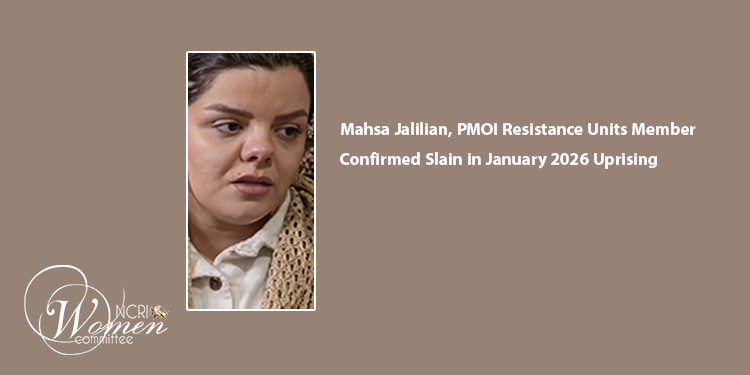
TEHRAN— As the dust begins to settle on the historic, bloody nationwide uprising that swept through Iran over the winter, new details are emerging about the heavy price paid by the women on the frontlines. Among the newly confirmed casualties of the Iranian regime’s brutal crackdown on the January 2026 uprising is Mahsa Jalilian, a 30-year-old resistance fighter whose death was verified and officially announced today by the People’s Mojahedin Organization of Iran (PMOI/MEK).
Mahsa Jalilian, a member of the organized PMOI Resistance Units, was shot directly by regime security forces on January 9, 2026, in the western city of Eslamabad-e Gharb. Previously listed as missing, her death highlights the distinct and perilous role young women have assumed in the ongoing fight to overthrow the clerical regime.
A Fatal Confrontation
According to resistance sources, Mahsa Jalilian lost her life during the absolute peak of the regime’s suppressive backlash in early January. While thousands of citizens took to the streets, organized units actively moved to defend unarmed civilians and push back against state authorities.
Mahsa Jalilian’s final moments occurred in Eslamabad-e Gharb, in Kermanshah Province, where she was targeted with direct gunfire by state forces. Her death came amid a bloody three-day stretch of intense, direct confrontations across the country, which also claimed the lives of 35-year-old electrical engineer Mohammad-Sadegh Alavinejad in Tehran on January 8, and 44-year-old Reza Vaghfiravan in Shahr-e Rey on January 10.
The PMOI has also announced the names of five other Resistance Unit members killed during confrontations with Revolutionary Guards on January 8, 2026.
Women at the Forefront of a Changing Movement
What began on December 28, 2025, as an economic protest by Tehran bazaar shopkeepers over skyrocketing inflation and the collapse of the Iranian rial quickly mutated into a sweeping political rebellion. The movement spread like wildfire across 400 counties and deep into the country’s university systems.
For women like Mahsa Jalilian, the protest was never just about economics—it was a battle for fundamental liberation.
Throughout the uprising, women have not merely been participants; they have been tactical leaders. The PMOI reported that its Resistance Units carried out 630 distinct operations against the Revolutionary Guard Corps (IRGC), the paramilitary Basij, and other state installations to defend civilian quarters.
Jalilian is part of a defiant mosaic of women and youth who paid the ultimate price during the winter crackdown. Other female casualties documented during this wave of unrest include Tehran University student Zahra Bahlouli-Pour, who was also a member of the resistance units killed during the January state crackdown.
The Toll of the Crackdown
To smother the uprising, the Iranian regime enforced a total communications blackout in January, deploying lethal force that resulted in the deaths of thousands of civilians.
Despite the regime’s extreme violence, which included the targeted killings of young academics, championship athletes, and teenage workers, the loss of women like Mahsa Jalilian is fueling a deeper sense of resolve. For a generation of Iranian women who have spent their lives under systemic gender apartheid, Jalilian’s defiance in Eslamabad-e Gharb is being remembered as a testament to female political agency and courage.