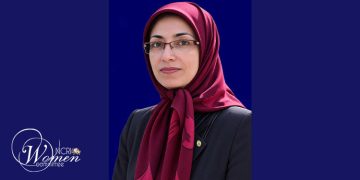
Mahin Khiabani was the third member of the Khiabani family to be martyred in the ranks of the People’s Mojahedin Organization of Iran (PMOI/MEK). She was born in 1953 in Tabriz, a city long associated with resistance and political activism.
During her early teenage years, Mahin came under the guidance of her older brother, Mousa Khiabani, one of the leading figures of the PMOI. Through him, she became familiar with the organization’s ideals, principles, and vision for Iran’s future.
In 1972, her life took a decisive turn. That year, her brother Mousa was arrested by the Shah’s notorious secret police, SAVAK. When Mahin learned of the brutal torture inflicted upon her brother and his comrades in the Shah’s prisons, she made a life-altering decision: she would dedicate herself to the struggle against dictatorship.
Despite her fragile health, Mahin Khiabani regularly visited her brother in prison. Those meetings became a source of strength, fueling her determination to spread the PMOI’s message among ordinary people. She actively participated in religious gatherings, spaces that, at the time, served as important platforms for raising political awareness, and used them to promote resistance against tyranny.
Following the 1979 Iranian Revolution, Mahin expanded her political activities. She first worked at the organization’s labor affairs division in Tabriz. Later, when the Association of Muslim Mothers was established, she played a crucial role in recruiting and mobilizing women to join the movement.
In 1980, Mahin was transferred to the PMOI headquarters in Tehran. In early 1981, she married fellow PMOI member Taghi Owsati, beginning a shared life devoted to political struggle.
After June 20, 1981, a turning point that marked the beginning of armed resistance against Khomeini’s regime, Mahin joined the armed struggle. She served various organizational bases and carried out her responsibilities with remarkable discipline and courage.
One phrase became her trademark during those turbulent days: “I want the day to come when I can confront these criminals face-to-face.”
That day ultimately arrived on May 2, 1982.
On that morning, forces of the Revolutionary Guard Corps (IRGC) launched coordinated attacks on several PMOI safe houses, including one belonging to Mohammad Zabeti, as well as the base where Mahin Khiabani and her husband were stationed.
Mahin was five months pregnant.
Yet she and Taghi refused to surrender.
They fought until their final bullet and their final breath.
When security forces failed to break their resistance through machine-gun fire and grenade attacks, they resorted to firing RPGs at the house. The building was destroyed and engulfed in flames.
Mahin and Taghi perished together in the house that was set ablaze.
The extent of the destruction was so severe that authorities reportedly withheld news of their deaths for a considerable period because they were unable to identify their remains.
In the final moments of her life, as heavy gunfire rained down on the house, Mahin managed to make one last phone call to a relative, warning them about the attack.
Her final words, spoken at 10:00 a.m. on May 2, 1982, remain a haunting testament to her resolve:
“Do you hear the sounds?… The gunfire… The Guards have surrounded us, and everyone is fighting. Our martyrdom is certain… There is no way to escape. We will fight until the end.
It is either martyrdom or the disgrace of surrender. There is no other path with Khomeini, and we have chosen the first.
I am five months pregnant. But all of us must go together, me, Taghi, and our child.”
Mahin Khiabani’s story is one of extraordinary conviction, a woman who remained steadfast to her beliefs until her final moments, choosing resistance over surrender even as death closed in around her.