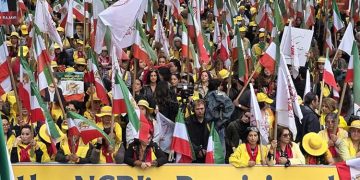


On Tuesday, January 6, 2026, Iran’s nationwide uprising entered a new and decisive phase of confrontation with the country’s clerical dictatorship. The protests have now spread to at least 110 cities across Iran, and the identities of 32 people killed during the uprising have been confirmed.
Alongside the widely heard chants of “Death to Khamenei” and “Death to the dictator,” a defining slogan echoed across cities nationwide: “This year is the year of sacrifice, Seyed Ali (Khamenei) will be overthrown.”
Tehran: The Bazaar Rises, Clashes Spread Across the Capital
Early Tuesday morning, the heart of Tehran witnessed a surge of protest led by bazaar merchants and rebellious youth. Large sections of the Grand Bazaar went on full strike as shopkeepers closed their businesses and launched protest gatherings. Despite the deployment of water cannons, a heavy presence of riot police, plainclothes agents, and at least 20 buses transporting security forces, the clerical regime failed to suppress the demonstrations.
At the same time, central areas of Tehran were placed under intense security lockdown. Security forces even used ambulances to transport personnel. From 3:00 p.m. onward, protests and clashes intensified in the southern districts of the capital. In all these areas, protesters chanted “Death to Khamenei” and “Death to the dictator.”
Demonstrations also continued in western and parts of northern Tehran. By evening, clashes peaked in Sadeghieh, Tajrish, and Enghelab Street. Security forces fired tear gas to disperse crowds but failed to regain control. Tear gas was even fired at Sina Hospital in the Hassan Abad area. Protests were also reported in the Khak-e Sefid district.
Meanwhile, students at Tehran’s all-female Al-Zahra University joined the uprising, chanting anti-regime slogans.
Shahrekord and Ilam: Prominent Role of Women, Direct Confrontations Erupt
In Shahrekord, widespread demonstrations erupted with a strong and visible presence of women. Protesters clashed directly with special forces units after security forces blocked major routes to prevent gatherings. Residents responded by setting fires in the streets to stop security units from advancing.
In one striking scene, a young woman stood alone in front of a water cannon, openly defying and humiliating the regime’s forces.
Bazaar merchants in Shahrekord were also on strike.
In Abdanan, in Ilam Province, the city was effectively taken over by protesters and rebellious youths. Crowds controlled the streets, and when IRGC forces attempted to attack demonstrators, they were met with organized resistance. A store owned by the Revolutionary Guard Corps was set on fire, and security forces, unable to confront the crowds, retreated to the rooftop of a police station. Fearing the spread of the uprising, authorities cut off electricity to the city.
Malekshahi and Ilam: Public Fury After Killings
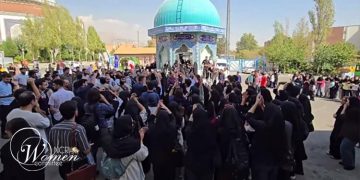
On Tuesday morning, victims of the uprising in Malekshahi, Ilam Province, were buried amid massive public participation, including large numbers of young women and girls. Funeral processions turned into protest marches, with chants of “Death to Khamenei,” “Death to the IRGC,” and “This year is the year of sacrifice, Seyed Ali (Khamenei) will be overthrown.”
Outrage over the killings of January 3 and 4 in Malekshahi and Ilam fueled further clashes. Protesters chanted, “I will kill the one who killed my brother.” During confrontations with riot police, several security forces were reportedly killed or injured, while others fled the scene. A state-owned bank was set on fire. Eyewitnesses reported that security forces retreated, leaving parts of the city effectively liberated.
Universities and Cities Nationwide Join the Uprising
On Monday night, January 5, in Tabriz, demonstrators chanting “An honorable Iranian—both the Shah and the Sheikh are disgraceful” blocked security supply routes by throwing firebombs and setting trash bins ablaze.
In Mashhad, protesters blocked roads on Ghayour Street while chanting “Death to the oppressor, whether Shah or (the mullahs’) Leader.”
At Birjand University, students chanted slogans such as “We didn’t give martyrs to compromise,” “I will kill the one who killed my brother,” and “Neutrality is betrayal.” Security forces later stormed the university and the women’s dormitory, arresting a number of students.
From 1:00 p.m. until midnight on January 6, protests and clashes continued across dozens of cities, including Arak, Songhor, Eslamabad-e Gharb, Isfahan (Yazdanshahr and Koushk), Shahrekord, Mashhad, Nourabad-e Mamasani, Hafshejan, Kuhdasht, Malekshahi, Jask, Qasr-e Shirin, Kermanshah, Ilam, Abdanan, Sari, Mojanabad in Khorasan Province, Neyriz in Fars Province, Mehrshahr, Qazvin (Alvand), Kerman University of Art, and Mahabad.
In Borujerd, residents marched in the evening chanting “Death to the dictator.”
In Mashhad, riot police attacked demonstrators in 17 Shahrivar Square using tear gas, but protesters resisted, chanting “Freedom, freedom.”
In Isfahan and Shiraz, residents attempted to free recently arrested protesters as anti-regime slogans filled the streets.
In Kermanshah, nighttime demonstrations reached their peak as large crowds confronted security forces.
Night protests were also reported in Lahijan, Qom, Tabriz, Birjand, and Sari.
Scale and Significance
By midnight on Tuesday, January 6, protests had erupted in more than 90 cities across 27 provinces. Approximately 20 cities, including Borujerd, Yazdanshahr, Koushk, Malekshahr, and Chenar Asadabad in Hamedan Province, joined the uprising for the first time.
The breadth, intensity, and coordination of these protests underscore a critical shift: Iran’s uprising has entered a new phase in which streets, universities, bazaars, and neighborhoods have simultaneously become arenas of direct confrontation with the clerical regime, driven in large part by the courage, leadership, and determination of women.