
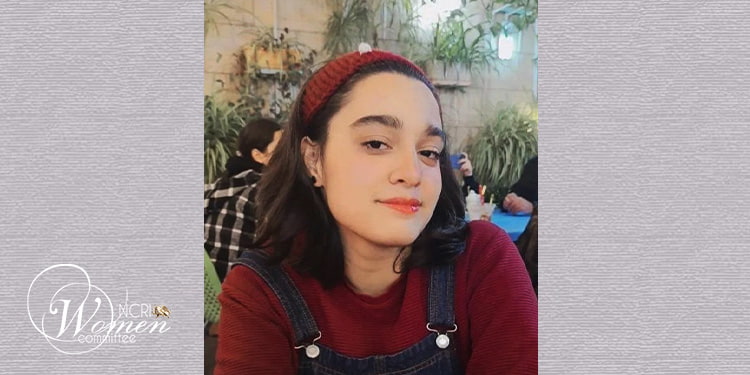
Setayesh Shafiei was killed on the evening of January 8, 2026, during nationwide protests in Tehran, after being struck by live ammunition fired by regime security forces.
That night, Setayesh Shafiei had gone out with several friends near their neighborhood in Khorrasan Square, in southern Tehran. The atmosphere was thick with smoke and tension. Gunfire blended with chants and shouting. Close to where Setayesh stood, a young teenage boy, reportedly just 12 or 13 years old, was shot and fell to the ground. He was killed at the scene.
Concerned that the boy’s body might be trampled in chaos, Setayesh told her friends and broke away from them, running toward him. She intended to pull his body to safety. As soon as she reached the teenager, security forces opened fire, first targeting her leg. She tried to stand. A second live round struck her in the back. She fell to the ground and died shortly thereafter.
The crowd dispersed amid the violence. When the situation calmed and her friends returned to search for her, neither Setayesh’s body nor that of the teenage boy remained on the scene. Both had been removed.
Setayesh Shafiei was 20 years old. She had grown up in the care system under the supervision of the State Welfare Organization. She was an athlete and an avid reader. The previous year, at the winter solstice celebration of Yalda Night, she had become engaged. She was determined to build the life that had long been denied to her.
Her fiancé, together with friends, began searching across the city, from hospital to hospital and other possible locations, until around 4:00 a.m. on January 10, 2026, when medical staff at a hospital informed them that a deceased woman matching her description had been admitted. Her fiancé was taken to identify her body.
Her face, pale from severe blood loss, confirmed what they feared. She had been shot twice in the back with live ammunition.
For the release of her body, the presence of her fiancé and friends was insufficient. A legal guardian was required. As Setayesh Shafiei had no immediate family, her friends contacted her court-appointed guardian within the State Welfare Organization. Hours later, her body was transferred to the Kahrizak Forensic Medicine Center. Before noon, her remains were formally handed over to her legal guardian, who also filed a complaint at the time of retrieval.
Setayesh’s body was taken to Behesht-e Zahra in Tehran. Due to the large number of mourners present, her burial was postponed until the following day. She was laid to rest there on January 11, 2026.
Setayesh Shafiei: The Girl Who Was the Sun
Setayesh Shafiei was a member of the district 6 Tehran basketball team and played at a club operating under the supervision of the Ministry of Education. She also served as an active judge in various editions of the “Mehr Book Prize.” At the time of her death, she was preparing for the national university entrance examination, determined to pursue higher education. In her new residence, she had built and decorated a personal library.
Her friends describe her as “wildly free”, a young woman who challenged the constraints imposed on her environment without hesitation, as though she were constantly judging her own life on her own terms. She was deeply compassionate and always ready to help others. She wrote extensively and ran a Telegram channel titled “The Girl Who Was the Sun,” where she put into words the thoughts and emotions she rarely voiced aloud.