
Friday, June 5, 2026
  • English
  • Français
  • فارسی
  • عربى
PODCASTS
NCRI Women Committee Women Resistance Freedom
  • Home
  • NEWS
    • Women’s News
    • Articles
    • Statements
  • PUBLICATIONS
    • Monthlies
    • Documents
    • Reference Library
  • ABOUT US
    • The NCRI Women’s Committee
    • Gender Equality
    • Women’s Platform
  • MARYAM RAJAVI
    • Maryam Rajavi
    • Maryam Rajavi Speeches
    • The Plan on Women’s Rights and Freedoms
    • Ten-Point Plan for the future of Iran
  • VANGUARDS
    • The Fallen for Freedom
    • Heroines in Chain
    • Women of Iranian Resistance
    • Famous Women
    • Women in History
  • EVENTS
    • IWD Conferences
    • Activities
    • IWD Speeches
    • Solidarity
  • VIDEO
    • Videos
    • IWD Videos
  • PODCAST
  • DONATE
  • CONTACT US
No Result
View All Result
NCRI Women Committee Women Resistance Freedom
  • Home
  • NEWS
    • Women’s News
    • Articles
    • Statements
  • PUBLICATIONS
    • Monthlies
    • Documents
    • Reference Library
  • ABOUT US
    • The NCRI Women’s Committee
    • Gender Equality
    • Women’s Platform
  • MARYAM RAJAVI
    • Maryam Rajavi
    • Maryam Rajavi Speeches
    • The Plan on Women’s Rights and Freedoms
    • Ten-Point Plan for the future of Iran
  • VANGUARDS
    • The Fallen for Freedom
    • Heroines in Chain
    • Women of Iranian Resistance
    • Famous Women
    • Women in History
  • EVENTS
    • IWD Conferences
    • Activities
    • IWD Speeches
    • Solidarity
  • VIDEO
    • Videos
    • IWD Videos
  • PODCAST
  • DONATE
  • CONTACT US
No Result
View All Result
NCRI Women Committee
No Result
View All Result
Home Heroines in Chain
The Women They Could Not Break _ Prison Memoirs of Azam Haj Heydari Part 9

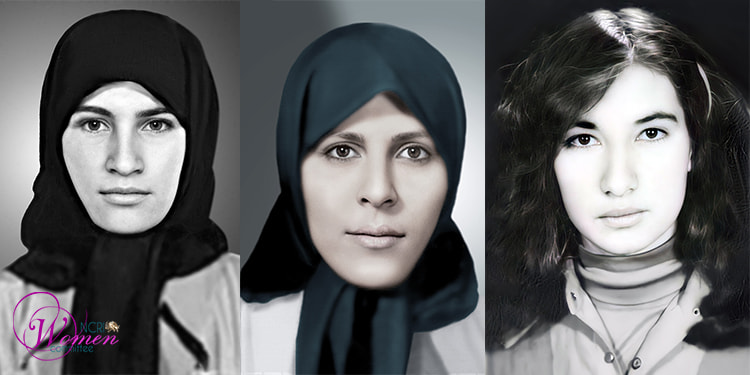
From left: Maryam Golzadeh Ghafouri, Sima Hakim Ma'ani, and Shahrbanu Ghorbani.

The Women They Could Not Break

June 4, 2026
in Heroines in Chain

Prison Memoirs of Azam Haj Heydari from the book The Price of Being Human — Part Nine

In this ninth installment of the prison memoirs of Azam Haj Heydari, published in The Price of Being Human, the author writes about the extraordinary spirit of her fellow PMOI women, their resistance under brutal torture, and the hunger strike in Evin Prison.

At the time, Azam was a young teacher in her early twenties who had entered the path of resistance. She spent five years imprisoned in the Temporary Judiciary Detention Center, Evin, Qezel Hesar, and Gohardasht prisons, where she endured savage torture at the hands of Khomeini’s Guards.

Resisting Savage Torture

One day the ward door opened and another new prisoner was brought in. She could barely walk, bent over from the severity of the torture she had endured.

She was a tall, dark-complexioned young woman with a worn face, yet there was something strikingly kind and compelling about her. I was drawn to her immediately.

I went over to her. Her legs were in terrible condition.

“Would you like some help?” I asked.

She looked at me and smiled.

Her face seemed familiar, but I could not place her.

“Azam, don’t you recognize me?” she asked.

I felt embarrassed. She knew me, but I did not recognize her.

She smiled again and said kindly, “It’s Sima. Have you forgotten? I can’t blame you. My face has changed, but I’m still the same person.”

She mentioned a few occasions when we had worked together in the Association of Teachers Supporting the PMOI.

Suddenly I recognized her.

“Sima? Is that really you? You’ve changed so much!”

It was Sima Hakim Ma’ani.[1] In the span of a single year, she looked as though she had aged more than ten years.

Before June 20, 1981, we had worked together extensively. Sima was the only child of a relatively well-off and educated family. She lacked nothing in life, yet she chose the path of struggle and remained steadfast until the very end.

Her legs were in terrible condition. Her wounds had become infected, and the infection had spread into her bloodstream. As punishment for her refusal to surrender, the executioners deliberately denied her medical treatment.

The pain and torture had caused her to lose twenty kilograms. She was extremely weak and moved around in a wheelchair. Yet even in that condition she could not sit idle for a moment.

Through relentless effort, and with the help of the other prisoners, she managed to regain some use of one of her arms so she could perform certain daily tasks herself.

Whenever the others urged her to rest, she refused.

“I don’t have much time,” she would say. “There isn’t much time left.”

In the end, they sent her before a firing squad in that same condition.

Another of these remarkable women was Shahrbanu Ghorbani.[2] The executioners tortured her with such fury and hatred that no one could recognize her face when she arrived in the ward. Her appearance shocked everyone.

Looking at what Shahrbanu had endured, I came to understand how precious and powerful human ideals truly are. Only something of immense value could give a person such limitless strength to withstand torture and make such a terrible struggle bearable.

Three days later they removed Shahrbanu from the ward.

I never saw her again.

About a year later I heard that she had been executed, though I never learned where or under what circumstances.

Standing Against the Collaborators

After some time, I and several other prisoners were transferred to another ward.

When I arrived, I was delighted to discover that I knew many of the women there.

Most had previously been taken away under the pretext of interrogation or accused of maintaining their political stance or organizational ties. We had lost all news of them. As I walked through the ward and saw them alive before me, my sadness at leaving my former friends disappeared completely.

I had believed many of them had already been executed.

Seeing them alive felt like being handed the world.

Among them were Parvin Haeri, Maryam Golzadeh Ghafouri, Homa Radmanesh, Azam Taqdareh, and many others.

All of them had the death sentence, and the regime eventually executed every one of them.

Perhaps the authorities had gathered them together in one ward in hopes of breaking them psychologically while they awaited execution.

That plan failed as well.

Not one of them surrendered.

All were eventually executed.

Parvin Haeri was known throughout the prison for the way she carried herself—with strength, dignity, and unshakable resolve—as well as for her extraordinary resistance. Both the collaborators and the interrogators knew exactly who she was and what she represented.

Because of her tall stature and remarkable strength, the prisoners had given her the nickname “The Colonel.”

The informers and collaborators visibly bristled whenever anyone referred to her by that title.

Houriyeh Beheshti-Tabar held a master’s degree in economics. She taught economics to the other prisoners with remarkable enthusiasm and dedication and never allowed prison time to be wasted.

Her efforts earned the hatred of the prison authorities.

Every encounter between Houriyeh and the executioners ended with insults and abuse. Their hostility was proof of how valuable her work was.

Everyone loved Houriyeh.

She was around forty-five years old at the time. Her eyesight was extremely poor, requiring glasses with a prescription of eight or ten diopters.

The executioners, the ward Guards, and the collaborators repeatedly tried to break her with vulgar insults rooted in the reactionary culture they embraced.

On at least two occasions they accused her of fabricated and degrading moral offenses and flogged her on a bench in front of her fellow prisoners. The painful details of those scenes deserve a story of their own.

Another hero was Homa Radmanesh.

The executioners could barely tolerate the sight of her.

She was physically frail, probably weighing no more than forty-five kilograms, yet she possessed extraordinary strength, dignity, patience, and love for every prisoner around her.

You never saw sadness or defeat on her face.

That alone filled the regime’s agents with resentment.

They would accuse her of secretly encouraging resistance among the prisoners.

In truth, they were right.

Simply having Homa Radmanesh in a ward inspired others to remain steadfast.

From the moment I arrived in this ward, we were constantly in conflict with the collaborators assigned to it.

We protested their presence and demanded to know why they had been placed among us.

“We are prisoners,” we argued. “If there are issues to address, we will deal directly with the Guards and prison officials—not with collaborators.”

The regime, however, wanted to place collaborators between us and the authorities. That way it could hide behind them and claim that the prisoners were merely fighting among themselves.

To protest this policy, we launched a hunger strike that later became known as the Thirteen-Day Hunger Strike in Evin.

The strike began when the collaborators brought food to distribute.

We refused to accept it.

“We do not recognize them,” we said.

The food remained untouched in the pots until the next day, when it was removed and replaced by a new batch.

The standoff continued.

The collaborators attacked and beat us, backed by the Guards and prison officials.

Each day they left food at the entrance to the ward and departed.

Each day we refused both food and tea and ignored all demands.

The hunger strike continued for thirteen days.

Some prisoners, especially Homa, became dangerously weak.

Unable to break the strike, the executioners eventually transferred seventeen of the prisoners to another ward.

At first, they were taken to the Evin infirmary ward.

About two weeks later, they were transferred again to a different section of the prison.

To be continued…


[1] Sima Hakim Ma’ani was a 24-year-old economics student and an employee of Iran’s Ministry of Oil.

On December 1, 1981, she was identified by a collaborator and arrested by an Evin Prison strike-force patrol. She was subjected to brutal torture and was executed by firing squad on March 10, 1982.

[2] Shahrbanu Ghorbani, born in Semnan, was a natural sciences student. She was executed in Evin Prison on September 20, 1984, at the age of twenty-six.

ShareTweetPinShareSendShare

Related Posts

Setayesh Shafiei, The Girl Who Was the Sun

June 4, 2026
Setayesh Shafiei was killed on the evening of January 8, 2026,

Setayesh Shafiei was killed on the evening of January 8, 2026, during nationwide protests in Tehran, after being struck by live ammunition fired by regime security forces. That...

Read moreDetails

Iran: Women Arrested Across Multiple Cities as Crackdown Continues

June 4, 2026
Iran: Women Arrested Across Multiple Cities as Crackdown Continues

As the clerical regime in Iran intensifies its repression of dissent following nationwide protests, authorities have expanded their campaign against women, teachers, and artists. From arbitrary arrests and...

Read moreDetails

Iranian Students Rise Up for Justice in Fresh Protests

June 2, 2026
Iranian Students Rise Up for Justice in Fresh Protests

This generation will not back down for empty promises and repetitive rhetoric Iranian students in Tehran, Mashhad, and Hamadan staged protests on Tuesday, June 2, 2026. Gathering outside...

Read moreDetails

In Memory of Carol Fontaine: A Steadfast Advocate for Iranian Women and the Struggle for Freedom

June 2, 2026
In Memory of Carol Fontaine: A Steadfast Advocate for Iranian Women and the Struggle for Freedom

The Iranian Resistance has lost one of its loyal friends and valued supporters. Carol Fontaine, a courageous human rights advocate and tireless defender of women's rights, who stood...

Read moreDetails

“No to Executions Tuesdays” Campaign: Continued Pressure on Female Prisoners

June 2, 2026
“No to Executions Tuesdays” Campaign: Continued Pressure on Female Prisoners

Marking the 123rd week of the protest campaign “No to Executions Tuesdays” political prisoners in 56 prisons across Iran launched another hunger strike on Tuesday, June 2, 2026,...

Read moreDetails

Documents

Crushed by Design: Structural Crises and Inequitable Policies Push Female-Headed Households to the Edge

Crushed by Design: Structural Crises and Inequitable Policies Push Female-Headed Households to the Edge

May 18, 2026

Introduction Life for the Iranian people under the religious dictatorship is fraught with hardship and peril from every perspective. Whether...

A Report to CSW70: Gender-Based Discrimination Under Iranian Law

A Report to CSW70: Gender-Based Discrimination Under Iranian Law

March 8, 2026

Structural Inequality and State-Sanctioned Oppression of Women Gender-Based Discrimination Under Iranian Law” is the title of the NCRI Women’s Committee’s...

Annual Report 2026: From Protests, to Uprising, and the Role of Iranian Women

Annual Report 2026: From Protests, to Uprising, and the Role of Iranian Women

March 3, 2026

On the eve of International Women’s Day 2026, the NCRI Women’s Committee presents its Annual Report 2026, offering a recap...

Monthlies

May 2026 Report: The Enduring Resistance of Iranian Women
Monthlies

May 2026 Report: The Enduring Resistance of Iranian Women

May 31, 2026
April 2026 Report: Mass Arrests of Women: Targeted Repression in Time of Crisis
Monthlies

April 2026 Report: Mass Arrests of Women in Iran

April 30, 2026
March 2026 Report: How Iranian Women Are Shaping the Resistance
Monthlies

March 2026 Report: Courage Under Fire

April 3, 2026
January 2026 Report: Women at the Core of the Uprising
Monthlies

January 2026 Report: Women at the Core of the Uprising

January 31, 2026

Articles

In Memory of Carol Fontaine: A Steadfast Advocate for Iranian Women and the Struggle for Freedom

In Memory of Carol Fontaine: A Steadfast Advocate for Iranian Women and the Struggle for Freedom

June 2, 2026

The Iranian Resistance has lost one of its loyal friends and valued supporters. Carol Fontaine, a courageous human rights advocate...

How Internet Blackout in Iran Forces Women into Structural Poverty

How Internet Blackout in Iran Forces Women into Structural Poverty

May 30, 2026

The internet blackout in Iran—which is now entering a phase of drip-fed restoration after nearly three months of absolute blockage—has...

The Crimson Diary Under the Daily Shadow of Femicide in Iran

The Crimson Diary Under the Daily Shadow of Femicide in Iran

May 29, 2026

What follows is merely a horrifying glimpse into leaked news from an incredibly brief period—from mid to late May 2026....

The Fallen for Freedom

Setayesh Shafiei was killed on the evening of January 8, 2026,
The Fallen for Freedom

Setayesh Shafiei, The Girl Who Was the Sun

June 4, 2026
White-Clad in the Line of Fire: Samin Rostami
The Fallen for Freedom

White-Clad in the Line of Fire: Samin Rostami

May 20, 2026
Killed by Two Bullets to the Heart and Leg: Fatemeh Abdollahi
The Fallen for Freedom

Killed by Two Bullets to the Heart and Leg: Fatemeh Abdollahi

May 17, 2026
Fereshteh Azhadi: A Life of Resistance, Sacrifice, and Unyielding Commitment
The Fallen for Freedom

Fereshteh Azhadi

May 1, 2026

ABOUT US

NCRI Women Committee

We work extensively with Iranian women outside the country and maintain a permanent contact with women inside Iran. The Women’s Committee is actively involved with many women’s rights organizations and NGO’s and the Iranian diaspora.
The committee is a major source of much of the information received from inside Iran with regards to women. Attending UN Human Rights Council meetings and other international or regional conferences on women’s issues and engaging in a relentless battle against the Iranian regime’s misogyny are part of the activities of members and associates of the committee.

CATEGORIES

  • Activities
  • Articles
  • Documents
  • Famous Women
  • Heroines in Chain
  • IWD Conferences
  • IWD Speeches
  • IWD Videos
  • Maryam Rajavi
  • Maryam Rajavi Speeches
  • Monthlies
  • Podcast
  • Reference Library
  • Solidarity
  • Statements
  • The Fallen for Freedom
  • Videos
  • Women in History
  • Women in Leadership
  • Women of Iranian Resistance
  • Women's News

BROWSE BY TAG

Child marriage coronavirus education execution forced hijab Gender Gap Generation Equality Honor killings Iran Teachers Maryam Akbari Monfared Nurses Plan on Women's Rights and Freedoms Poverty Prisoners Protests rural women Saba Kord Afshari The girl child Violence against women Women's Leadership Women Heads of Household Zeinab Jalalian

The copyright of all the material published on this website has been registered under © 2016 the Women’s Committee of the National Council of Resistance of Iran. To obtain permission to copy, redistribute or publish the material published on this website, you should write to the NCRI Women’s Committee. Please include the link of the original article on our website, women.ncr-iran.org.

Welcome Back!

Login to your account below

Forgotten Password?

Retrieve your password

Please enter your username or email address to reset your password.

Log In

Add New Playlist

No Result
View All Result
  • Home
  • News
    • Women’s News
    • Articles
    • Statements
  • Publications
    • Monthlies
    • Documents
    • Reference Library
  • About Us
    • The NCRI Women’s Committee
    • Gender Equality
    • Women’s Platform
  • Maryam Rajavi
    • Maryam Rajavi
    • Maryam Rajavi Speeches
    • Ten Point Plan for Iran
    • The Plan on Women’s Rights and Freedoms
  • Vanguards
    • The Fallen for Freedom
    • Heroines in Chain
    • Women of Iranian Resistance
    • Famous Women
    • Women in History
  • Events
    • IWD Conferences
    • Activities
    • IWD Speeches
    • Solidarity
  • Video
    • Videos
    • IWD Videos
  • Podcast
  • Donate
  • Contact us
  • فارسی
  • عربی
  • Français

The copyright of all the material published on this website has been registered under © 2016 the Women’s Committee of the National Council of Resistance of Iran. To obtain permission to copy, redistribute or publish the material published on this website, you should write to the NCRI Women’s Committee. Please include the link of the original article on our website, women.ncr-iran.org.