
Prison Memoirs of Azam Haj Heydari from the Book The Price of Being Human — Part Seven
In the seventh installment of Azam Haj Heydari’s prison memoirs from The Price of Being Human, she recounts the many forms of resistance practiced by steadfast political prisoners in Evin Prison—acts of solidarity and creativity that ultimately defeated the torturers’ efforts to break them.
At the time, Azam was a young schoolteacher in her early twenties who had joined the struggle for freedom. She spent five years imprisoned in the Temporary Judiciary Prison, Evin, Qezel Hesar Prison, and Gohardasht Prison, where she endured brutal torture at the hands of Khomeini’s Guards.
Keeping Our Humanity Alive Behind Bars
The torturers sought not only to destroy prisoners physically, but above all to crush their spirit of resistance and strip them of their human identity.
To achieve this, they did everything they could to isolate us from one another and then break us individually. They understood very well that our strength came from being together.
We, in turn, constantly searched for ways to remain connected—to strengthen one another, help each other grow, and instill hope and self-confidence.
One of the women suggested that anyone who came from a particular city, or knew it well, should give a presentation about it. She could talk about its history, customs, traditions, language, dialect, and social and economic conditions. The idea was warmly received, and we called the series “A Journey Through the Cities of Iran.”
Some of these presentations were remarkably detailed and fascinating.
One was given by Mahdokht Mohammadi-Zadeh, who spoke about her hometown of Kerman. Her talk was so vivid that I told her, “Mahdokht, I feel as if I’ve already seen Kerman. If I ever go there, I could walk through it with my eyes closed.”
On the day they came to take her for execution, she said to me, “Azam, if you are ever released, don’t forget Kerman. And don’t miss its beautiful, star-filled nights.”
Then, with her warm and gentle smile, she kissed me goodbye and walked away.
Another series of talks focused on science. Anyone with academic knowledge or personal expertise shared what they knew with the rest of us.
One day, while speaking with Zahra Nazari, I mentioned my interest in biology and in the story of the Earth’s formation and the evolution of life.
She replied, “Biology was my field at university, and I loved it.”
I asked, “Don’t you still?”
She smiled and said, “I do. But a greater love came and overshadowed it—the love of freedom, which I found in the ideals of the PMOI.”
Then she asked, “Would you like me to teach you a course in biology and evolution?”
I was thrilled and said yes immediately.
“But you are under interrogation,” I protested.
“Don’t worry about that,” she replied.
We arranged a schedule, and each day she taught me for two hours. Like an experienced professor, with no books or notes, she delivered from memory a captivating course on the formation of the Earth and the evolution of living creatures.
Her explanations were so engaging that, even after more than twenty years, much of what she taught me remains vivid in my mind.
Zahra was filled with love and a profound sense of responsibility toward every prisoner.
Although she had endured prolonged and severe torture, she behaved as though nothing had happened. She never spoke about her suffering. We learned of her extraordinary courage from other prisoners who had witnessed her during interrogation and described how she had utterly frustrated her interrogators, denying them even a single word of information.
In that hell, we still experienced moments of genuine happiness.
We drew strength from these extraordinary women and from the deep human bonds and shared ideals that united us.
We understood clearly that we had to preserve our morale at all costs and never allow the enemy to achieve its goal of breaking our spirit.
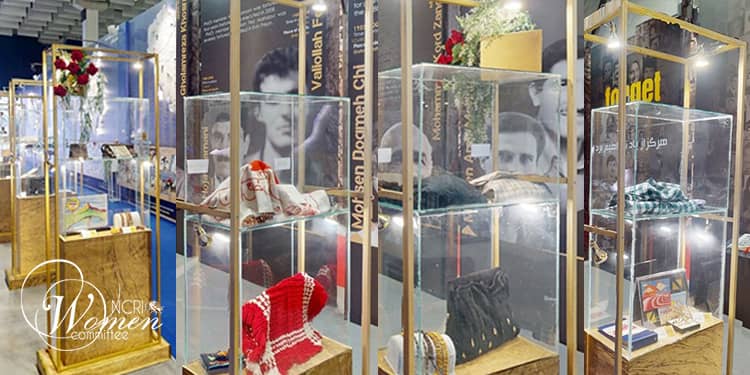
One important way we maintained hope was by making handicrafts from whatever materials we could find.
The women pulled colored threads from worn clothing to create beautiful embroidery.
Using whatever was available—from date pits to bones from our meals, which we soaked in water for days until they turned white, then carved and polished delicate objects. We even smuggled small stones from the prison yard while being taken to interrogation and carved them into miniature sculptures and decorative designs.
All of these creations were acts of resistance.
Assadollah Lajevardi and the informers he planted among us were enraged by these efforts.
They used beatings, torture, threats, and intimidation to stop us.
Many prisoners had little or nothing in their case files, and some had been arrested for the most trivial reasons. Yet they endured the harshest pressure simply because they continued to resist in these ways. Many were ultimately executed for that reason alone.
Our ward included women from every walk of life: schoolgirls as young as fourteen and fifteen, university students, graduates, doctors, office workers, homemakers, and many others from different social backgrounds.
But this diversity never divided us.
On the contrary, each person used her strengths and knowledge to help the others.
What united this remarkable group was our vitality, our optimism, and our unwavering spirit.
That was precisely what the torturers and collaborators feared most.
Their hatred ran so deep that they could not hide it. They lashed out with insults, calling us shameless and carefree to suppress our joy. They also tried to isolate the older women by suggesting they were different from the younger prisoners.
But every one of these tactics failed.