
Sunday, May 17, 2026
  • English
  • Français
  • فارسی
  • عربى
PODCASTS
NCRI Women Committee Women Resistance Freedom
  • Home
  • NEWS
    • Women’s News
    • Articles
    • Statements
  • PUBLICATIONS
    • Monthlies
    • Documents
    • Reference Library
  • ABOUT US
    • The NCRI Women’s Committee
    • Gender Equality
    • Women’s Platform
  • MARYAM RAJAVI
    • Maryam Rajavi
    • Maryam Rajavi Speeches
    • The Plan on Women’s Rights and Freedoms
    • Ten-Point Plan for the future of Iran
  • VANGUARDS
    • The Fallen for Freedom
    • Heroines in Chain
    • Women of Iranian Resistance
    • Famous Women
    • Women in History
  • EVENTS
    • IWD Conferences
    • Activities
    • IWD Speeches
    • Solidarity
  • VIDEO
    • Videos
    • IWD Videos
  • PODCAST
  • DONATE
  • CONTACT US
No Result
View All Result
NCRI Women Committee Women Resistance Freedom
  • Home
  • NEWS
    • Women’s News
    • Articles
    • Statements
  • PUBLICATIONS
    • Monthlies
    • Documents
    • Reference Library
  • ABOUT US
    • The NCRI Women’s Committee
    • Gender Equality
    • Women’s Platform
  • MARYAM RAJAVI
    • Maryam Rajavi
    • Maryam Rajavi Speeches
    • The Plan on Women’s Rights and Freedoms
    • Ten-Point Plan for the future of Iran
  • VANGUARDS
    • The Fallen for Freedom
    • Heroines in Chain
    • Women of Iranian Resistance
    • Famous Women
    • Women in History
  • EVENTS
    • IWD Conferences
    • Activities
    • IWD Speeches
    • Solidarity
  • VIDEO
    • Videos
    • IWD Videos
  • PODCAST
  • DONATE
  • CONTACT US
No Result
View All Result
NCRI Women Committee
No Result
View All Result
Home Heroines in Chain
Standing Up to the Savagery of Khomeini’s Revolutionary Guards Prison memoirs of Azam Haji-Heydari from the book The Price of Being Human – Part 1

Standing Up to the Savagery of Khomeini’s Revolutionary Guards

April 9, 2026
in Heroines in Chain

Prison memoirs of Azam Haji-Heydari from the book The Price of Being Human – Part One

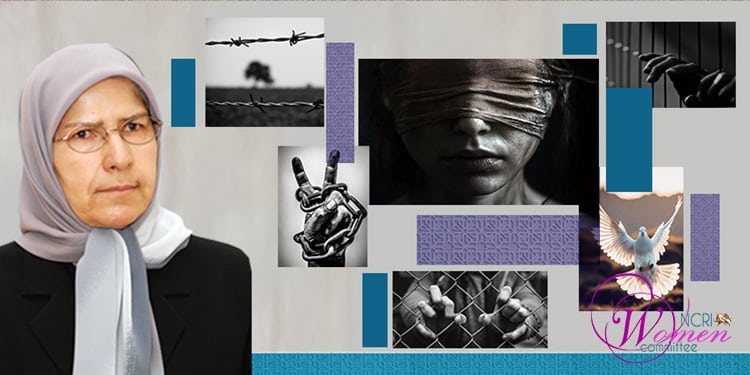
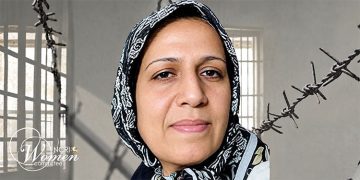
Beginning with this issue, we turn to the prison memoirs published in the book The Price of Being Human, written by Azam Haji-Heydari.

Azam Haji-Heydari was born into a traditional religious family in one of the impoverished neighborhoods of southern Tehran, near Shush Square. She was twenty years old at the time of the 1979 revolution. Because of the rigid and conservative views of her family, taking part in political and revolutionary activities was extremely difficult for her and filled with obstacles.

Azam worked as a teacher for underprivileged children. After becoming acquainted with the People’s Mojahedin Organization of Iran (PMOI/MEK) through Tahereh Moharrer Khansari, a PMOI member killed by the regime, and after rebelling against the restrictions her family had imposed on her, she stepped onto the path of struggle for the freedom of her people.

Following her arrest by the Revolutionary Guards Corps (IRGC), she spent five years in prison—including the Temporary Judiciary Detention Center, Evin, Qezel Hesar, and Gohardasht prisons—where she was subjected to torture.

In the coming issues, we will publish excerpts from The Price of Being Human, describing her arrest and her resistance in prison against the reactionary rule of Khomeini, edited for publication on the website.

In this first installment, the author recounts the period before her arrest and her confrontation with the brutality of the regime’s Revolutionary Guards.

The Struggle Between Two Forces

In late 1980 and early 1981, the attacks and assaults by the IRGC and regime thugs against members and supporters of the Mojahedin had become openly savage and deadly.

There was hardly a day when we could go out into the streets without being attacked. And there was hardly a day when one or more supporters of the Mojahedin were not beaten, wounded, arrested, or dragged off to torture by club-wielding gangs. They struck us with fists, kicks, and all kinds of blunt and bladed weapons, intending to kill.

One day a friend and I were standing at the Jomhouri intersection in Tehran, selling copies of Mojahed newspaper. My friend held the newspaper and, as usual, was reading the headlines out loud. I kept watch.

Suddenly I saw three huge, heavily bearded men, each perhaps seventy centimeters taller than me, walking toward us. One of them had his hand inside his shirt. I realized he was planning something and was about to pull out a weapon to strike my friend. I kept my eyes fixed on them, trying to decide what to do.

I moved behind them. Just one step before they reached my friend, the giant pulled a nunchaku from inside his shirt and raised his arm to strike her with full force.

I still don’t know where I found the strength at that moment. I jumped up, grabbed the nunchaku from behind him, and ran.

Jomhouri Street was crowded. I ran as fast as I could while the two giants chased after me. I was exhausted and terrified, almost out of breath. Because the mentality of seeing myself as a “weak woman” still lingered in me, in those moments I found myself wishing that a strong man might appear and rescue me from them.

As I ran, I wondered what I should do. Then I saw a small bridge over a drainage canal—an opportunity. I threw the nunchaku underneath it and kept running.

A few moments later they caught up with me and began beating me with punches and kicks. My body felt completely crushed. But inside I felt victorious. I had saved my friend, and I had taken their weapon away from them, and that burned them deeply. What humiliated them most was that they had been defeated by a thin young girl.

Gradually people gathered around us and began protesting, asking why several men had attacked a defenseless girl.

Each of these incidents—which happened many times during our publicity and awareness-raising activities—pushed me one step further away from feelings of weakness and gave me greater confidence. At the same time, I believe people’s attitudes toward the regime and toward us were also changing.

People saw the brutality of the regime’s thugs against us and grew to hate them. At the same time, they witnessed our resistance and began to respect and support us—especially the women and girls who supported the Mojahedin. Many people themselves gained greater courage and determination to stand up against the regime’s repressive forces.

In that vast and widespread struggle taking place across society and throughout the cities, we could see with our own eyes how Khomeini was gradually losing the position he once held. People who had initially had illusions about him were turning away and moving toward the Mojahedin and other progressive forces.

At the same time, the regime’s Revolutionary Guards and club-wielding gangs became increasingly brutal toward us. Every day when we went out to sell publications or carry out political activities, we did not expect to return home that night.

When we returned, we often came back with broken arms or heads, our bodies bruised and bloodied. Yet our morale remained high because of the social transformation that was taking place. We could see the regime weakening in society while our own movement was gaining strength.

Mass Arrests – 31 May 1981

On 31 May 1981, Revolutionary Guards came to the school where I was teaching to arrest me.

One of the teachers, a friend of mine whose classroom window faced the street, warned me that several suspicious men were standing around the school. I looked out the window and guessed they had come for me.

I climbed out through the classroom window and quickly escaped from the school, managing to slip away from the Guards.

From that day on I was a fugitive, pursued by the Revolutionary Guards.

But I had not yet given my students their final exam, and I was worried about their studies. Through my colleagues I arranged a time for the exam. Although this was extremely risky and my friends strongly warned me against it, I decided to take the chance. I couldn’t bear to leave my students in uncertainty.

I returned to school and held the exam.

When the children saw me, they happily gathered around me, excited that they could see me again. After the exam, I told them that I might no longer be their teacher and that we might not see each other again for a long time.

The children were clearly upset. Some had tears in their eyes as they said they hoped I would still be their teacher the following year. It was very difficult for me to part from those kind and underprivileged little children. But I said goodbye, left quickly, and once again managed to escape from Khomeini’s Guards unharmed.

Even before that, several times in May and June 1981, during our political activities I had come close to being arrested by various revolutionary committees. Each time I had been beaten and insulted by the Guards before eventually being released.

For example, on 8 June 1981, during a peaceful demonstration in Tehran, I was attacked by Revolutionary Guards—many of them from our own neighborhood committee who recognized me—and I was injured.

They attacked the demonstrators with clubs, knives, machetes, and nunchaku, surrounding us in a tight circle and beating people with extreme cruelty and savagery. Most of the demonstrators were young women and girls who supported the Mojahedin.

During the assault, one of my friends, Tahereh Naqdi,[1] was severely wounded. She was later executed in Evin Prison.

In the end, with the help of people in the crowd, we managed to break through the circle of attackers and rescue Tahereh and the others from the thugs.

To be continued…


[1] Tahereh Naqdi was executed on 20 December 1981 in Evin Prison. She was a relative of Mohammad-Hossein Naqdi, the representative of the National Council of Resistance of Iran (NCRI) in Italy, who himself was assassinated in 1993 in Rome by agents of the Iranian regime.
ShareTweetPinShareSendShare

Related Posts

Imprisoned Writer Sends Letter from Evin Prison to PEN America

May 16, 2026
Imprisoned Writer Sends Letter from Evin Prison to PEN America

Golrokh Iraee, an imprisoned writer, held in the women’s ward of Evin Prison, has written a letter addressed to PEN America in May 2026, highlighting the critical role...

Read moreDetails

Iran Regime Sentences Female Political Prisoner to an Additional Year in Prison

May 15, 2026
Iran Regime Sentences Female Political Prisoner to an Additional Year in Prison March 8 in Evin Prison – Forough Taghipour’s Account of Struggle and Resilience

Forough Taghipour, a political prisoner held in Evin Prison, has been sentenced to an additional one year of discretionary imprisonment amid the Iranian regime’s ongoing judicial and security...

Read moreDetails

Iran Regime Arrests Justice-Seeking Families and Women Protesters

May 15, 2026
Iran Regime Arrests Justice-Seeking Families and Women Protesters

The Identities of 30 Women Detained in Vakilabad Prison Established Amid the continuing wave of arbitrary arrests carried out by the Iranian regime, families of those killed during...

Read moreDetails

Iranian Student Recounts Prison Abuse: My Brother Was Tortured before My Eyes

May 14, 2026
Iranian student Shabnam Madadzadeh recounts prison abuse: My brother was tortured before my eyes

On May 10, 2026, the Daily Mail published an interview with Iranian student Shabnam Madadzadeh, a former political prisoner, member of the Mojahedin-e Khalq Organization, and human rights...

Read moreDetails

Iran: Female Political Prisoners Detained Under Deplorable Conditions

May 13, 2026
Iranian Regime Holds Female Political Prisoners in Evin Prison Under Unsanitary Conditions

As temperatures rise and the critical conditions inside Evin Prison continue, new reports indicate a severe deterioration in sanitary conditions and an increasing spread of insects and vermin...

Read moreDetails
Next Post
Wave of Arrests Targeting Women and Minors Amid Wartime in Iran

Wave of Arrests Targeting Women and Minors Amid Wartime in Iran

Documents

A Report to CSW70: Gender-Based Discrimination Under Iranian Law

A Report to CSW70: Gender-Based Discrimination Under Iranian Law

March 8, 2026

Structural Inequality and State-Sanctioned Oppression of Women Gender-Based Discrimination Under Iranian Law” is the title of the NCRI Women’s Committee’s...

Annual Report 2026: From Protests, to Uprising, and the Role of Iranian Women

Annual Report 2026: From Protests, to Uprising, and the Role of Iranian Women

March 3, 2026

On the eve of International Women’s Day 2026, the NCRI Women’s Committee presents its Annual Report 2026, offering a recap...

Iranian women Who Lost Their Lives in Iran’s January 2026 Uprising

Iranian Women Who Lost Their Lives in Iran’s January 2026 Uprising

January 25, 2026

Names That Must Not Be Forgotten Iranian women played a central and courageous role in the January 2026 uprising, standing...

Monthlies

April 2026 Report: Mass Arrests of Women: Targeted Repression in Time of Crisis
Monthlies

April 2026 Report: Mass Arrests of Women in Iran

April 30, 2026
March 2026 Report: How Iranian Women Are Shaping the Resistance
Monthlies

March 2026 Report: Courage Under Fire

April 3, 2026
January 2026 Report: Women at the Core of the Uprising
Monthlies

January 2026 Report: Women at the Core of the Uprising

January 31, 2026
December 2025 Report: A Year in Review: Iranian Women’s Resistance Against Religious Dictatorship
Monthlies

December 2025 Report: A Year in Review: Iranian Women’s Resistance Against Religious Dictatorship

January 5, 2026

Articles

Iranian student Shabnam Madadzadeh recounts prison abuse: My brother was tortured before my eyes

Iranian Student Recounts Prison Abuse: My Brother Was Tortured before My Eyes

May 14, 2026

On May 10, 2026, the Daily Mail published an interview with Iranian student Shabnam Madadzadeh, a former political prisoner, member...

The Commercial Complex Death Trap: When Corruption and Rente Burn Iranian Women to Ashes

The Commercial Complex Death Trap: When Corruption and Rente Burn Iranian Women to Ashes

May 10, 2026

On the evening of Tuesday, May 5, 2026, the Arghavan commercialcomplex in Shahriar County, west of Tehran, became a death...

Iranian nurses’ defiance in January 2026 uprising

Iranian Nurses Braved Fire with Defiance During January 2026 Uprising

May 3, 2026

In the blood-stained annals of the January 2026 uprising, Iran’s healthcare professionals stood witness to a stark battle between human...

The Fallen for Freedom

Fereshteh Azhadi: A Life of Resistance, Sacrifice, and Unyielding Commitment
The Fallen for Freedom

Fereshteh Azhadi

May 1, 2026
Mahin Khiabani: A Life of Defiance Until the Final Breath
The Fallen for Freedom

Mahin Khiabani

May 1, 2026
Sholeh Sotoudeh (Pregnant)
The Fallen for Freedom

Sholeh Sotoudeh “Shot Dead Alongside Her Unborn Child”

April 19, 2026
Ghazal Aghaei Lindi was killed on January 9, 2026
The Fallen for Freedom

Ghazal Aghaei Lindi

April 16, 2026

ABOUT US

NCRI Women Committee

We work extensively with Iranian women outside the country and maintain a permanent contact with women inside Iran. The Women’s Committee is actively involved with many women’s rights organizations and NGO’s and the Iranian diaspora.
The committee is a major source of much of the information received from inside Iran with regards to women. Attending UN Human Rights Council meetings and other international or regional conferences on women’s issues and engaging in a relentless battle against the Iranian regime’s misogyny are part of the activities of members and associates of the committee.

CATEGORIES

  • Activities
  • Articles
  • Documents
  • Famous Women
  • Heroines in Chain
  • IWD Conferences
  • IWD Speeches
  • IWD Videos
  • Maryam Rajavi
  • Maryam Rajavi Speeches
  • Monthlies
  • Podcast
  • Reference Library
  • Solidarity
  • Statements
  • The Fallen for Freedom
  • Videos
  • Women in History
  • Women in Leadership
  • Women of Iranian Resistance
  • Women's News

BROWSE BY TAG

Child marriage coronavirus education execution forced hijab Gender Gap Generation Equality Honor killings Iran Teachers Maryam Akbari Monfared Nurses Plan on Women's Rights and Freedoms Poverty Prisoners Protests rural women Saba Kord Afshari The girl child Violence against women Women's Leadership Women Heads of Household Zeinab Jalalian

The copyright of all the material published on this website has been registered under © 2016 the Women’s Committee of the National Council of Resistance of Iran. To obtain permission to copy, redistribute or publish the material published on this website, you should write to the NCRI Women’s Committee. Please include the link of the original article on our website, women.ncr-iran.org.

Welcome Back!

Login to your account below

Forgotten Password?

Retrieve your password

Please enter your username or email address to reset your password.

Log In

Add New Playlist

No Result
View All Result
  • Home
  • News
    • Women’s News
    • Articles
    • Statements
  • Publications
    • Monthlies
    • Documents
    • Reference Library
  • About Us
    • The NCRI Women’s Committee
    • Gender Equality
    • Women’s Platform
  • Maryam Rajavi
    • Maryam Rajavi
    • Maryam Rajavi Speeches
    • Ten Point Plan for Iran
    • The Plan on Women’s Rights and Freedoms
  • Vanguards
    • The Fallen for Freedom
    • Heroines in Chain
    • Women of Iranian Resistance
    • Famous Women
    • Women in History
  • Events
    • IWD Conferences
    • Activities
    • IWD Speeches
    • Solidarity
  • Video
    • Videos
    • IWD Videos
  • Podcast
  • Donate
  • Contact us
  • فارسی
  • عربی
  • Français

The copyright of all the material published on this website has been registered under © 2016 the Women’s Committee of the National Council of Resistance of Iran. To obtain permission to copy, redistribute or publish the material published on this website, you should write to the NCRI Women’s Committee. Please include the link of the original article on our website, women.ncr-iran.org.