
Thursday, March 12, 2026
  • English
  • Français
  • فارسی
  • عربى
PODCASTS
NCRI Women Committee Women Resistance Freedom
  • Home
  • NEWS
    • Women’s News
    • Articles
    • Statements
  • PUBLICATIONS
    • Monthlies
    • Documents
    • Reference Library
  • ABOUT US
    • The NCRI Women’s Committee
    • Gender Equality
    • Women’s Platform
  • MARYAM RAJAVI
    • Maryam Rajavi
    • Maryam Rajavi Speeches
    • The Plan on Women’s Rights and Freedoms
    • Ten-Point Plan for the future of Iran
  • VANGUARDS
    • The Fallen for Freedom
    • Heroines in Chain
    • Women of Iranian Resistance
    • Famous Women
    • Women in History
  • EVENTS
    • IWD Conferences
    • Activities
    • IWD Speeches
    • Solidarity
  • VIDEO
    • Videos
    • IWD Videos
  • PODCAST
  • DONATE
  • CONTACT US
No Result
View All Result
NCRI Women Committee Women Resistance Freedom
  • Home
  • NEWS
    • Women’s News
    • Articles
    • Statements
  • PUBLICATIONS
    • Monthlies
    • Documents
    • Reference Library
  • ABOUT US
    • The NCRI Women’s Committee
    • Gender Equality
    • Women’s Platform
  • MARYAM RAJAVI
    • Maryam Rajavi
    • Maryam Rajavi Speeches
    • The Plan on Women’s Rights and Freedoms
    • Ten-Point Plan for the future of Iran
  • VANGUARDS
    • The Fallen for Freedom
    • Heroines in Chain
    • Women of Iranian Resistance
    • Famous Women
    • Women in History
  • EVENTS
    • IWD Conferences
    • Activities
    • IWD Speeches
    • Solidarity
  • VIDEO
    • Videos
    • IWD Videos
  • PODCAST
  • DONATE
  • CONTACT US
No Result
View All Result
NCRI Women Committee
No Result
View All Result
Home Articles
Resistance for freedom

4 decades of resistance for freedom by Generation Equality in Iran

Never before in history, had a dictator launched a genocide by releasing the photos of unidentified young women he executed.

June 19, 2025
in Articles

June 20 marks the beginning of the Iranian people’s resistance for freedom and democracy in 1981.  Iran’s women pioneer their people’s movement against the mullahs’ religious dictatorship.

Generation Equality has been playing a significant role in the Iranian people’s resistance for freedom from the Shah’s time until today. Women who sacrificed their lives for freedom in the 1970s opened the way for women’s largescale participation in the movement. Then came another generation of women in the 1980s whose sacrifices and unsubmissive struggle shook the foundations of the mullahs’ misogynous regime.

And then, the world saw the next generations of brave Iranian women and girls who pursued this tortuous and blood-drenched path during the uprisings in 1999, 2009, 2017, 2018, 2019, 2020, 2022, and 2023. Generation equality will continue to thread this path until the overthrow of the mullahs’ misogynous regime and the dawn of genuine freedom in Iran.

So, let us commemorate on this anniversary the tens of thousands of women who watered the sapling of freedom with their blood and persisted in their democratic demands since the beginning of the mullahs’ rule in Iran. They chose to resist at any cost honorably but not succumb to the dictator and turned into shining stars who lit the dark night of their nation.

Women’s largescale participation in resistance for freedom

Less than a month after the Iranian people’s overthrow of the Shah’s dictatorship, women were the first to hear the footsteps of another tyrannical regime.

Khomeini’s first fatwa on March 7, 1979, targeted Iranian women’s freedoms. By this order, it became mandatory for women to cover their hair and wear the veil in government offices.

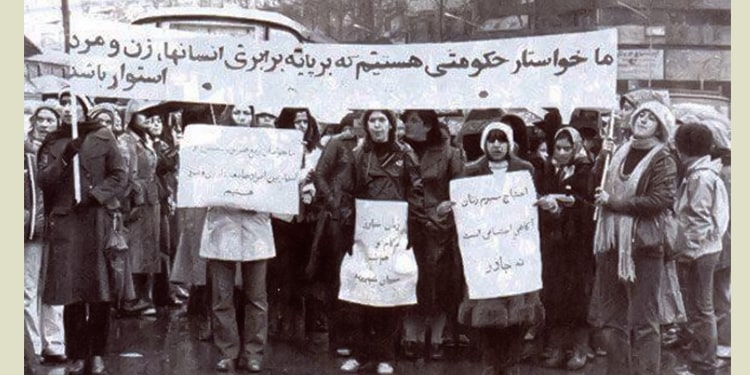
Iranian women took to the streets the next day which coincided with International Women’s Day, March 8, 1979, to protest the oppressive fatwa against women in a massive demonstration.

Women’s largescale participation in resistance for freedom
Tehran, March 8, 1979 – Iranian women protest against mandatory Hijab
Less than a month after the Iranian people’s overthrow of the Shah’s dictatorship
Tehran, March 8, 1979 – Women demand a government based on gender equality

Hassan Rouhani, the regime’s incumbent president, has boasted that he was the one to ban the entry of non-veiled women to the offices and departments of the Armed Forces.

For 2.5 years before June 20, 1981, women and girls joined opposition groups, particularly the PMOI/MEK, and actively participated in resistance for freedom and efforts to stop the tyrannical advances of the new regime.

Dozens of schoolgirls who supported the PMOI/MEK opposition were killed and wounded in attacks by the regime’s agents and club wielders during this period. Nasrin Rostami, 16, in Shiraz, Mehri Saremi in Khorram Abad, Sima Sabbagh in Rasht, Sanam Ghoreishi in Bandar Abbas, Fatemeh Rahimi and Somayeh Noghre-Khaja in Ghaemshahr, and Fatemeh Karimi in Karaj were among many who did not succumb to the club wielders’ threats at the cost of their lives.

Fatemeh Karimi in Karaj were among many who did not succumb to the club wielders’ threats at the cost of their lives
From left, Somayyeh Noghre-Khaja and Fatemeh Rahimi in Gha’emshahr, Fatemeh Karimi in Karaj, and Sanam Ghoreishi in Bandar Abbas were killed in the streets before June 20, 1981.

On April 27, 1981, the Muslim Mothers’ Society which supported the opposition PMOI/MEK staged a demonstration in protest of the beating and killing of their children. 200,000 women participated in this protest rally. Their strong presence caught the mullahs by surprise and had a tremendous impact on developments in that critical period of Iran’s history.

The Iranian people’s resistance for freedom reached a turning point on June 20, 1981
Tehran, April 27, 1981 – Demonstration by Muslim Mothers’ Society

The Iranian people’s resistance for freedom reached a turning point on June 20, 1981, when half a million Tehran residents participated in a historic march for freedom.

On that day, Khomeini’s revolutionary guards opened fire on the peaceful demonstrators. Iran’s pioneering women, too, had to make a choice. They had to choose between the shame of caving into the mullahs’ suppression and the honor of resistance for freedom. Of course, they chose the latter and answered the call of history.

they chose the latter and answered the call of history.
Tehran, June 20, 1981 – Peaceful demonstration by half a million people against the religious dictatorship

June 20 bloody crackdown, women’s magnificent resistance in prisons

After cracking down on the June 20th peaceful demonstration, the clerical regime began its massacre of opponents. Ironically, the first group of victims comprised of girl students, 16-17 years of age, who had not given even their names to the regime.

Indeed, what was the message of these young women? Why was it that the first statement of the prosecutor’s office after June 20, bore the pictures of 12 under-18 girls who had not even identified themselves to the regime officials before being executed?

June 20 bloody crackdown, women’s magnificent resistance in prisons
The first statement issued by the Public Prosecutor’s Office bearing the photos of 12 teenage girls who had been executed without establishing their identities, was published in the state-run daily newspapers.

Never in history, had a dictator launched a genocide by releasing the photos of unidentified young women he executed.

The mullahs’ murder machine started its endless and indiscriminate killings. Young teenage girls, pregnant women, elderly mothers, workers, farmers, doctors, engineers, artists, and athletes were killed en masse. Sometimes, all or five-six children of the same family were executed in the course of mass executions of the 1980s.

Women’s rights were half of men’s everywhere except in prisons where they had a double quota of torture merely for being a woman. The misogynist mullahs could not tolerate the women who opposed them.

The victims included Nafiseh Ashraf Jahani, 10, who was put on summary trial and sent before the firing squads. Maryam Assadi, 11, Afsaneh Farabi, 12, and 13-year-olds Fatemeh Mesbah, Shahla Ghorbani, Fatemeh Sajedi, and Fatemeh Jabbarzadeh Ansari, and Nassrin Nouri Mani, 15, were also among those executed in the 1980s.

Tahereh Aghakhan Moghaddam was executed while eight-months pregnant
Fatemeh Mesbah, 13, and Mother Zakeri, 70, were executed

Tahereh Aghakhan Moghaddam was executed while eight months pregnant. The names of at least 50 pregnant women are among those executed by the Iranian regime. Dozens of elderly women, like Sakineh Mohammadi Ardehali (Mother Zakeri), 70, stood up bravely to the mullahs and defeated their efforts to break them.
Women’s inspiring resistance and their double quota under torture
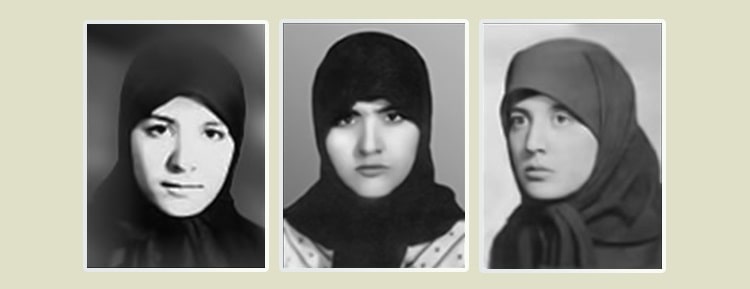
From left: Batool Alamzadeh Horjandi, Zohreh Bijanyar, and Massoumeh Azdanlou were pregnant at the time of execution

Women’s inspiring resistance and their double quota under torture

Hundreds of former prisoners have attested that women’s resistance in prisons and under torture was inspiring to the imprisoned men, as well.

By their resistance, Iranian women dealt effective blows to the medieval outlook promoted by the clerical regime.

So, the mullahs put women under tremendous pressure to break their high spirits. Long-term solitary confinement, Unit One, Cage, and the most brutal of these torture chambers, the residential unit where they sexually assaulted female prisoners, were designed to reach this aim.

Iranian women, however, were deeply aware of their great role and historic mission and were thus able to endure such inhuman tortures, imprisonment, and executions.

They were not just a few isolated examples but a generation of women who regardless of their age, education, profession, ethnicity, and economic class, chose the honor of resistance for freedom to defeat the enemy of their nation.

Various groups of women in resistance for freedom

Despite repressive conditions in Iran, secret executions, and all the dangers threatening those who have such information, the Iranian Resistance has been able to compile the names and information about 20,000 victims of execution.

Around 5,000 of those names belong to the women of PMOI/MEK.

The most general categorizations based on age, profession, and education attest to the reality of a Generation Equality born in Iran to determine the fate of their nation through their resistance for freedom.

Following are the categories:

681 women were killed under torture

50 women were executed while pregnant

789 teenagers were executed between 11 and 18 years of age

230 women had a high academic education

734 women had bachelor’s degrees

4,010 women were high school graduates

381 women were government employees

73 women were artists

The number of victims of political executions by the clerical regime is estimated to be 120,000, one-third of whom are women. The said figures are therefore but a small and incomplete part of the whole picture.

On the anniversary of the June 20th milestone in the history of Iran, we honor the memory of and pay tribute to heroines who fulfilled their responsibility towards their people, country, and history with utmost courage. Future generations will have a lot more to say about their role and values.

Tags: executionGeneration EqualityViolence against womenWomen's Leadership
Share13TweetPinShareSendShare

Related Posts

Pilar Rojo at IWD 2026: The Spanish Senate Stands Unanimously with the Iranian People’s Aspirations for a Free, Democratic, and Secular Country

March 11, 2026
Pilar Rojo at IWD 2026: The Spanish Senate Stands Unanimously with the Iranian People’s Aspirations for a Free, Democratic, and Secular Country

On Saturday, February 21, 2026, on the eve of March 8, International Women’s Day, the NCRI Women’s Committee hosted an international conference in Paris entitled “Women’s Leadership: An...

Read moreDetails

Eve Borg Bonello at IWD 2026: A Regime That Murders Protesters and Executes Dissenters is Not Strong; It is Terrified of Its People

March 11, 2026
Eve Borg Bonello at IWD 2026: A Regime That Murders Protesters and Executes Dissenters is Not Strong; It is Terrified of Its People

On Saturday, February 21, 2026, on the eve of March 8, International Women’s Day, the NCRI Women’s Committee hosted an international conference in Paris entitled “Women’s Leadership: An...

Read moreDetails

Elly van Wijk at IWD 2026: Iranian Women at the Frontlines of the Uprising: The Courage That Broke the Silence

March 11, 2026
Elly van Wijk at IWD 2026: Iranian Women at the Frontlines of the Uprising: The Courage That Broke the Silence

On Saturday, February 21, 2026, on the eve of March 8, International Women’s Day, the NCRI Women’s Committee hosted an international conference in Paris entitled “Women’s Leadership: An...

Read moreDetails

Rosa Romero at IWD 2026: Iranian Women: Not Victims of Discrimination, but Leaders on the Frontlines of Freedom

March 9, 2026
Rosa Romero at IWD 2026: Iranian Women: Not Victims of Discrimination, but Leaders on the Frontlines of Freedom

On Saturday, February 21, 2026, on the eve of March 8, International Women’s Day, the NCRI Women’s Committee hosted an international conference in Paris entitled “Women’s Leadership: An...

Read moreDetails

Elisabetta Zamparutti at IWD 2026: The Courage of Iranian Resistance Women to Sacrifice Their Lives for Freedom

March 9, 2026
Elisabetta Zamparutti at IWD 2026: The Courage of Iranian Resistance Women to Sacrifice Their Lives for Freedom

On Saturday, February 21, 2026, on the eve of March 8, International Women’s Day, the NCRI Women’s Committee hosted an international conference in Paris entitled “Women’s Leadership: An...

Read moreDetails
Next Post
Breaking Barriers: The Trailblazing Life of Dorothea Erxleben, Germany’s First Female Doctor

Breaking Barriers: The Trailblazing Life of Dorothea Erxleben, Germany’s First Female Doctor

Documents

A Report to CSW70: Gender-Based Discrimination Under Iranian Law

A Report to CSW70: Gender-Based Discrimination Under Iranian Law

March 8, 2026

Structural Inequality and State-Sanctioned Oppression of Women Gender-Based Discrimination Under Iranian Law” is the title of the NCRI Women’s Committee’s...

Annual Report 2026: From Protests, to Uprising, and the Role of Iranian Women

Annual Report 2026: From Protests, to Uprising, and the Role of Iranian Women

March 3, 2026

On the eve of International Women’s Day 2026, the NCRI Women’s Committee presents its Annual Report 2026, offering a recap...

Iranian women Who Lost Their Lives in Iran’s January 2026 Uprising

Iranian Women Who Lost Their Lives in Iran’s January 2026 Uprising

January 25, 2026

Names That Must Not Be Forgotten Iranian women played a central and courageous role in the January 2026 uprising, standing...

Monthlies

January 2026 Report: Women at the Core of the Uprising
Monthlies

January 2026 Report: Women at the Core of the Uprising

January 31, 2026
December 2025 Report: A Year in Review: Iranian Women’s Resistance Against Religious Dictatorship
Monthlies

December 2025 Report: A Year in Review: Iranian Women’s Resistance Against Religious Dictatorship

January 5, 2026
November 2025 Report: Under the Clerical Regime, Nowhere Is Safe for Women in Iran
Monthlies

November 2025 Report: Under the Clerical Regime, Nowhere Is Safe for Women in Iran

November 30, 2025
October 2025 Report: Death Sentence for a Female Political Prisoner The Resistance of Female Political Prisoners Inspires Iranian Women and Girls in Their Struggle Against the Regime of Executions and Massacre
Monthlies

October 2025 Report: Death Sentence for a Female Political Prisoner

October 31, 2025

Articles

Qarchak Prison: Around 80 Women detained During January Uprising Held in Harsh Conditions

Qarchak Prison: Around 80 Women detained During January Uprising Held in Harsh Conditions

March 11, 2026

Approximately 80 women detained during the January uprising are currently being held in Qarchak Prison, according to informed sources. The...

Iranians Rally in Paris, Back NCRI’s Provisional Government, Maryam Rajaiv’s Ten-Point Plan

Iranians Rally in Paris, Back NCRI’s Provisional Government, Maryam Rajavi’s Ten-Point Plan

March 10, 2026

Supporters of the Iranian Resistance rallied in Paris, voicing support for the NCRI’s provisional government to transfer sovereignty to the...

Maryam Rajavi Discusses Iran’s Transitional Roadmap in Interview with Frankfurter Rundschau

Maryam Rajavi Discusses Iran’s Transitional Roadmap in Interview with Frankfurter Rundschau

March 8, 2026

Maryam Rajavi, the President-elect of the National Council of Resistance of Iran, said in an interview with the German newspaper...

The Fallen for Freedom

Sonya Salehi-Rad was killed on January 8, 2026, during the nationwide popular protests in Shiraz
The Fallen for Freedom

Sonya Salehi-Rad

February 10, 2026
Arezoo Abedi was killed on January 9, 2026, during the nationwide popular protests
The Fallen for Freedom

Arezoo Abedi

February 10, 2026
Arnika Dabbagh, from Gorgan, was killed on January 9, 2026
The Fallen for Freedom

Arnika Dabbagh

February 7, 2026
Maedeh Moradi Kia, a resident of Tehran, was killed on January 9, 2026
The Fallen for Freedom

Maedeh Moradi Kia

February 7, 2026

ABOUT US

NCRI Women Committee

We work extensively with Iranian women outside the country and maintain a permanent contact with women inside Iran. The Women’s Committee is actively involved with many women’s rights organizations and NGO’s and the Iranian diaspora.
The committee is a major source of much of the information received from inside Iran with regards to women. Attending UN Human Rights Council meetings and other international or regional conferences on women’s issues and engaging in a relentless battle against the Iranian regime’s misogyny are part of the activities of members and associates of the committee.

CATEGORIES

  • Activities
  • Articles
  • Documents
  • Famous Women
  • Heroines in Chain
  • IWD Conferences
  • IWD Speeches
  • IWD Videos
  • Maryam Rajavi
  • Maryam Rajavi Speeches
  • Monthlies
  • Podcast
  • Reference Library
  • Solidarity
  • Statements
  • The Fallen for Freedom
  • Videos
  • Women in History
  • Women in Leadership
  • Women of Iranian Resistance
  • Women's News

BROWSE BY TAG

Child marriage coronavirus education execution forced hijab Gender Gap Generation Equality Honor killings Iran Teachers Maryam Akbari Monfared Nurses Plan on Women's Rights and Freedoms Poverty Prisoners Protests rural women Saba Kord Afshari The girl child Violence against women Women's Leadership Women Heads of Household Zeinab Jalalian

The copyright of all the material published on this website has been registered under © 2016 the Women’s Committee of the National Council of Resistance of Iran. To obtain permission to copy, redistribute or publish the material published on this website, you should write to the NCRI Women’s Committee. Please include the link of the original article on our website, women.ncr-iran.org.

Welcome Back!

Login to your account below

Forgotten Password?

Retrieve your password

Please enter your username or email address to reset your password.

Log In

Add New Playlist

No Result
View All Result
  • Home
  • News
    • Women’s News
    • Articles
    • Statements
  • Publications
    • Monthlies
    • Documents
    • Reference Library
  • About Us
    • The NCRI Women’s Committee
    • Gender Equality
    • Women’s Platform
  • Maryam Rajavi
    • Maryam Rajavi
    • Maryam Rajavi Speeches
    • Ten Point Plan for Iran
    • The Plan on Women’s Rights and Freedoms
  • Vanguards
    • The Fallen for Freedom
    • Heroines in Chain
    • Women of Iranian Resistance
    • Famous Women
    • Women in History
  • Events
    • IWD Conferences
    • Activities
    • IWD Speeches
    • Solidarity
  • Video
    • Videos
    • IWD Videos
  • Podcast
  • Donate
  • Contact us
  • فارسی
  • عربی
  • Français

The copyright of all the material published on this website has been registered under © 2016 the Women’s Committee of the National Council of Resistance of Iran. To obtain permission to copy, redistribute or publish the material published on this website, you should write to the NCRI Women’s Committee. Please include the link of the original article on our website, women.ncr-iran.org.