
Abstract: A compilation of official data, media reports, and disclosures published in April, May, and June 2026 demonstrates that Iran is grappling with a multi-layered demographic crisis. This crisis is characterized by a plummeting birth rate, declining marriage rates, a rise in lifelong celibacy, rapid population aging, mounting pressure on the healthcare system, and a profound gap between families’ desire to have children and their actual financial and social ability to do so.
Despite this, the ideological population policies in Iran, dictated by the ruling religious dictatorship, rather than addressing the economic, social, and legal root causes of the crisis, have focused primarily on controlling women’s bodies, promoting the role of motherhood, restricting reproductive choices, and securitizing the population issue.
Relying on reports from the regime’s own state media, this review demonstrates that the demographic population policies in Iran have not only failed to resolve the crisis but have actively exacerbated it by completely ignoring women’s rights and the grim economic realities of society.
1. Introduction: The Population Crisis as a Crisis of Governance
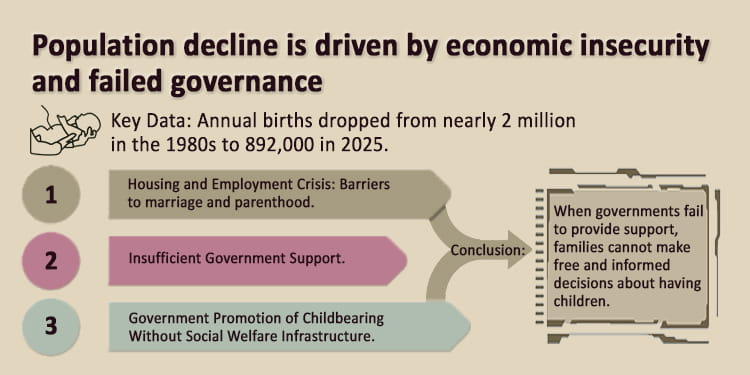
The population crisis in Iran is no longer merely a forward-looking warning; it is now starkly visible in official data regarding births, marriages, aging, and household structures. A report by the state-run Etemad newspaper on June 3, 2026, titled “The Historic Plummet of Births in Iran,” reveals that annual births have dropped from 2 million in the 1980s to just 892,000 in 2025. Consequently, the net population increase has fallen below 500,000 for the first time. The same report documented a drop in the marriage rate of single women from 4.35% in 2022 to 3.16% in 2025, citing the housing crisis, lack of future prospects, economic hardship, and an increasing age of marriage as the driving causes.
These data demonstrate that the current crisis cannot be reduced to factors like “cultural refusal” or “women’s reluctance.” The decline in marriage and childbearing in Iran is, above all, a clear symptom of a governance crisis: the regime’s inability to provide a stable economic outlook, social security, job opportunities, housing, childcare services, and to guarantee equal rights for women and families.
Under such circumstances, institutional population policies in Iran that define women solely by their role as mothers and as mere tools for population reproduction were doomed to fail from the outset.
This failure is especially glaring in Iranian society, where women have consistently proven to be brilliant examples of courage and resilience—both in leading protests against oppression and misogyny, and in achieving high levels of education and diverse professional skills. Today, even the regime’s own state media are forced to concede this definitive failure.
2. Plummeting Birth Rates and the Failure of Incentive Policies
In a report by the state-run Mehr News Agency on May 19, 2026, titled “Warning Regarding the Decline in Births,” Alireza Raeisi, the Deputy Minister of Health, stated that Iran’s population in 2025 stood at 86,564,000. He noted that the fertility rate has plummeted from 6.5 in the 1980s to just 1.35 in 2025—a figure significantly below the replacement level of 2.1 to 2.5. Furthermore, he reported the 2025 statistics as 892,268 births against 451,682 deaths, alongside a decline in marriages from 470,372 cases in 2024 to 431,664 in 2025.
Marziyeh Vahid Dastjerdi, the Secretary of the National Population Staff, also specified in a report by Mehr on May 20, 2026, that marriages have dropped from 891,627 cases in 2010 to 431,021 cases in 2025, while live births in 2025 stood at 892,278. She characterized Iran’s fertility rate as being within the range of “very low fertility” and emphasized that state policies should not focus solely on families having a third child or more.
Despite these official admissions, the regime’s population policies in Iran remain largely built upon limited incentives, propaganda campaigns, inadequate financial aid, and the restriction of women’s reproductive rights.
Amir-Hossein Bankipour, a parliament member from Isfahan and a member of the Parliamentary Cultural Committee, claimed in an interview with the state-run IRNA news agency on May 20, 2026, that more than 50% of the provisions in the “Youthful Population Law” have been implemented. He further alleged that the pattern of having a third child or more has increased by 65%, and that abortions have decreased by 52%.
The confluence of these claims with the plummeting birth rate, the decline in marriages, and long queues for loans demonstrates that even if some of the indicators claimed by officials have improved, the objective of these policies is not to respect citizenship rights, individual autonomy, economic justice, and social support. Instead, they seek to exploit the population crisis as an opportunity to further marginalize women.
3. Economic Uncertainty: The Biggest Obstacle to Youth Marriage
One of the most pivotal pieces of evidence showing the failure of the regime’s population policy is the state of marriage among young people. A report by the state-run IRNA news agency on May 26, 2026, titled “Lifelong Celibacy for Over 18 Million Iranians,” reveals the existence of 18,775,452 never-married individuals and 24,635,974 individuals who are at the age of marriage. Furthermore, the marriage rate among single women shows a 1.20% decline compared to the previous year.
In this report, Alireza Rahimi, the Deputy for Youth Affairs at the mullahs’ Ministry of Sports and Youth, acknowledged that “promoting marriage is impossible through slogans and coercion,” identifying economic uncertainty as the greatest obstacle.
Under such circumstances, the regime’s official calls for young people to marry and bear children—without achieving any real reduction in living costs, housing, employment, care services, and future security—resemble a shifting of the crisis’s responsibility from the state to individuals.
The cultural pressure exerted on women to marry and embrace motherhood, while the structural foundations for an independent and secure life are completely absent, serves less as an effort to resolve the population crisis and more as a pretext to suppress and marginalize women.
4. The Gap Between the Desire for Children and the Ability to Bear Them
A report by the state-run IRNA news agency on May 20, 2026, regarding the “Deep Gap Between Desire and Reality in Childbearing,” provides some of the most critical evidence against the regime’s official narrative. Reza Saeedi, the head of the Center for Youthful Population, Family Health, and Schools at the Ministry of Health, stated that Iranians, on average, desire to have 2.6 children, yet the actual fertility rate is reported to be around 1.5 or lower.
Overall statistics also indicate a decline in births in 2025 compared to 2024, showing a severe gap between the current fertility rate and the replacement level. These data demonstrate that the core issue is not a “lack of desire for children,” but rather the absolute inability of families to provide for basic living requirements.
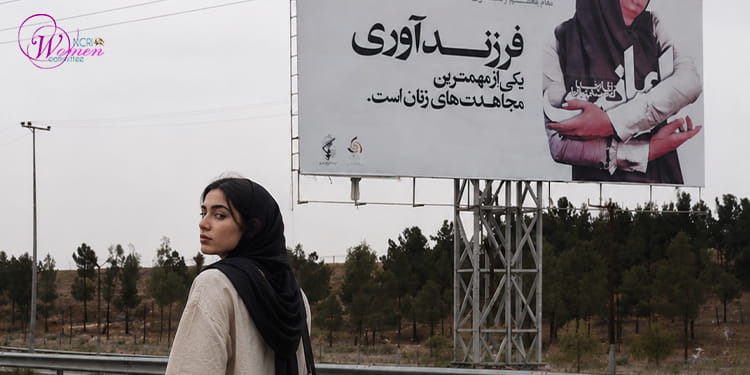
This gap holds a specific meaning for women: while facing intense official pressure to embrace motherhood, they simultaneously confront systemic workplace discrimination, economic insecurity, a total lack of support for working mothers, a shortage of accessible childcare, and the severe restriction of their reproductive rights.
5. Rapid Aging and Inadequate Institutional Readiness
A report by the state-run Asr Iran website on May 19, 2026, quoting Seyed Javad Hosseini, the head of the mullahs’ Welfare Organization, warns of the high velocity of population aging in Iran, with the elderly projected to constitute nearly 30% of the population by 2050 or 2051.
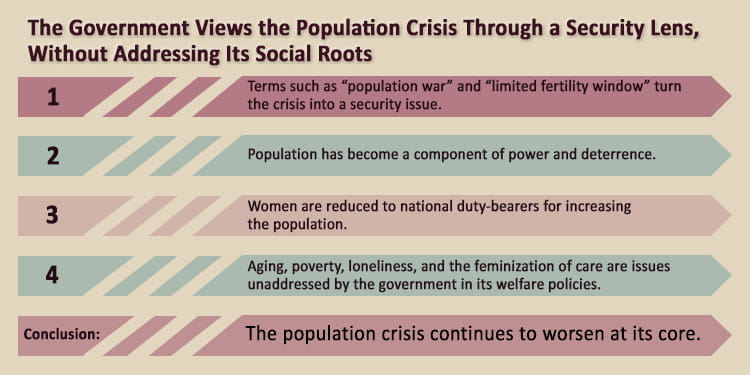
Aging is not merely a medical concern; it is deeply intertwined with poverty, isolation, disability, and the “feminization of aging”—particularly with the continuous rise in elderly, female-headed households. Women who are worn down in their youth by restrictions on their right to education and free choice of a spouse, alongside being deprived of suitable employment opportunities, job security, and safe working environments, find themselves trapped in a double cycle of poverty and loneliness in their old age, just as they lose their basic physical strength.
6. The Securitization of Population and the Instrumentalization of Women
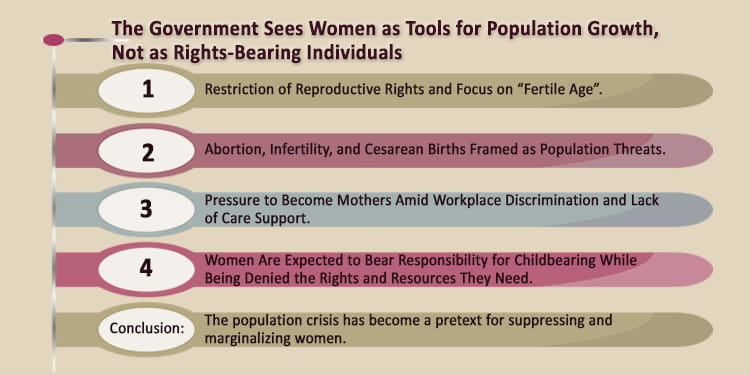
One of the most dangerous dimensions of the regime’s demographic framework is its outright securitization. Fatemeh Mohammadbeigi, a member of the Parliamentary Health Committee, advanced the concept of a “demographic war,” claiming that only 4 to 5 years remain to capitalize on the fertility window of the current generation. She explicitly characterized the population as an element of “power, security, and deterrence.” Other reports by Mehr similarly forecast demographic decline using threat-centered rhetoric, warning that Iran’s population will dwindle to 30 to 32 million by the year 2100. (Mehr News Agency, May 20, 2026)
This security-driven language transforms the population crisis from a social and rights-based issue into a securitized project. The consequence of such an approach is that women are viewed not as citizens with the right to choose, but merely as instruments for population production. It is through this very rhetoric that the ruling misogynistic dictatorship whitewashes the restriction of abortion, its intense focus on “women’s useful childbearing age,” the glorification of motherhood, and the cultural pressure to marry and bear children.
Consequently, women’s bodies have been placed at the very center of the regime’s population interventions. Officials such as Reza Saeedi and Alireza Raeisi frequently cite statistics regarding millions of infertile couples, insurance coverage for infertility treatments, high rates of cesarean sections, registered abortion cases, and millions of women of childbearing age. While these data point to genuine challenges within the women’s healthcare system, the issue becomes deeply alarming when official policy, rather than strengthening health rights, informed access to reproductive services, and maternal support, treats women’s bodies as objects of demographic control and threats.
When abortion is framed not in relation to health, freedom of choice, poverty, domestic violence, or social insecurity, but strictly as a demographic threat, population policies in Iran cease to be a system of support and transform into an instrument of repression.
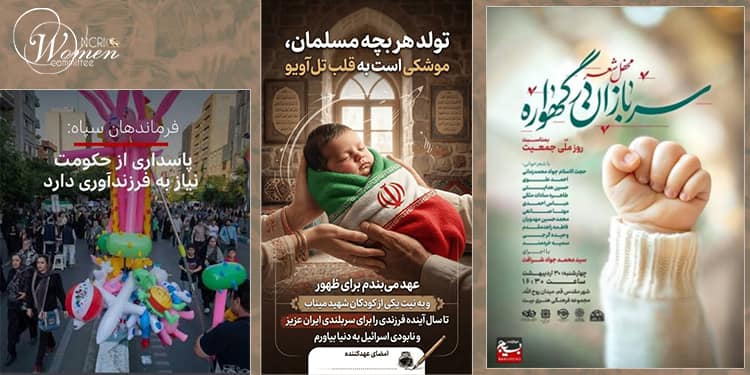
7. Cultural Propaganda in Lieu of Welfare Policies
Alongside its coercive control mechanisms, the regime has relegated a significant portion of its response to cultural propaganda and symbolic initiatives: marriage counseling, cultural campaigns, childbearing festivals, the “Mother’s Hope Card,” mother-and-child rooms, and urban programming. Maryam Ardebili, the mayor’s advisor and head of the Women and Family Center at Tehran Municipality, implicitly validates our exposure of the regime’s media maneuvering by acknowledging a stark reality: “The childbearing rate will not increase without hope, and we must move away from a threat-centered approach.”
8. Conclusion
The population crisis in Iran is not merely the byproduct of a shifting lifestyle; rather, it is the simultaneous result of economic insecurity, a severe housing crisis, skyrocketing living costs, plummeting public trust, performative state support, systemic gender discrimination, a lack of care services, and the draconian restriction of women’s rights. While official authorities have repeatedly acknowledged some of these factors, official policy remains obsessively focused on control, propaganda, and securitization instead of structural reform.
The effective resolution of this crisis—much like all of Iran’s deep-rooted social issues—demands the complete overthrow of the Velayat-e Faqih (Guardianship of the Islamic Jurist) regime and the establishment of a democratic and popular government. Only then will Iranian society transition from the control of women to the support of women’s rights; from deceptive cultural propaganda to genuine welfare policies; from the securitization of the population to the restoration of social trust; and from forced motherhood to creating conditions where women and families can freely, safely, and consciously decide on marriage and childbearing.