The Iran water crisis has transcended a mere climatic challenge, evolving into a structural catastrophe marked by severe ecosystem destruction and land subsidence. As examined in previous parts of this series, this crisis is the product of decades of disastrous mismanagement, with more than 70 to 80 percent of it rooted in the corruption of the clerical regime and the plunder of the water mafia—decisions that have left the land thirstier and the future of Iranian society darker.
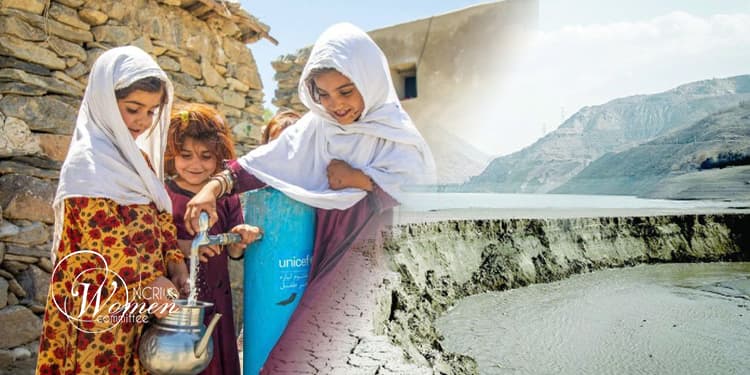
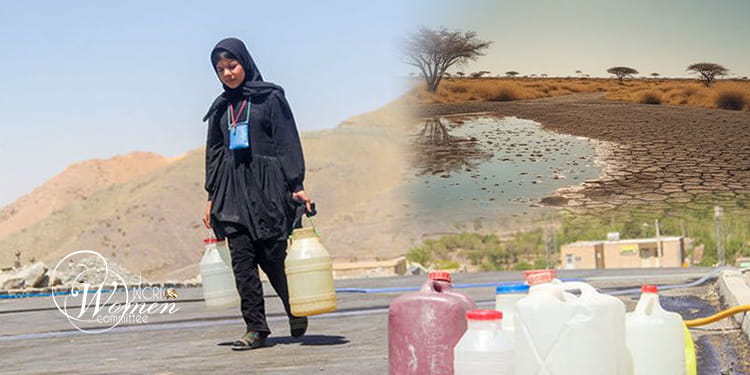
However, the consequences of this disaster are not borne equally across all sectors of society. Due to their pivotal role in securing hygiene, managing households, and caring for families, women are the first and primary victims of the country’s escalating drought and water scarcity.
At a time when millions face severe water shortages, Iranian women are forced to bear the heavy burden of livelihood, health, and social insecurities caused by the misogynistic and predatory policies of the mullahs’ regime.
In the first part of these articles on Iran water crisis, we examined the dimensions of the deep imbalance in water resources, the catastrophic depletion of dam reserves, and the initial challenges women face in confronting this crisis. In the second part, we addressed its disastrous consequences on the collapse of agriculture, the worsening of discrimination and class inequalities, and ultimately, the leading and key role of women on the front lines of anti-government protests.
Now, in this third and final part—compiled as an analytical appendix to the document The Gendered Dimensions of the Water Crisis in Iran—we conduct a closer anatomy of the geographical and structural dimensions of this disaster. Backed by data and documentation, this article will examine the disappearance of lakes, the death of rivers, the destruction of wetlands, and the depletion of the country’s dams. We will also unmask the predatory entities and discriminatory inter-basin water transfer projects that have depleted underground aquifers and turned land subsidence into an immediate threat to the nation’s entire infrastructure.
1.Dimensions of Water Crisis in Iran
When the Lakes Disappear
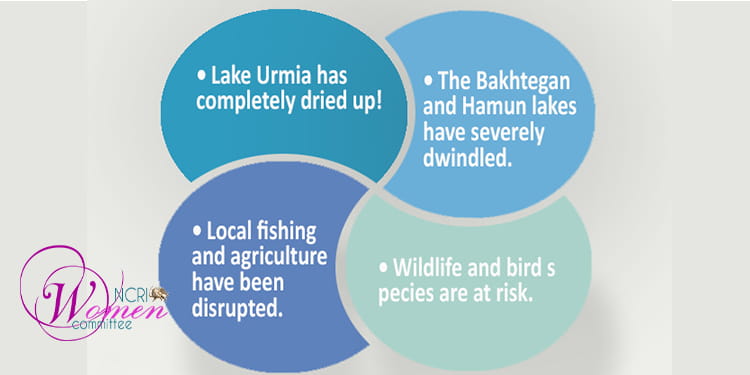
On September 7, 2025, Donya-e-Eqtesad reported: “Lake Urmia has completely dried up.” According to the latest NASA satellite image of Lake Urmia, the once-blue gem of northwestern Iran has entirely vanished, no trace of a lake can be seen in the aerial image. Earlier in the summer, environmental authorities had already warned that Lake Urmia would be 100 percent dry by the end of the season.
Located in northwestern Iran, Lake Urmia was once the largest lake in the Middle East, spanning at least 5,200 square kilometers.
In addition to Lake Urmia, Lake Bakhtegan, Iran’s second-largest lake located in Fars Province, is also struggling with severe water loss and drying. Renowned for its rich biodiversity and birdlife, the lake’s decline is largely attributed to the construction of Doroodzan, Sivand, and Molla-Sadra dams along the upper reaches of the Kor and Sivand rivers.
Lake Hamun, in Sistan and Baluchestan Province, is likewise facing drying and a sharp drop in water levels. The lake holds major economic significance for the local population, as fishing and farming traditionally take place around it, and some of the indigenous people use the lake’s resources to sustain their daily lives. (Ghatreh News – “The Main Causes of Iran’s Lake Drying Crisis”)
Even the Caspian Sea is drying up under the shadow of government corruption. Over the past 20 years, its water level has dropped by two meters. (Khabar Online – February 8, 2025)
The Rivers Are Dying
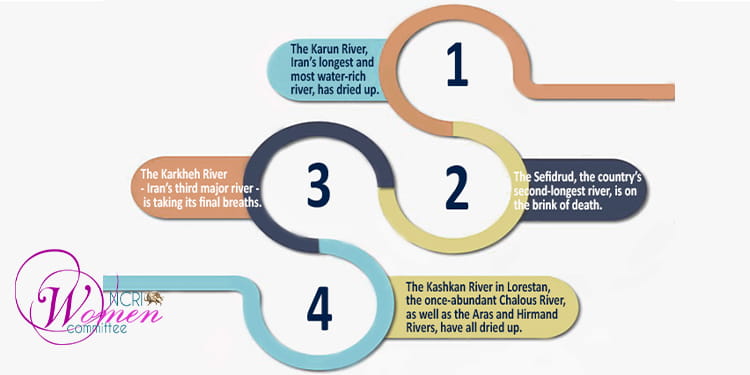
The situation of Iran’s rivers is equally alarming. Aftab News reported on July 4, 2022: “Iran’s most turbulent rivers have dried up; the country’s water resources are in a critical state.”
The Karun River, Iran’s longest and most water-rich river, has dried up. The Sefidrud River, the second-longest river in Iran and the primary water source for over 170,000 hectares of rice paddies in Gilan Province, is now on the verge of collapse.
Images of dead fish on the cracked, parched riverbed have emerged from the Karkheh River, Iran’s third-largest river. The Dez River, which flows from the Zagros Mountains, is taking its last breaths and has completely dried up for the first time in recorded history. Other rivers—including the Kashkan in Lorestan, the Chalous River, one of Iran’s water-rich rivers, the Aras, and the Hirmand River once known as the “Wild River”have all dried up.
Hedayat Fahmi, former director-general of water resources at the Ministry of Energy, states that in Iran, catastrophic management attributes water scarcity to climate change to avoid taking responsibility for its own failures.
Mournful Wetlands
Another devastating aspect of Iran’s water crisis is the destruction of wetlands and aquatic ecosystems, which play a vital role in environmental balance. Shargh Network (March 15, 2025) reported the drying of wetlands such as Hoor-al-Azim in Khuzestan and Gavkhuni in Isfahan. Once havens for diverse plant and animal species, these wetlands have been transformed into barren lands due to uncontrolled dam construction and water diversion by the regime.
The series of dams on the Zayandeh-Rud River, built to supply water for industrial and agricultural projects affiliated with the regime, have dried up Gavkhuni Wetland, and the resulting dust storms pose serious health risks to residents. (Iranpedia, May 2, 2025)
Empty Dams
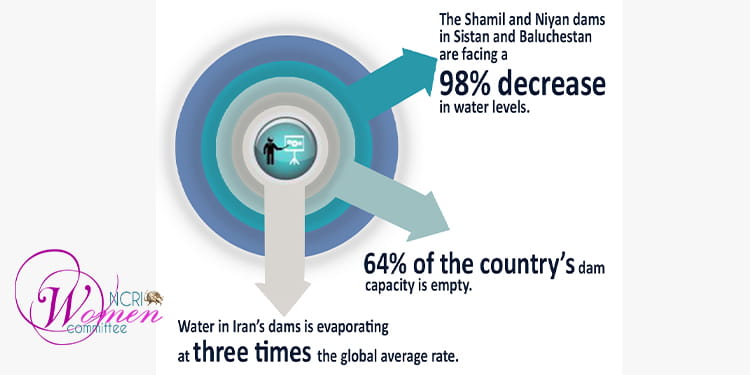
The condition of Iran’s dams represents another tragic chapter in the country’s water crisis. Water stored behind Iran’s dams is evaporating at a rate three times higher than the global average. (Ebtekar, July 21, 2025)
State news agency Mehr reported under the headline, “64% of the country’s dams are empty”: an inventory of the country’s dams shows that dams in Tehran, Khorasan Razavi, Qom, West Azerbaijan, Sistan and Baluchestan, Hormozgan, Golestan, South Khorasan, Zanjan, Kerman, Fars, and Markazi provinces are in critical condition. (Mehr News Agency, September 21, 2025)
The total water volume in the country’s dams has decreased by 25% compared to last year. Amir-Kabir Dam, as of September 20, 2025, held 30 million cubic meters of water, reflecting 17% of its capacity, a 73% decrease compared to the same time last year. Lar Dam, with 24 million cubic meters of water, is only 3% full, 43% less than the previous year. (ILNA – September 21, 2025)
Energy expert Mohammad Ebrahim Raisi warned that Tehran’s water crisis could escalate if Mamlou Dam goes offline; if this occurs, Latyan, Lar, and Karaj dams would also be affected. (Setareh-e Sobh newspaper – June 25, 2025)
Among provinces, Hormozgan has suffered the most, with Shamil and Niyan dams experiencing a 98% decrease compared to last year, marking the most critical situation. These dams previously played a key role in supplying water to southern Iran. Esteghlal Dam in the province has also seen a 76% reduction in water levels. (Ham-Mihan – July 21, 2025)
Land Subsidence and Its Impact on Infrastructure
A study published in 2024 revealed that excessive extraction of groundwater resources has caused widespread land subsidence; in some areas, the rate exceeds 10 centimeters per year, affecting 3.5% of Iran’s land. The subsidence rate in certain regions is among the highest in the world, increasing the vulnerability of critical infrastructure, including airports and roadways. (The Guardian, September 25, 2024)
State-affiliated media Arman-e-Melli also reported on July 20, 2025that 30 provinces are experiencing subsidence due to extraction of groundwater resources. Energy expert Ali Moradi stated that over 60% of the country’s water supply comes from underground sources, with extraction rates three times faster than their natural replenishment.
2. Structural Mismanagement and the Water Mafia
It must be said that the term “mismanagement” is insufficient to describe the performance of the clerical regime. Even state media use the term “Water Mafia.” Everyone in Iran knows that this phrase refers to a network of regime-linked individuals and institutions — ministers, contractors, and security organizations — that push forward large, water-intensive projects for political and economic gain, without regard for technical or environmental considerations.
The state-run Jahan-e San’at newspaper wrote:
“The current crisis is neither sudden nor a product of climate change, but the accumulated result of years of mismanagement.” (Jahan-e San’at newspaper – July 26, 2025)
According to Hossein Raghfar, an economist, “One of the key factors behind the water crisis has been the adoption of flawed or unprincipled policies imposed on the country. The second factor is greed; the exploitation of national resources under economic pretexts. Since the years following the Iran–Iraq War, and even during the first decade after the 1979 Revolution, projects were launched with no regard for environmental principles. For example, the Mobarakeh Steel Complex was established in the dry region of Isfahan (central Iran), and hundreds of other water-intensive factories have caused major disasters for the country. The construction of steel and petrochemical plants in Iran’s eastern and western dry regions, if not outright betrayal, was completely unprincipled. Unfortunately, these programs still continue. Numerous dams have been built in desert areas incapable of retaining water.” (Arman-e Melli newspaper, July 23, 2025)
Mehdi Esmaeili Bidehendi, a professor at the University of Tehran’s Faculty of Environment, stated: “Our dams have unintentionally contributed to higher evaporation. In the past, water flowed freely through riverbeds and replenished our groundwater. By storing it behind dams, we created reservoirs where constant evaporation occurs, and the rate of evaporation from these reservoirs is far greater than if the water had continued its natural course through rivers.” (Ebtekar newspaper, July 21, 2025)
Energy expert Mohammad Ebrahim Raisi explained: “Groundwater functions as a stored resource. But now, over 60 percent of Tehran’s water comes from groundwater and wells drilled within the city. The excessive withdrawal from the country’s aquifers has increased from 130 billion to around 160 billion cubic meters.” (Setareh-e Sobh newspaper – June 25, 2025)
Historical Summary
In the 1980s and 1990s, under the pretext of economic self-sufficiency and post–Iran–Iraq War reconstruction, the Iranian regime launched massive dam-building projects without adequate environmental studies.
For example, the Gotvand Dam in Khuzestan Province (southwestern Iran), inaugurated in 2011, was built atop salt domes, which salinized the Karun River and caused one of Iran’s worst environmental disasters. This project, which consumed vast amounts of public funds, not only failed to help local agriculture but also destroyed downstream wetlands and disrupted the lives of millions of people.
From the 2000s onward, regime institutions — particularly the Revolutionary Guard Corps (IRGC) — took control of construction and agricultural projects, leading to excessive extraction of groundwater. Multiple independent reports indicate that IRGC-controlled companies drilled illegal wells and diverted water to industrial zones under their control, turning once-fertile plains into barren lands.
This systematic plunder, combined with the lack of oversight over water consumption in agriculture (which uses more than 90 percent of the country’s water resources), laid the foundation for today’s crisis.
In the 2010s, as climate change intensified and rainfall decreased, environmental experts increasingly warned of the imminent collapse of Iran’s water resources. Yet the regime, instead of reforming its policies, chose to suppress dissent and deny reality.
Public protests in Khuzestan Province in 2021, sparked by water shortages and the drying of the Hour al-Azim Wetland, were violently crushed, and no fundamental solution was offered. This trend continued through 2025.
This historical background shows that Iran’s water crisis is not merely the result of incompetence; it is part of the regime’s deliberate strategy to preserve its power at the cost of destroying the nation’s natural resources. (IranPedia, May 2, 2025)
3.Aging Water Infrastructure and Waste
The state-run EcoResaneh website wrote on July 15, 2025: “Iran’s water distribution network is outdated, and there has not been sufficient investment to modernize it… Discussions about the existence of a ‘Water Mafia,’ particularly in critical regions such as Isfahan, have not been clarified or addressed.”
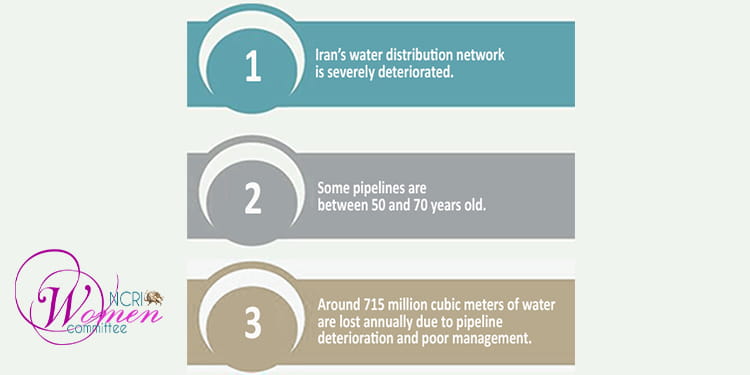
Mohammad Ebrahim Raeisi stated: “Around 715 million cubic meters of water are lost annually due to the deterioration of the pipeline network and weaknesses in infrastructure management and investment.” (Setareh-e Sobh newspaper – June 25, 2025)
Urban affairs expert Hossein Imani Jajarmi noted: “Tehran’s population continues to grow due to migration from other cities, even though its water resources are limited and unstable.” (Arman-e Emrooz newspaper, July 22, 2025)
He added that water pressure drops cause serious issues even for homes on the first and second floors. However, if the pressure is increased, leakage rises to about 80 million cubic meters annually. Some pipes are between 50 and 70 years old. (Etemad newspaper – July 22, 2025)
Mehdi Pirhadi, head of the Tehran City Council’s Commission for Health, Environment, and Urban Services, stated, “More than 165 million cubic meters of leakage have occurred from the Lar Dam alone.” (Ham-Mihan newspaper – July 21, 2025)
Reza Haji-Karim, head of the Water Federation, admitted, “Even under these critical conditions, construction permits are still being issued in the western and eastern parts of Tehran.” (Jahan-e San’at newspaper, August 6, 2025)
4. Regional Discrimination in Water Distribution
One of the most destructive aspects of the regime’s policies is the series of inter-basin water transfer projects implemented to supply water to central and industrial areas favored by the regime. These projects, such as transferring water from the Karun River to Iran’s central plateau or from the Caspian Sea to Semnan (north-central Iran), are neither scientifically nor environmentally justifiable and have created blatant regional inequality.
The article “Mismanagement, Aggravating the Water Crisis in Iran” published by Radio Zamaneh on August 8, 2023, reported that such projects, mostly carried out by IRGC-linked companies, have plundered the water resources of border provinces like Khuzestan and Gilan (northern Iran) in favor of regime-aligned regions. These policies have accelerated the drying of rivers and wetlands in source regions, fueling public anger.
This regional discrimination reflects the regime’s prioritization of political interests over the real needs of the population.
Inter-basin transfers, excessive dam construction, and diverting water to central regions have concentrated resources in the hands of specific institutions and urban-industrial centers, while deprived provinces such as Khuzestan and Sistan and Baluchestan (southeastern Iran) remain neglected.
(Atlantic Council website, January 22, 2024; Wikipedia, May 27, 2025)
Meanwhile, the economic pressure resulting from higher water service costs and the imposition of household purification expenses adds an extra burden on low-income families, deepening class divides. (Arman-e Emrooz , July 19, 2025)