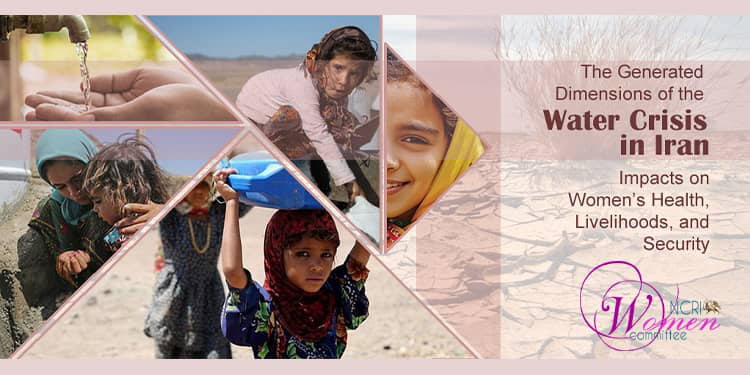
From securing family water to coping with poverty and migration, women are the primary victims of Iran’s escalating water crisis.
The water crisis in Iran is no longer just an environmental issue; it is a humanitarian, ecological, and economic disaster. While triggered by falling rainfall and drought, its destructive roots lie much deeper in the structural corruption and mismanagement of the ruling establishment. Until these systemic roots are unearthed, the future of the Iranian people will only grow more critical.
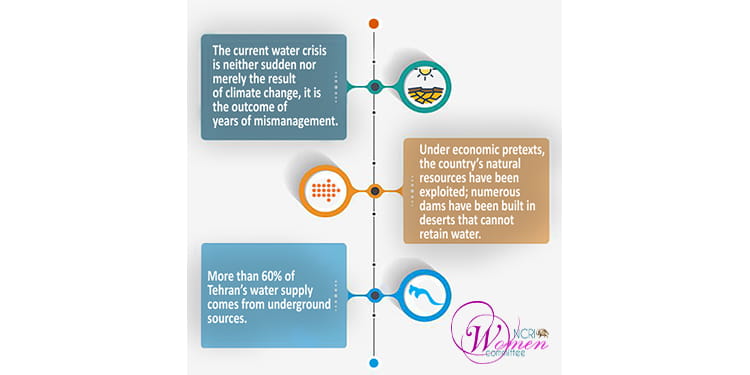
A significant number of researchers and international observers emphasize that 70 to 80 percent of the current water crisis in Iran stems from mismanagement, unsustainable policies, lack of transparency, and corruption. As international reports note: “Iran’s water crisis is not a crisis of resources; it is a crisis of decisions—decisions that have made the land thirstier and the future darker. This crisis, alongside the erosion of public trust in governance, is a symptom of structural and managerial failure.” (Newsweek, August 1, 2025; The Times, December 8, 2022; Reuters, April 27, 2021)
The water crisis in Iran is no longer just an environmental warning or a seasonal challenge. It has reached a stage that threatens the social and economic lives of millions. It is now one of the most serious threats facing Iranian society.
For years, the clerical regime has tried to blame water scarcity solely on low rainfall and climate change. However, experts point to decades of mismanagement, unchecked dam construction, the plundering of groundwater, the uncontrolled growth of water-heavy industries, and a total lack of sustainable planning.
Therefore, the crisis is the direct product of decisions and policies that have pushed the country’s water resources to the brink of collapse.
Even state-affiliated media and experts no longer speak of a “temporary crisis.” The state-run Jahan-e Sanat newspaper pointed to the state of the country’s water resources and emphasized: “Water scarcity in Iran, especially in Tehran, is not a temporary phenomenon or the result of a single dry year. It is a sign of a deep, structural imbalance in the nation’s water supply and consumption system.” The paper warned that the current state of Tehran’s dams is not a passing issue, but a sign of the system’s inability to withstand climate and managerial shocks. (Jahan-e Sanat, February 17, 2026)
The scale of this disaster is clear even in official statistics. Isa Bozorgzadeh, the spokesperson for the water industry, announced in May 2026 that about 35 million people face water scarcity, and 11 provinces still experience below-normal rainfall. He emphasized that the country “has absolutely not entered a wet cycle,” as the recorded rainfall was only about two percent above the long-term average. (Mehr News Agency, May 11, 2026)
Months earlier, the same official reported a 37 percent drop in water entering dam reservoirs, a 27 percent decline in active water reserves, and stated that dams were filled to only 32 percent of their capacity. These numbers show the continuous decay of the country’s water resources. (Mehr News Agency, December 13, 2025)
The water crisis in Iran has now struck the heart of the most populated cities. According to Behnam Bakhshi, spokesperson for Tehran’s Water and Wastewater Company, the water reserves of Tehran’s five main dams faced a deficit of 90 million cubic meters in early May 2026 compared to the previous year. (Fararu, May 3, 2026)
Furthermore, the spokesperson for the regime’s water industry admitted that recent rains failed to compensate for Tehran’s water deficits. He revealed that during certain periods, a portion of the required water had to be pulled from the “dead volume of dams,” a fact that exposes the true depth of the crisis. (Mehr News Agency, April 9, 2026)
However, the impacts of this crisis do not fall equally on all segments of society. Due to their traditional roles and daily responsibilities—such as securing water, maintaining family hygiene, caring for children and the elderly, preparing food, and managing the household—women carry the heaviest burden of water scarcity. The state-run Shargh newspaper highlighted this reality, noting: “Women are always the closest to water-related developments, and they are the first to suffer from drought. We must not ignore this deep connection.” (Shargh, May 15, 2025)
Therefore, the water crisis in Iran is not just an ecological issue; it is directly tied to women’s health, livelihoods, security, education, and human dignity. While millions face water shortages, Iranian women are the first to suffer the consequences in their daily lives. They are forced to bear the brunt of the sheer incompetence and mismanagement of the misogynistic clerical regime.
2. A Portrait of the Crisis
The destructive policies of the clerical regime, including unchecked dam construction, plundering of water resources by institutions such as the Revolutionary Guard Corps (IRGC), discriminatory water transfers between regions, and the deliberate disregard of scientific warnings, have pushed the country to the edge of collapse.
Predictions such as “Iran will turn into a complete desert within the next 30 years” paint a bleak future marked by drastically depleted reservoirs, the destruction of wetlands, contamination of water sources, and the collapse of ecosystems.
Reports from state-run websites, including Shargh Network (March 15, 2025), reveal that the severe drought of 2025 has disrupted the lives of millions. The report, titled “Summer 2025: Iran and the Escalating Drought and Water Crisis,” emphasizes that many parts of Iran, especially the central and southern regions, are facing prolonged water shortages, while farmers are unable to cultivate their crops due to dried-up wells and rivers. This situation has not only destroyed rural livelihoods, but has also triggered large-scale migration to cities, placing additional pressure on urban infrastructure.
According to Eisa Bozorgzadeh, spokesperson for the water industry, the entire Tehran and Alborz regions, with a combined population of 20 million, face the highest level of water stress. (ISNA News Agency, July 21, 2025)
Energy expert Ali Moradi notes: “This issue is not limited to Tehran; most provinces—including Khorasan, Markazi, Hormozgan, and Sistanand Baluchestan—are also affected, placing the entire country in a state of crisis.” (Arman-e Melli, July 20, 2025)
The Didban Iran website reported on July 23, 2025, that 50 percent of Iran’s urban population across 24 provinces is experiencing water stress. Meanwhile, Borna News Agency (November 18, 2024) announced that, according to data from the Iran Meteorological Organization, nearly the entire country is affected by drought.
According to NASA, Iran entered a 30-year drought cycle eight years ago. The severity of the drought is so extreme that Iranian agriculture is on the verge of total collapse, and the country is expected to become a full-scale importer of agricultural products. (Etemad – September 17, 2025)
3. The Double Burden on Women
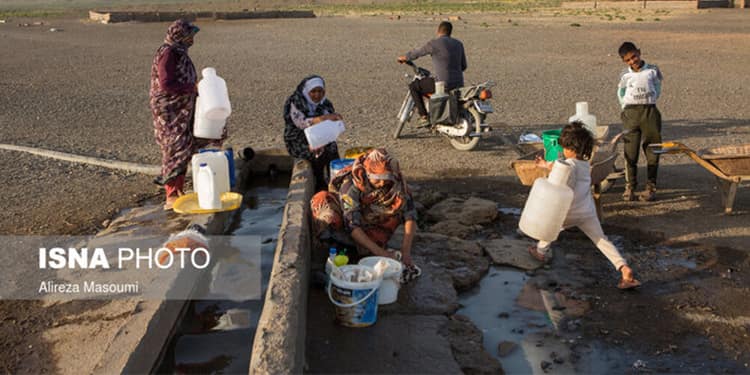
The catastrophe of water scarcity has profound social and economic consequences that affect millions of lives in Iran. Long and unplanned water cuts have paralyzed urban and rural life; agriculture has collapsed, livestock suffer from thirst, and families lack even drinking water.
Signs of water scarcity appear in family relations, household economies, physical and mental health, and the growing wave of internal migration.
Because of women’s traditional responsibilities, such as caring for children or the elderly, preparing food, maintaining hygiene, and managing gardens and livestock, they bear the greatest stress.
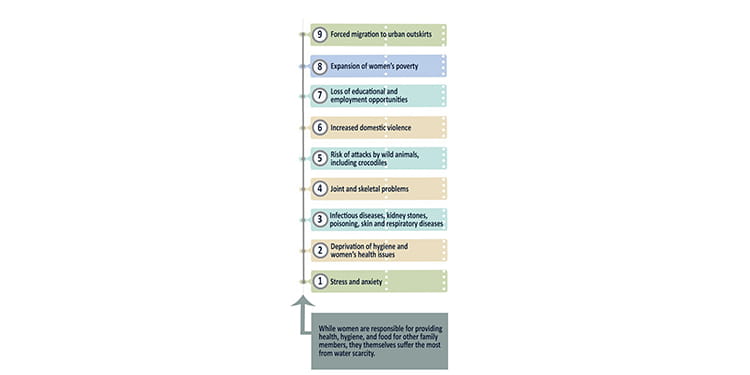
It is women who, from morning to night, must manage the crisis of water shortage. The psychological strain caused by repeated water cuts, long queues at water tanks, deteriorating hygiene for children and women, and rising water costs deprive them of learning opportunities, health, and leisure. These conditions lead to depression, chronic anxiety, rising family tensions, and domestic violence.
3.1 Health Issues and Diseases Caused by Water Shortage
Lack of access to basic human rights such as clean water directly affects hygiene and health, especially for women, whose health needs are often treated as taboo subjects in Iranian society. In times of water scarcity, women cannot easily express or resolve their hygiene-related problems, and given the heavy workload many carry, their own health often becomes their last priority.
Marzieh, 32, from Chabahar, explains:
“Despite the coastal location of Konarak and Chabahar, there is no reliable supply of fresh water for these towns. We’re forced to use salty and hard water for household chores like washing clothes and dishes, and even for bathing and toilets. Many women here suffer from infections, kidney stones, and digestive disorders.” (Radio Zamaneh, December 3, 2024)
Salomeh from Gomishan, a northern Iranian town once known for fishing and caviar trade, adds:
“We’ve never had purified water here. The water in Gomishan has always been salty. Managing drinking water has always been the responsibility of women. I remember women tying their children to their backs with a chador and walking to fill water from the tankers. Women’s and bladder diseases are common here, but there are almost no medical facilities because the town has been deliberately kept underdeveloped.” (Radio Zamaneh, December 3, 2024)
Moreover, to access water, women often have to walk through remote and dangerous paths, exposing them to attacks by wild animals, the risk of sexual assault, and skeletal problems caused by physical strain. (Local newspaper Payam-e Ma, May 17, 2023)
3.2 Long Queues and “Water Portering”
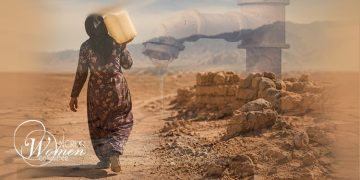
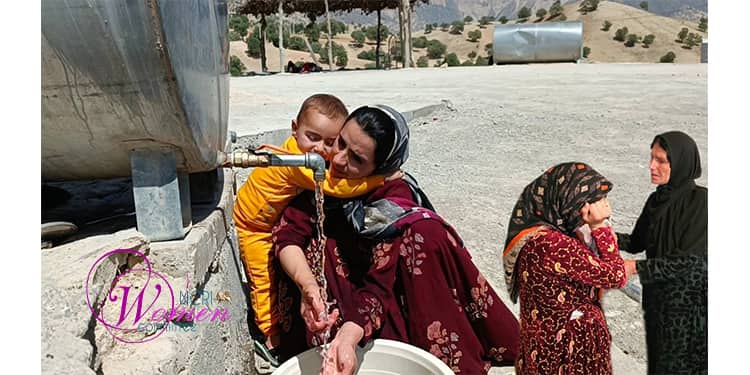
In regions without water, women and children, especially young girls with limited physical strength, are forced to walk long distances to fetch water from springs, wells, or hootags (traditional open-water reservoirs) especially in Sistan and Baluchestan province. Many have lost their lives to crocodile attacks or drowning in these reservoirs.
Many women in this province suffer from anemia, vitamin D deficiency, and joint problems, all of which are worsened by the daily task of carrying heavy containers of water over long distances. (Jame’e 24, July 31, 2021)
Elnaz, a 36-year-old Baluch woman, says:
“In Nikshahr and nearby villages, water supply is often cut off for days. Water tankers come to sell drinking water, but even that water is not clean. Many of us must walk far to find springs or other water sources, which takes a lot of time, worsens our joint pain, and leaves us with less time to care for our children.” (Radio Zamaneh, December 3, 2024)
In Khuzestan, water scarcity has become unbearable. Temperatures exceeding 50°C, lack of drinkable water, and saline rivers have turned life in this region into a living hell. Women and children spend hours in long queues to fill pots and barrels from water tankers.
Videos from villages like Abu Agab near Abadan show heartbreaking scenes of small children running after tankers with buckets in hand. (Mazra’e Sabz, July 27, 2025)
3.3 Water Shortage and Violence Against Women
Beyond household hardships, water scarcity also disrupts local economies and livelihoods, leading to widespread poverty. In turn, poverty contributes to child marriage, domestic violence, and various social harms. “One of the main causes of violence against women is poverty,” notes Jame’e 24. (July 31, 2021)
Salomeh explains:
“As our city’s economy worsened, education and healthcare declined too, and child marriage increased. Imagine how hard it is for a 15- or 16-year-old girl, already married, to deal with the water crisis, become pregnant, give birth, and care for her baby in these conditions.” (Radio Zamaneh, October 17, 2024)
This pattern is visible throughout Iran’s water-deprived regions, particularly in rural parts of Sistan and Baluchestan and South Khorasan, where the water crisis fuels school dropouts, child and forced marriages, and the neglect of women’s health and hygiene. (Bahre Vari Website, December 17, 2024)
3.4. Loss of Educational and Employment Opportunities
The dominant culture imposed by the clerical regime — which defines the man as the “head of the household” and “provider,” and the woman as “dependent” and “provided for” — has made women increasingly vulnerable amid the water crisis.
In this culture, the significant role of women in the informal family economy, particularly in household, agricultural, and livestock sectors, is ignored. Women spend their time and energy collecting and storing water and raw materials, as well as preparing food and maintaining family hygiene. Yet it is the man who gains access to the marketplace, recognition, employment, and wages. As women are distanced from opportunities for education and entry into the economic cycle, they move closer to the cycle of poverty. (Bahre Vari Website, December 17, 2024)

3.5. Reproduction of Feminized Poverty and Social Harm
In Iran, especially in the southern and southeastern regions, many villages lack access to piped drinking water and struggle with severe water shortages and drought. The little available water is often scarce and sometimes must be purchased. This situation perpetuates the cycle of poverty.
Leaving farmland uncultivated due to water scarcity negatively affects employment and family economies. Many men are forced to migrate seasonally in search of work, leaving women and children behind in waterless villages to face countless hardships. These women, mostly due to poverty and social conditions, are poorly educated and lack formal, paid employment, making it impossible to secure a stable livelihood for themselves and their families. (Bahre Vari Website, December 17, 2024)
The water crisis has harmed women in two major ways. First, water management within households largely falls on women, and this responsibility is difficult in itself. However, due to the economic crisis and the growing migration of men, women are also forced to earn small incomes through handicrafts such as embroidery, which greatly increases their burden.
Meanwhile, middlemen buy these products from the women at very low prices and sell them in Tehran for several times more. Most of the women have little bargaining power, as many of them do not even speak Persian fluently.(Radio Zamaneh, October 17, 2024)
These hardships sometimes force people into choices they would never willingly make. Therefore, water scarcity can also contribute to social problems such as begging. (Jame’e 24, July 31, 2021; Local Newspaper Payam-e Ma, May 17, 2023)
3.6. Forced Migration and Urban Marginalization
One of the most evident social consequences of the water crisis is the large-scale migration from rural areas to cities. The drying up of wells and rivers in provinces such as Khuzestan, Sistan and Baluchestan, and Fars has forced farmers to abandon their lands. These forced migrations, often ending up on the outskirts of major cities like Tehran, Mashhad, and Isfahan, have led to the expansion of urban slums and the deepening of poverty.
The displaced populations, deprived of basic services such as access to clean drinking water, face inhumane living conditions. The regime has not only failed to implement any plans to manage these migrations but has also resorted to suppressing the protests of the affected people. (IranPedia, May 2, 2025)