Friday, May 8, 2026
  • English
  • Français
  • فارسی
  • عربى
PODCASTS
NCRI Women Committee Women Resistance Freedom
  • Home
  • NEWS
    • Women’s News
    • Articles
    • Statements
  • PUBLICATIONS
    • Monthlies
    • Documents
    • Reference Library
  • ABOUT US
    • The NCRI Women’s Committee
    • Gender Equality
    • Women’s Platform
  • MARYAM RAJAVI
    • Maryam Rajavi
    • Maryam Rajavi Speeches
    • The Plan on Women’s Rights and Freedoms
    • Ten-Point Plan for the future of Iran
  • VANGUARDS
    • The Fallen for Freedom
    • Heroines in Chain
    • Women of Iranian Resistance
    • Famous Women
    • Women in History
  • EVENTS
    • IWD Conferences
    • Activities
    • IWD Speeches
    • Solidarity
  • VIDEO
    • Videos
    • IWD Videos
  • PODCAST
  • DONATE
  • CONTACT US
No Result
View All Result
NCRI Women Committee Women Resistance Freedom
  • Home
  • NEWS
    • Women’s News
    • Articles
    • Statements
  • PUBLICATIONS
    • Monthlies
    • Documents
    • Reference Library
  • ABOUT US
    • The NCRI Women’s Committee
    • Gender Equality
    • Women’s Platform
  • MARYAM RAJAVI
    • Maryam Rajavi
    • Maryam Rajavi Speeches
    • The Plan on Women’s Rights and Freedoms
    • Ten-Point Plan for the future of Iran
  • VANGUARDS
    • The Fallen for Freedom
    • Heroines in Chain
    • Women of Iranian Resistance
    • Famous Women
    • Women in History
  • EVENTS
    • IWD Conferences
    • Activities
    • IWD Speeches
    • Solidarity
  • VIDEO
    • Videos
    • IWD Videos
  • PODCAST
  • DONATE
  • CONTACT US
No Result
View All Result
NCRI Women Committee
No Result
View All Result
Home Heroines in Chain
Blood Ties Turned Weapons: Inside Evin Under a Family of Interrogators Prison Memoirs of Azam Haj Heydari from the book “The Price of Being Human” – Part Five

Blood Ties Turned Weapons: Inside Evin Under a Family of Interrogators

May 8, 2026
in Heroines in Chain

Prison Memoirs of Azam Haj Heydari from the book “The Price of Being Human” – Part Five

Blood Ties Turned Weapons: Inside Evin Under a Family of Interrogators

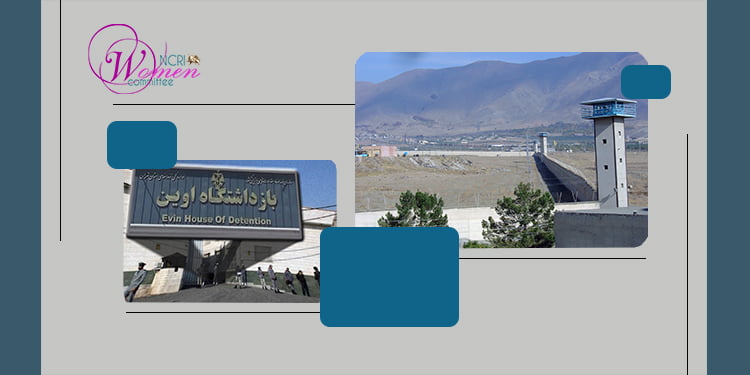
In this installment of Azam Haj Heydari’s prison memoir, she recounts her transfer to Evin Prison, the brutal conditions inside, and the shocking reality of facing her own relatives—now serving as Guards and interrogators.

At the time, Azam was a young teacher in her early twenties who had chosen the path of resistance. She would ultimately spend five years imprisoned in various facilities, including Judiciary Detention, Evin, Qezel Hesar, and Gohardasht, enduring severe torture at the hands of the Guards.

Transfer to Evin

In the early days of September, my sister Mahin, who was in very poor physical condition, and I were taken from the detention center and thrown into a vehicle. They covered our heads and bodies with blankets so we couldn’t see anything outside. In this way, they transferred us to Evin and took us straight to the interrogation unit.

We were kept there waiting until midnight. After hours of delay, they conducted a brief initial interrogation, recorded our identities, and then transferred us to Ward 240.

This ward consisted of three rooms. One of them was reserved for monarchists, who enjoyed every possible privilege available to prisoners. They were on friendly terms with the Guards and were provided with whatever they wanted.

The other two rooms held the rest of us, about 70% students and 30% from other professions: teachers, doctors, nurses, office workers. Each room, measuring roughly 5 by 3 meters, held between 50 and 70 people, packed tightly together. Despite the overcrowding, no one was relocated.

Among us were three very young girls: Farzaneh, 11; Forough, 12; and Zahra, 15. Their “crime” was supporting the Mojahedin. In reality, they were hostages, held to pressure their families into surrender.

Farzaneh and Forough were so young that they would fall asleep during interrogations. At times, when the Guards locked the room as punishment and denied us access to the toilet, these children couldn’t hold themselves.

On October 5, word spread through the prison that demonstrators had attacked Evin. In response, the prison authorities sealed all the doors. For three days, no one was allowed out—not even to use the toilet or perform ablutions.

In a 5-by-3 room crammed with 55 people, what could we possibly do for those children?

We lifted a corner of the carpet and placed a tin container—once used for cheese—for them to use. Eventually, others had no choice but to use it as well. After three days, the stench became unbearable. Only after repeated pleas, paid for with beatings and interrogations, did they finally open the doors.

A female Guard named Alizadeh, who oversaw the ward, had a deep hatred for Mojahedin supporters. She subjected even these young girls to the most degrading insults and beatings. She would say: “You deserve this. The Imam (Khomeini) said your lives, your property, your honor are all permissible. I don’t care what happens to you. All of you should be executed. You’re living extra lives.”

This was the mindset they had been trained to believe.

Zahra, only 15, was executed after six months of torture because she refused to renounce her beliefs. She would not repeat the phrase they demanded: “I am a hypocrite.” She was executed at dawn on September 12, 1981. The news was broadcast on the radio that same morning.

I never learned what happened to Farzaneh and Forough after they were transferred elsewhere. But given what we witnessed, it would not be surprising if they too were executed. One of the regime’s officials had openly stated on television that girls as young as nine and boys of fifteen could be executed.

Illness and Neglect

By the time I arrived at Evin, I was suffering severely from a fungal infection. My cellmates tried to help me bathe at least once a day, even with cold water, to prevent it from worsening.

Hot water was available only once a week, for about ten minutes. We usually prioritized those whose injuries from torture were severe, since cold water would worsen their condition. The rest of us had to wash ourselves in freezing water in Evin’s cold mountain air.

When we raised this issue with “Hosseini,” the prison official, he replied: “Be grateful you have this much. Complain more and we’ll cut even that off.”

A Family of Interrogators

Now that I’ve mentioned “Hosseini,” I should explain: his real name is Abolfazl Haj Heydari—my cousin.

He was related to powerful figures and had been imprisoned before the revolution alongside others who later rose to positions of authority. After their release, they publicly pledged loyalty and later became deeply embedded in the system.

Abolfazl brought his own brother Aziz Haj Heydari and my older brother Mohammad Haj Heydari into the prosecutor’s office and Evin Prison. While he operated openly as the face of the prison, Aziz and Mohammad worked as interrogators and torturers under aliases.

Whenever I was taken for interrogation, I could tell when one of them was present. The questions revealed intimate knowledge of my family.

One time, I lifted my blindfold just enough to see, and I recognized Aziz. He saw me too.

For that moment, I was flogged and tortured for an entire week.

Overcrowding and Recognition

From September onward, arrests increased dramatically. Evin was overflowing far beyond capacity. We were suffocating in the overcrowded wards.

Eventually, they moved us to another ward—also called 240. Like all wards in Evin, it had two floors. I was placed upstairs; my sister Mahin was sent downstairs. We were separated.

Each floor had six rooms. To give a sense of the overcrowding: prisoners from a three-room ward were now packed into all twelve rooms of this new space. Our former ward was turned into an infirmary.

One day, we were told a delegation of officials would visit. We sat in our rooms waiting.

I was in Room One when Hosseini entered.

At that moment, any doubt I had vanished. I knew for certain: he was my cousin, Abolfazl.

Seeing him, I felt a jolt, and a deep sense of disgust that I shared a name with him. I had never felt any connection to that side of the family. Even before my political involvement, I had distanced myself from their corrupt and backward values.

He looked straight at me and asked, “Who are you?”

I didn’t answer.

He asked again.

I said: “Azam Haj Heydari.”

He scanned me with a smirk and asked, “What do you do?”

I remained silent.

He repeated the question several times. I stared back at him and refused to respond.

The others spoke up, complaining about the lack of hot water and basic hygiene.

He laughed mockingly and said: “Be grateful you even have water.”

And just like that, he dismissed every concern, turning even the most basic human needs into something to ridicule.

To be continued…

ShareTweetPinShareSendShare

Related Posts

Infinite Horizons: The Legacy of Maryam Mirzakhani

May 7, 2026
Infinite Horizons: The Legacy of Maryam Mirzakhani

Welcome to another episode of podcasts of the Women's Committee of the National Council of Resistance of Iran. Infinite Horizons: The Legacy of Maryam Mirzakhani

Read moreDetails

Defense Counsel Silenced: Two Human Rights Attorneys Arrested

May 7, 2026
Defense Counsel Silenced: Two Human Rights Attorneys Arrested

In a blatant attempt to stifle the voices of legal advocates, two defense counsels, Elham Zera’atpisheh and Asetareh Ansari, were arrested by the regime's security forces in Shiraz....

Read moreDetails

Systematic Denial of Care Risks Life of Female Political Prisoner in Iran

May 7, 2026
Systematic Denial of Care Risks Life of Female Political Prisoner in Iran

Female political prisoner in Iran, Parisa Kamali, is facing a life-threatening health crisis as Yazd Prison authorities weaponize medical neglect against political prisoners. Under the hollow pretext of...

Read moreDetails

Iran: Female Prisoners Held in Inhumane Conditions at Vakilabad Prison

May 6, 2026
Female Prisoners Held in Inhumane Conditions at Vakilabad Prison

The “Aramesh” ward at Vakilabad Prison in Mashhad houses a number of female prisoners. At present, at least 23 women are being held in this ward, some of...

Read moreDetails

Evin Prison: Six Months Added to the Sentences of Two Women Political Prisoners

May 5, 2026
Iran Regime Adds Six Months to Prison Sentences of Two Women in Evin Prison

Amid an ongoing escalation of judicial pressure against female political prisoners in Iran, authorities have imposed an additional six-month prison sentence on two inmates held in Evin Prison,...

Read moreDetails

Documents

A Report to CSW70: Gender-Based Discrimination Under Iranian Law

A Report to CSW70: Gender-Based Discrimination Under Iranian Law

March 8, 2026

Structural Inequality and State-Sanctioned Oppression of Women Gender-Based Discrimination Under Iranian Law” is the title of the NCRI Women’s Committee’s...

Annual Report 2026: From Protests, to Uprising, and the Role of Iranian Women

Annual Report 2026: From Protests, to Uprising, and the Role of Iranian Women

March 3, 2026

On the eve of International Women’s Day 2026, the NCRI Women’s Committee presents its Annual Report 2026, offering a recap...

Iranian women Who Lost Their Lives in Iran’s January 2026 Uprising

Iranian Women Who Lost Their Lives in Iran’s January 2026 Uprising

January 25, 2026

Names That Must Not Be Forgotten Iranian women played a central and courageous role in the January 2026 uprising, standing...

Monthlies

April 2026 Report: Mass Arrests of Women: Targeted Repression in Time of Crisis
Monthlies

April 2026 Report: Mass Arrests of Women in Iran

April 30, 2026
March 2026 Report: How Iranian Women Are Shaping the Resistance
Monthlies

March 2026 Report: Courage Under Fire

April 3, 2026
January 2026 Report: Women at the Core of the Uprising
Monthlies

January 2026 Report: Women at the Core of the Uprising

January 31, 2026
December 2025 Report: A Year in Review: Iranian Women’s Resistance Against Religious Dictatorship
Monthlies

December 2025 Report: A Year in Review: Iranian Women’s Resistance Against Religious Dictatorship

January 5, 2026

Articles

Iranian nurses’ defiance in January 2026 uprising

Iranian Nurses Braved Fire with Defiance During January 2026 Uprising

May 3, 2026

In the blood-stained annals of the January 2026 uprising, Iran’s healthcare professionals stood witness to a stark battle between human...

O Mothers of Iran: A Manifesto of Unyielding Resistance

O Mothers of Iran: A Manifesto of Unyielding Resistance to Misogynistic Barbarity

April 28, 2026

Through the deeply moving story of the Ebrahimpour family, Massoumeh Raouf delivers, with Ô Mères d’Iran (O Mothers of Iran),...

Iran detains women and girls: torture and detention without legal clarity

Iran Regime Arrests Women and Girls: Torture and Detention without Legal Clarity

April 22, 2026

Amid a growing wave of arrests targeting women and teenage girls across multiple Iranian cities, numerous reports have emerged detailing...

The Fallen for Freedom

Fereshteh Azhadi: A Life of Resistance, Sacrifice, and Unyielding Commitment
The Fallen for Freedom

Fereshteh Azhadi

May 1, 2026
Mahin Khiabani: A Life of Defiance Until the Final Breath
The Fallen for Freedom

Mahin Khiabani

May 1, 2026
Sholeh Sotoudeh (Pregnant)
The Fallen for Freedom

Sholeh Sotoudeh “Shot Dead Alongside Her Unborn Child”

April 19, 2026
Ghazal Aghaei Lindi was killed on January 9, 2026
The Fallen for Freedom

Ghazal Aghaei Lindi

April 16, 2026

ABOUT US

NCRI Women Committee

We work extensively with Iranian women outside the country and maintain a permanent contact with women inside Iran. The Women’s Committee is actively involved with many women’s rights organizations and NGO’s and the Iranian diaspora.
The committee is a major source of much of the information received from inside Iran with regards to women. Attending UN Human Rights Council meetings and other international or regional conferences on women’s issues and engaging in a relentless battle against the Iranian regime’s misogyny are part of the activities of members and associates of the committee.

CATEGORIES

  • Activities
  • Articles
  • Documents
  • Famous Women
  • Heroines in Chain
  • IWD Conferences
  • IWD Speeches
  • IWD Videos
  • Maryam Rajavi
  • Maryam Rajavi Speeches
  • Monthlies
  • Podcast
  • Reference Library
  • Solidarity
  • Statements
  • The Fallen for Freedom
  • Videos
  • Women in History
  • Women in Leadership
  • Women of Iranian Resistance
  • Women's News

BROWSE BY TAG

Child marriage coronavirus education execution forced hijab Gender Gap Generation Equality Honor killings Iran Teachers Maryam Akbari Monfared Nurses Plan on Women's Rights and Freedoms Poverty Prisoners Protests rural women Saba Kord Afshari The girl child Violence against women Women's Leadership Women Heads of Household Zeinab Jalalian

The copyright of all the material published on this website has been registered under © 2016 the Women’s Committee of the National Council of Resistance of Iran. To obtain permission to copy, redistribute or publish the material published on this website, you should write to the NCRI Women’s Committee. Please include the link of the original article on our website, women.ncr-iran.org.

Welcome Back!

Login to your account below

Forgotten Password?

Retrieve your password

Please enter your username or email address to reset your password.

Log In

Add New Playlist

No Result
View All Result
  • Home
  • News
    • Women’s News
    • Articles
    • Statements
  • Publications
    • Monthlies
    • Documents
    • Reference Library
  • About Us
    • The NCRI Women’s Committee
    • Gender Equality
    • Women’s Platform
  • Maryam Rajavi
    • Maryam Rajavi
    • Maryam Rajavi Speeches
    • Ten Point Plan for Iran
    • The Plan on Women’s Rights and Freedoms
  • Vanguards
    • The Fallen for Freedom
    • Heroines in Chain
    • Women of Iranian Resistance
    • Famous Women
    • Women in History
  • Events
    • IWD Conferences
    • Activities
    • IWD Speeches
    • Solidarity
  • Video
    • Videos
    • IWD Videos
  • Podcast
  • Donate
  • Contact us
  • فارسی
  • عربی
  • Français

The copyright of all the material published on this website has been registered under © 2016 the Women’s Committee of the National Council of Resistance of Iran. To obtain permission to copy, redistribute or publish the material published on this website, you should write to the NCRI Women’s Committee. Please include the link of the original article on our website, women.ncr-iran.org.