
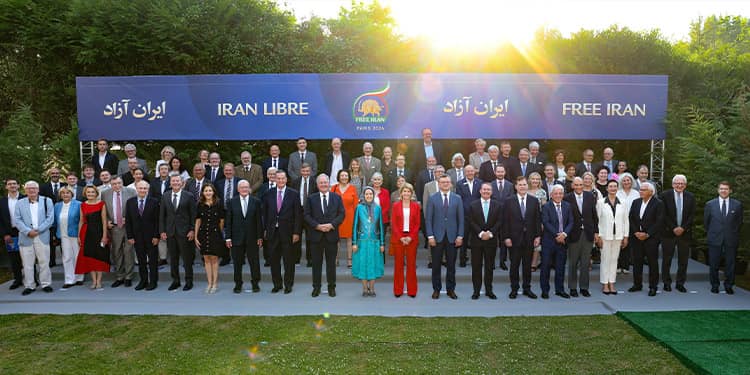
On Sunday, June 21, 2026, the second day of the “Free Iran 2026 – Supporting the Democratic Alternative” conference was held at the headquarters of the National Council of Resistance of Iran in Auvers-sur-Oise, France. The conference was attended by dozens of political figures, former government officials, lawmakers, and human rights advocates from various countries.
In their speeches, the participants expressed their firm support for the Iranian people’s right to self-determination and for Mrs. Maryam Rajavi’s Ten-Point Plan as a definitive roadmap for a secular and democratic republic.
Referring to the last-minute restrictions imposed by the French authorities on a large-scale rally that had been planned in Paris, they condemned Western appeasement of the clerical regime and called for the Revolutionary Guard Corps (IRGC) to be designated as a terrorist organization. They also rejected any return to hereditary dictatorship.
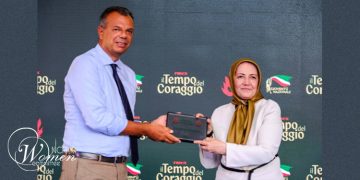
At the conference, a delegation from the United Kingdom presented Mrs. Rajavi with a book containing the signatures of 3,000 lawmakers from around the world in support of the National Council of Resistance’s provisional government.
The following report highlights selected excerpts from the speeches delivered at the conference:
Change in Iran Through the Resistance Force on the Ground
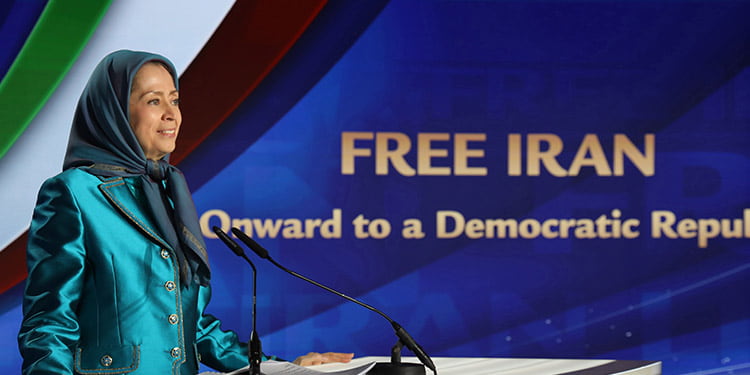
Mrs. Maryam Rajavi opened her remarks by saluting the demonstrators:
“I salute the tens of thousands of Iranians who came yesterday to Place Vauban and its surrounding areas in Paris for their demonstration, only to see it confronted with an unjustified ban. I salute them—especially the younger generation whose voice was heard around the world.”
“The remnants of the regime sought, through backroom deals, to silence this voice. But their voice, the most legitimate voice of Iran, resounded in the heart of Paris more powerfully than ever. Fortunately, the French people and their honorable representatives demonstrated, and declared loudly, that they stand against the policy of granting concessions to the regime and alongside this Resistance, the National Council of Resistance, and the Resistance Units.”
In another part of her speech, Mrs. Rajavi said: “Our message is this: no to war, no to appeasement, and no to the endless negotiations that have continued up to today. But yes to uprising, yes to the freedom of the Iranian people through support for their independent Resistance to overthrow this ruthless regime.”
Mrs. Rajavi then posed the question, “What is the solution to the crisis?” and emphasized: “The only solution to the current crisis is regime change, and that change is possible through the uprising of the people and their organized resistance. The central issue is this: change in Iran requires a force capable of bringing about that change. It requires a force that can fight under the harshest repression; a force that can stand shoulder to shoulder with the people’s uprising and remove the Revolutionary Guards from the path of the Iranian people.
with such an organized Resistance on the ground, and with an alternative that has been tested for forty-five years through the fiercest domestic, regional, and international trials, the equation of Iran has found its answer. And this comes at a time when the ruling theocracy is weaker and more desperate than ever before.”
Dr. Ramesh Sepehrrad – Academic and Cybersecurity Executive
“Let us be clear: no ban, no threat, and no policy of appeasement can stop the Free Iran movement. Our message is clear. We have come together for political prisoners. We have gathered to call for an end to executions, for the women who are at the forefront of change in Iran, and for the young people who are protesting in the streets of Iran.
We have also come together for the families of those who have been executed, for young people, and for Iran’s various ethnic and national communities, those who have chosen to reject both dictatorships, that of the Shah and that of the mullahs. This is our clear message.”
Anneli Jäätteenmäki, Finland’s First Female Prime Minister (2003) and Member of the European Parliament (2004–2019)
“Dictatorships have fallen, and this will also happen in Iran. We do not know when it will happen, but it could occur quickly, because its time has come. When the Berlin Wall fell, we could not have imagined it beforehand. History is on the side of freedom.
I believe in a free Iran, in Mrs. Maryam Rajavi, and in her Ten-Point Plan. This path offers a roadmap to a secure, democratic, and free Iran. And one day, sooner or later, we will witness a system led by Mrs. Rajavi.”
Dr. Margot Kaessmann, Bishop and Chair of the Evangelical Church in Germany (2009)
“I would like to express my solidarity with all those who, despite intimidation, are striving for a democratic Iran. I am deeply impressed by Mrs. Rajavi’s Ten-Point Plan, including the separation of religion and state and equality between women and men.
Because this is about people, women, men, and children. It is about human beings, and it is about hope. It is about faith and equal belief. It is about the hope that God will grant us the strength to preserve this hope for a future filled with justice and peace.
And I hope that one day we will be able to meet each other in a free and democratic Iran.”
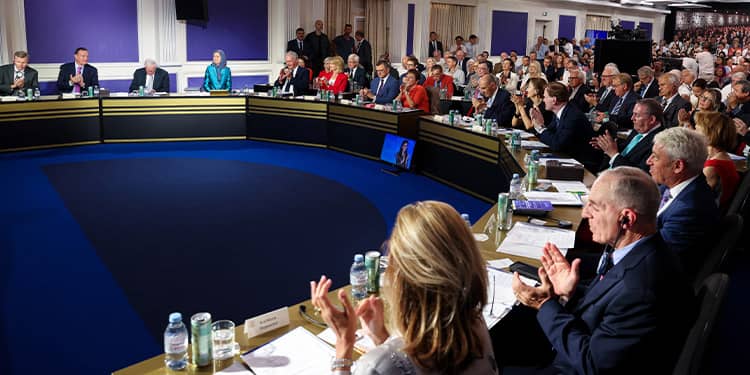
Ingrid Betancourt, Senator and Former Presidential Candidate of Colombia
“If free societies are unable to defend their principles when those principles are threatened anywhere in the world, those same threats will eventually return to their own countries. History teaches us that fear has a cost, appeasement has a cost, and complicity has a cost, and in many cases, it is paid in human lives.
Military operations alone cannot bring freedom to Iran. If we believe that Iran’s future belongs to the Iranian people, then we must recognize a fundamental truth.
Only the Iranian people can overthrow this tyranny. External action may weaken it, but only the people of Iran can replace this regime with a democratic government. That is why the Iranian people’s right to struggle must be recognized: their voice must be heard around the world, and they must be able to organize themselves.”
Karla Sands, U.S. Ambassador to Denmark, Greenland, and the Faroe Islands (2017–2021)
“The National Council of Resistance of Iran, under the leadership of Mrs. Maryam Rajavi, offers a genuine democratic alternative. Mrs. Rajavi has devoted her life to strengthening this movement for change. Her brilliant Ten-Point Plan outlines a clear path for the future.
This is a practical plan for transition that began years ago within this very movement and is now being realized; the best example of it is the leadership of women within its structure.
Now, the international community and the United States, if they wish to adopt a rational approach, must support this Resistance and this movement. This is the only real solution to Iran’s crisis. The choice between continuing past policies or embracing this strategy is, in fact, a choice between different paths that concern the will of the Iranian people, people whose central force is the organized Iranian Resistance.”
Linda Chavez, Former White House Public Relations Director
Mrs. Rajavi’s speech about what lies ahead reflected an optimistic approach. She was not pessimistic; her remarks were filled with hope, because she rightly emphasized that freedom cannot be imposed through bombing.
Some measures might have limited effectiveness, for example, eliminating parts of the nuclear program, or destroying the air force and navy, but these actions are not sufficient and cannot impose freedom from the outside.
What must happen is that the people of Iran must rise up and fight for themselves. And I know that those present in this hall, those in Ashraf, and Iranians in exile around the world all want this to be achieved.
Mahan Taraj, Iranian Lawyer and Representative of the Association of Iranian Youth in France
“We are united in the shared belief that the people of Iran deserve a republic based on the separation of religion and state. The blood that was shed on June 20, was not shed in vain; it lives on in every person who refuses to submit to tyranny.
It is present in every act recognized as resistance, in international support for the Iranian people’s right to freedom and democracy, and that blood continues to flow.
This blood runs through successive generations; today we are also witnessing the third generation, which is fighting inside Iran and is present across the world. And we, together, will not remain silent until the dawn of a free republic in Iran is realized.”
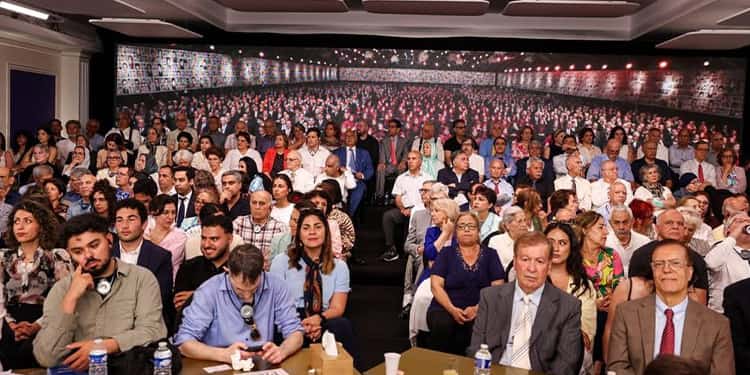
Other personalities who spoke on the second day of the Free Iran 2026 Summit included:
- General James L. Jones, U.S. National Security Advisor (2009–2010)
- Keith Kellogg, U.S. Special Envoy for Ukraine and Russia
- Bob Blackman, Member of the UK Parliament and Chair of the British Committee for Iran Freedom
- Sir Liam Fox, UK Secretary of State for Defence (2010–2011)
- David Jones, UK Government Minister for Wales (2012–2014)
- Louis Freeh, Director of the Federal Bureau of Investigation (1993–2001)
- General Tod D. Wolters, former Supreme Allied Commander Europe (NATO)
- Geir H. Haarde, Prime Minister of Iceland (2006–2009)
- Íñigo Fernández García, Senator of Spain
- Ambassador Robert Joseph, former U.S. Under Secretary of State for Arms Control and International Security
- Lincoln P. Bloomfield Jr., former U.S. Assistant Secretary of State for Political-Military Affairs
- Struan Stevenson, Member of the European Parliament (1999–2014)
- Paulo Casaca, Member of the European Parliament (1999–2009)
A more detailed report of the speeches from this session can be read here.