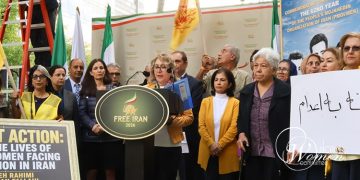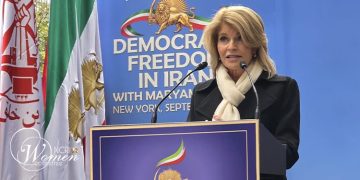

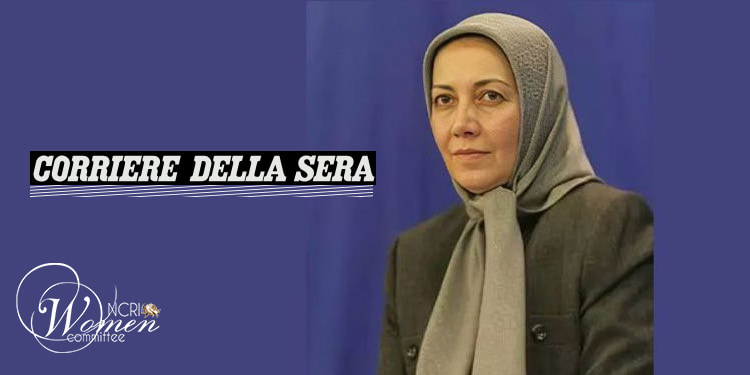
The Italian newspaper Corriere della Sera conducted an interview with Sarvnaz Chitsaz, Chair of the Women’s Committee of the National Council of Resistance of Iran (NCRI). Corriere della Sera published the interview under the title “Né con lo Scià, né con i mullah”, l’opposizione iraniana: “Noi pronti a governare” (Neither Shah nor Mullahs: Iran’s Opposition Poised to Govern), on February 19, 2026.
The discussion addressed the prospects of the fall of the clerical regime, the opposition’s readiness to form a transitional government, the role of women in recent uprisings, and relations with the West.
The translation of the interview follows below.
Neither Shah nor Mullahs, Iran’s Opposition Poised to Govern
In June 1981, half a million people flooded the streets of Tehran, demanding democracy. The protests were met with brutal bloodshed. Since that day, says Sarvnaz Chitsaz, the mullahs’ regime launched a new chapter of mass arrests, executions, and long-term imprisonments.
Chitsaz was twenty at the time. She had been studying in the United States during the 1979 revolution, then returned to Iran. One of her sisters was imprisoned for six years, and her husband was executed. “Staying was impossible,” she recalls. Today, she lives in Europe and serves as head of the Women’s Committee of the National Council of Resistance of Iran — one of the most organized and internationally visible opposition groups in exile.
The central question in her life mirrors the question facing Iran today: Can this regime truly fall? And if it does, what comes next?
Protests, Repression, and the Regime’s Limits
Over the past nine years, Iran has witnessed at least four major uprisings, all met with severe repression. This time, thousands have been killed. Yet, Chitsaz insists, the Iranian people’s thirst for freedom and democracy cannot be crushed. More uprisings are inevitable, because the regime cannot solve the pressing problems facing ordinary Iranians: soaring inflation, water shortages, and blackouts have made daily life unbearable, and the mullahs offer no solutions.
Ready for a Government-in-Exile
Chitsaz explains that the regime has long tried to fragment the opposition and create the illusion that no organized force could govern. Currently, 25 committees have been formed, laying the groundwork for a government-in-exile. “We are ready,” she says.
If the ayatollahs fall, the plan is clear: six months of transitional governance, the formation of a provisional government, followed by elections for a constituent assembly tasked with drafting a new constitution. The aim is neither a return to the past nor a continuation of the status quo, but a full institutional rebuilding.
Women at the Forefront
Recent uprisings have had a distinctly female face… Chitsaz emphasizes that the Islamic Republic is structurally misogynistic, and the compulsory hijab is a tool of control. She herself is Muslim and wears the hijab, but stresses that true Islam has no compulsion. When wearing it is enforced and disobedience leads to imprisonment, it becomes a symbol of oppression.
On the Shah and Monarchy
The figure of Reza Pahlavi, son of the last Shah, remains divisive among opposition circles. Some see him as a unifying symbol, others call for a referendum between a republic and a monarchy. Chitsaz is clear: Iranians shout “Neither Shah, nor Mullahs”, and the official line of the National Council of Resistance is a republican system — neither religious rule nor monarchy.
Relations with the West
The most political part of the interview concerns the West. Chitsaz strongly rejects foreign military intervention: “No boots on the ground,” she says. At the same time, she condemns decades of appeasement policies, arguing that attempts to engage the regime in hopes of moderation have backfired. Nuclear agreements, she says, freed billions in cash that went straight into the pockets of the ruling elite rather than improving the lives of ordinary Iranians.
Appeals to Europe
Chitsaz outlines the NCRI’s demands from Europe:
- Recognize the Iranian people’s right to overthrow the regime and the legitimate resistance of youth and resistance units against the Revolutionary Guards.
- Immediate action by the UN Security Council to end executions and full support for the “No to Execution” campaign.
- Guarantee free and uncensored internet.
- Refer senior regime figures, including Khamenei, to international courts for crimes against humanity.
- Close embassies and expel regime agents and Ministry of Intelligence operatives abroad.
- Neutralize the regime’s financial resources to prevent further repression and foreign meddling.
Conclusion
Since 2017, Iran has experienced recurring unrest. Repression has been severe, but Chitsaz believes the cycle is far from over and protests will return. She says the real question is not whether Iran will change, but whether Europe will remain a bystander or play an active role in this transformation.