

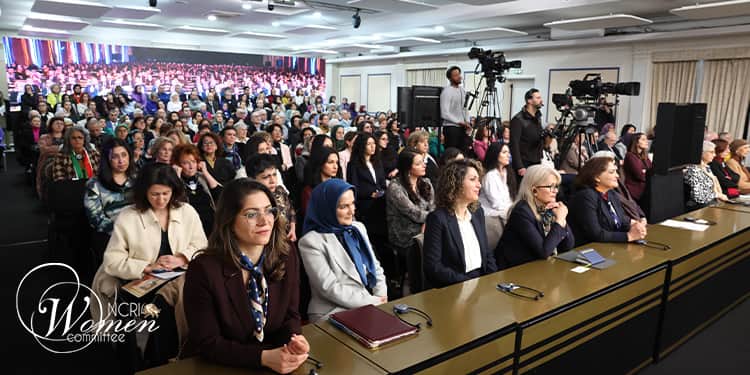
On Saturday, February 21, 2026, on the eve of March 8, International Women’s Day, the NCRI Women’s Committee hosted an international conference in Paris entitled “Women’s Leadership: An Imperative for a Free Iran and a Democratic Republic.”
The conference, attended by women legislators, academics, thinkers, and prominent political figures, focused on women’s political participation and leadership as a decisive element in a democratic society.
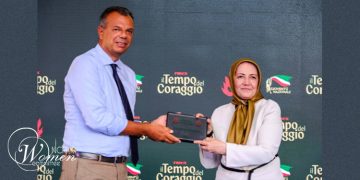
At this conference, Linda Chavez, the former director of the White House Office of Public Liaison, was also in attendance and delivered a speech. Excerpts of her speech follow:
Linda Chavez: We no longer ask “if” the regime will change; we know this change will happen
This is always a very humbling experience for me. I have to tell you, I don’t think there is any other single event that I can think of where you have as many powerful women are gathered in one place. Not only our beloved Maryam Rajavi, but also former heads of state, ministers, ambassadors, members of legislatures and congresses, all assembled here to support women and the people of Iran.
You know every year we talk about regime change, at least for the fifteen years I’ve been coming to these. Always talk about regime change. But this year is different. We are not talking about if there will be regime change, we know there will. The only questions are “when and how”. We have gone through periods of resistance in Iran from the beginning of the takeover by the mullahs of that country. We saw huge uprisings in Iran in 2009. We saw people taking to the streets in 2022 after a young woman was killed.
And this year and at the end of last year, we saw literally a million people in the streets of Tehran. We saw people in the streets in every one of the 31 provinces in the country of Iran. The streets were flooded with people.
And what does the regime do when the people of Iran rise up? They do what they always do. They increase their repression. They kill, they maim, they torture, and the victims include not only men and women, but children as well.
When we look at those resistance, the resistance this late December and the month of January, you have to ask yourself: how did it happen? How did it come about? Why then? Well, it happened for a lot of reasons, but it didn’t happen exactly spontaneously. In fact, there were resistance movements within Iran ready to be able to go out into the streets and to gather around them others. And that is what happened, and we saw that. And it happened because ordinary people were feeling the repression of the regime. People are unable to buy food, people do not have access to water. In an oil-rich country, you have problems with energy. And you have the repression, and particularly the repression of women. Women who are not allowed to even be in the streets, who are not allowed to do things unaccompanied, who are not allowed to pursue their life’s ambition, who are not allowed even to dress how they choose. And finally, when this happens and you realize you don’t have enough money to be able to put food on the table, you have all of your rights restricted, people say, “Enough. Enough is enough. We are going to rise up.”
Unfortunately, they rose up and they were killed by the thousands. And since then, the question throughout the world has been: well, what’s going to come next? Are we going to see any change? I can tell you in the United States, every day I open the newspapers wondering whether there’s F-35s going to be headed towards Iran to try to hit sites there. And I know there are a lot of people who think, “Well, what will happen after? And that is the question I think everyone needs to ask themselves. What is it that will replace this regime? Now, some in Washington, I know, think that well maybe they can negotiate something. Maybe they can find some moderate leaders in the Iranian leadership class that they can bring in and install and maybe they’ll be more reasonable and maybe they won’t pursue nuclear weapons, and we’ll just work out a deal.
There are others who think that maybe we can pick who the leader is going to be. And oh yeah, we have this guy who’s been living in the states for forty-some years, he’s very well connected with other elites, but what has he been doing these last many decades? Has he been out giving speeches and talking and trying to get the people of Iran to look to a future? Has he been gathering a movement of people who are committed to democracy and who want to see a free Iran that is different than the regime that preceded the mullahs? To my knowledge, not at all.
And there really does not seem to me, and I’ve been involved in this issue going back to the ’90s, there doesn’t seem to me to be another movement, not just a single person, but a movement. And with all due respect, Maryam Rajavi, you are a charismatic leader. But you deserve to lead because you have followers. Because there are people whom you inspire, many of them women. And women who do not just lick envelopes, as we say in the United States, and do the back-office stuff of politics, but who actually lead. And that is why I think your movement is so powerful. And it is also not just one person or a charismatic leader. It is an idea for the future of Iran. What you have done by creating a third alternative: not negotiations, not re-imposing someone from, related to someone who led the country, not even himself ever having been a leader, but instead you have created a plan of action for the Iranian people.
And I looked to Madame Rajavi’s 10-point plan, and one of the things that I see there is justice and equal opportunities in the realms of employment and entrepreneurship for all people of Iran in a free market economy. So the lies that are told about this movement are extremely disturbing to me. And it is so commendable that so many of you in this room have fought against those lies. Because those lies are corrosive, and we know who is telling those lies. It is the regime. I’ve had people say to me, “Uhh, you really shouldn’t be fooling around with those people. And they don’t have any support in Iran.” And I say, “Well, that’s very interesting that they have no support in Iran, because I’ve seen the support, I’ve seen the pictures like we saw today.” But more importantly, you know who thinks they have support in Iran? The mullahs think they do, which is why they put prices on the heads of people who support them.
I want to conclude by saying that speaking as an American, I do not believe that we should arrogantly decide who it is the people of Iran should choose. I know who I prefer, but it is not up to me or any other one except the people of Iran. And they are going to be the ones who choose the next leadership. And in choosing that leadership, I think they will look to somebody who has been with the people, fighting for the people every day of her adult life, organizing a movement that has been out there fighting for the people of Iran for decades. And that means that when we gather again next year, Maryam, we’re not going to be gathering in Paris.