
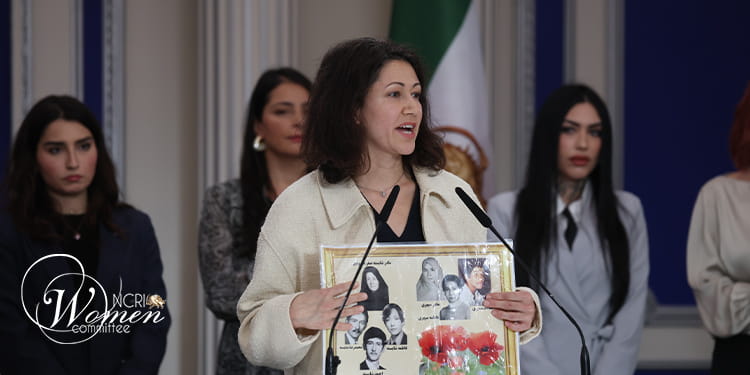
On Saturday, February 21, 2026, on the eve of International Women’s Day, the NCRI Women’s Committee hosted an international conference in Paris entitled “Women’s Leadership: An Imperative for a Free Iran and a Democratic Republic.”
The conference, attended by women legislators, academics, thinkers, and prominent political figures, focused on women’s political participation and leadership as a decisive element in a democratic society.
Azadeh Akhbari, who holds a PhD in History, delivered a speech at this conference.
Azadeh Akhbari: I stand in the shadow of women who refused to bow to tyranny
Good afternoon, everyone. It’s a privilege to be here. I’m Dr. Azadeh Akhbari. I hold a PhD in History, and I work as a consultant. My name, Azadeh, means “free.” I was given this name because I was born just after the revolutionary year of 1979. My parents and millions of other Iranians thought they would be free after the tyranny of the Shah. But despite my name, I was imprisoned at the age of two, alongside my parents and my younger brother.
Today, as we approach International Women’s Day, I stand here in the shadow of women who refused to bow to tyranny. I was a child when my family faced the regime, so I cannot and do not count myself among those who acted. I’m simply here to tell their story.
From Family Repression to a Global Call for Supporting Freedom in Iran
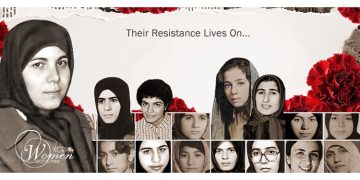
In 1979, my mother took to the streets to protest against the Shah. She had the same dream that young Iranians have today: freedom and the right to self-determination. This has been the heartbeat of the Iranian people for over a hundred years. But the revolution was stolen; it was hijacked by the Ayatollahs. In the dark years that followed, I lost eight members of my family, seven of whom are depicted here. They were supporters of the Mojahedin-e Khalq.

Terrified of strong women, the regime executed my aunt first, Fatemeh Shayesteh. She was in the prime of her life. She was highly educated and was building her career as an engineer. The regime then hanged my grandmother, Soghra Davoudi, who was 56 years old. My mother was sentenced to death; her execution was postponed only because she had small children to care for.
But my story is not unique. It is the story of a century of oppression, first by monarchy and then by religious dictatorship. Millions of Iranians have paid the price. They paid with their lives, their freedom, or by fleeing their homes. I have lived in the safety of Europe—a free and democratic Europe—for 40 years. I know what a privilege it is to work, to speak, and to be myself in a free society. But I also see how fragile this democracy can be.
I applaud the European Parliament for taking a stand. Placing the IRGC on the terrorist list is a vital step, but Europe must do more. It must end the policy of appeasement, close the embassies that serve as nests for spies, and stop the Iranian lobby. These are not just political options; they are necessary steps to protect our collective freedom.
In this safe haven of Europe, I feel my Iranian roots more than ever. I recently saw a video of a young woman who had just left Iran. She described the protests as a true uprising—a revolution; a revolution of students, bazaris, workers, and all ethnicities in Iran. Like her, I realize that I’m part of something much, much bigger.
I owe this awareness to the women of Ashraf 3. I also owe it to the rebellious youth and the organized resistance units in Iran. They are the engine of this movement, paying the ultimate price for a new future. That future is reflected in Maryam Rajavi’s 10-point plan, a vision to transform Iran into a democratic, secular, and pluralistic country. This plan is the blueprint for a nation that brings freedom to its people and stability to the world.
History shows us that the struggle for democracy in Europe and the United States was long and bloody, but it succeeded. The courage that we see in Iran today proves that the struggle of the Iranian people will succeed as well. After more than a hundred years of struggle, the people of Iran will prevail. We will win.