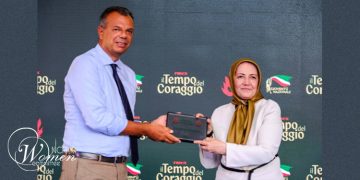


On Saturday, February 21, 2026, on the eve of March 8, International Women’s Day, the NCRI Women’s Committee hosted an international conference in Paris entitled “Women’s Leadership: An Imperative for a Free Iran and a Democratic Republic.” The conference, attended by women legislators, academics, thinkers, and prominent political figures, focused on women’s political participation and leadership as a decisive element in a democratic society.
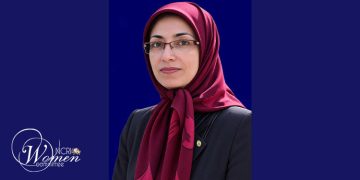
At this conference, Ms. Zinat Mirhashemi, a member of the NCRI and the Central Committee of the People’s Fedayeen of Iran (OIPFG) delivered a speech. The full text of her speech is provided below:
Zinat Mirhashemi: New Generation of Iranian Women Breaks Fear, Shakes the Balance of Power
Greetings to all of you, and special greetings to Mrs. Maryam Rajavi, along with my gratitude for creating this colorful and powerful solidarity among women from different countries. This is your art in supporting the rights of women in Iran.
Before I begin my remarks, I want to point out something that is rarely seen anywhere else and is only witnessed today in Iran: in mourning ceremonies for their lost loved ones, the Iranian people dance, sing songs, and chant anthems, they do not cry. Do you know why? Because they want to tell this regime: you have failed, not us.
They want to say that it is this regime that is mourning. Nowhere else in the world do people take pride in the grief of losing loved ones and say: “This is a gift to the homeland.” This is a unique feature of the resistance of the Iranian people.
Regarding the “child of the Shah,” as was mentioned earlier, I also call him “the child of the Shah” because he is still a child to us. I would just like to say that I am proud to have participated in the 1979 revolution, in the struggle against the monarchy and its overthrow. I am a “one of the revolutionaries of 1979” and this is my pride.
I send my greetings to the women political prisoners who, in the medieval dungeons of the Iran’s regime, spend every moment of their lives resisting.
In Iran, women are not only victims of a discriminatory system, but they are also narrators of historical resistance. The prominent role of women was evident in the uprising of this past December. Women who, with courage, opened a new chapter in the history of the Iranian people’s struggle against religious dictatorship.
The reality is that discrimination against women is a fundamental pillar of the power structure in Iran. In the laws of the Velayat-e Faqih system, women, who make up half of society, are not heard, their bodies are controlled by a patriarchal order, and in many cases they are oppressed.
This has been the reality under the ruling regime in Iran for 47 years. Yet the force of resistance against this inhumane system has grown steadily, and women have blocked the path of retreat themselves. What is happening today in the Iranian women’s movement is not just a temporary protest, it is the manifestation of centuries of accumulated anger from women who have experienced decades of discrimination at home and in society.
This generation of women will no longer remain silent; it is a generation that has known fear, paid the price, and yet refused to step back. Their persistence has shaken the previous balance of power.
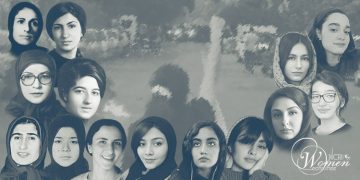
The voices that rose from the streets of Iran during the Zhina (Mahsa Amini) movement in 2022 and the bloody uprising of January 2026 crossed borders and registered a global truth: without women’s freedom, no society can be truly free, and without the active participation of women, no movement can achieve results.
But today, our task is not only to recount the suffering of women—it is to recognize their strength and pay tribute to those who refused to bow under oppression. Some of these women gave their lives on the battlefield, and at the very least, their actions have led to the partial defeat of compulsory hijab, which is a blow to the structure of the religious dictatorship in power.
History has shown that whenever women enter the public stage in a society, the movement for freedom accelerates. And in contemporary Iran, it seems this process will no longer be stopped.