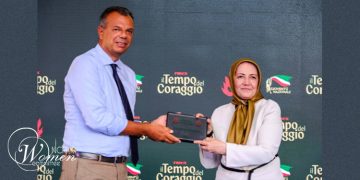
On Saturday, February 21, 2026, on the eve of International Women’s Day, the NCRI Women’s Committee hosted an international conference in Paris entitled “Women’s Leadership: An Imperative for a Free Iran and a Democratic Republic.”
The conference, attended by women legislators, academics, thinkers, and prominent political figures, focused on women’s political participation and leadership as a decisive element in a democratic society.
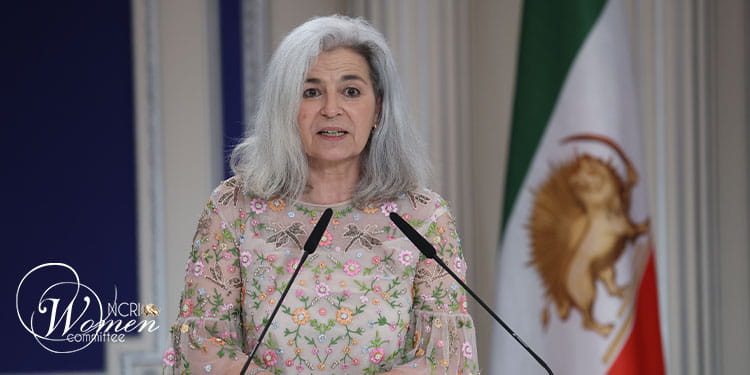
Dorien Rookmaker former Member of the European Parliament from the Netherlands, delivered a speech at this conference.
Dorien Rookmaker: Repression and brutality are manifestations of the regime’s deepening fragility
I’m very happy to be standing here, and I am deeply honored to be here as well. Mrs. Rajavi, thank you for all that you have done. It is so much that if I were to spell it all out, we would still be standing here a week from now, so I will not attempt to do so. This morning, we had a session, and we are all filled with admiration for the example you set. In the West, we often speak about the role of women in terms of being role models, and of course that is important. But this morning we understood something different: you are not simply a role model, and women should not be confined to being role models, though they can be. What you have shown us is that you have changed the nature of leadership. You have said that we do not have to be role models; we must be women leaders, because we lead on the basis of equality, not authority. I believe this is a very important new perspective that you have introduced.
Dorien Rookmaker: The shift in the balance of fear and the movement toward democracy
I am also very happy to be standing here because I am grateful that we are on the brink of significant change. The fundamental shift is that fear has changed sides. It was once the people of Iran who were afraid of the regime, but now the regime is afraid of the people. This is true not only inside Iran but also in relation to the opposition here. We can feel it, and they demonstrate it. Change will come. Everyone here knows that change will come and that democracy will come. It is only a matter of time. We do not know when, but it will happen. A regime characterized by the kind of terror we have witnessed in Iran presents a face of madness. Yet when it begins to crumble, it also reveals a face of weakness. The oppression that the mullah regime in Iran is now displaying shows its weakness day after day, and this is significant.
When I first became acquainted with you, your organization, and the NCRI, I was initially somewhat reluctant because people warned me from all sides. They told me that the NCRI consisted of terrible communists, that it was probably a sect, and that I would be brainwashed. They said that once brainwashed, I would speak only what I was told to say. Of course, this is not true. They also labeled you a communist, suggesting that communism was something to be avoided at all costs. So, I conducted my own investigation. I am a risk manager by profession, and as a risk manager you learn to ask questions of everyone in order to determine whether they are telling the truth. I questioned your representatives in the European Parliament, and I also questioned individuals connected to the Iranian regime, including its agents. For me, it became inevitable that my decision to support your organization and to support Maryam Rajavi was the right one. For example, I could recognize the regime’s agents because they were telling lies and were inconsistent. Among those who support the Shah, I observed something similar: they seemed empty. They are not fighting for a cause; they are fighting for money.
I believe the West, and perhaps the world, is experiencing a moral crisis. There is a sense of emptiness, and I think people need a greater goal, a larger cause with which to connect. In the West in particular, I see that this is lacking, including in my own country. Young people are searching for a purpose, for an objective greater than themselves. The Iranian people have been unfortunate in that they have suffered for so long under a regime that is so extreme. Yet they are also fortunate because they know what they are fighting for: democracy in Iran. I call on everyone in the world, especially members of the European Parliament, to connect with this objective, democracy in Iran and the removal of the current regime. We can be involved. In the Netherlands, many people say that if we speak about what should happen in Iran, we are overstepping because it is their country and they must determine their own future. I agree that it is the Iranian people who should decide who leads them; that is not our decision to make. But we can support those who are best positioned to bring about that future, and I believe that Maryam Rajavi is such a person.
Finally, I would like to thank you all. On my way to this meeting, I was sitting next to a woman who told me about her life in Ashraf 3 and her life in Ashraf 1. It was a remarkable story. I will not share it here because I told her she must write it down. I am certain that many people in this room have similar stories. I have heard many of them over the past years. I encourage everyone who has a powerful and compelling story to write it down and share it. If you share your story, I am confident that good people in the West, and there are many, will support you and connect with your cause. Thank you.