Prison Memoirs of Azam Haj-Heydari from the book The Price of Being Human — Part Twenty-Two
In the twenty-second installment of Azam Haj-Heydari’s prison memoir from The Price of Being Human, she continues her account of the grueling months of imprisonment and torture in Khomeini’s prisons—a story of a woman whose captors sought to break her through torture, humiliation, threats, and physical and psychological exhaustion, yet who found a renewed sense of resistance and victory each day.
Azam Haj-Heydari spent years in the temporary detention facilities of the Judiciary, Evin, Gohardasht, and Ghezal-Hesar prisons after, as a young woman, embarking on the path of resistance against the regime of religious dictatorship. In this section of her memoir, she describes the various methods used to break the morale of women prisoners—from degrading abuse and physical torture to the constant creation of fear and anxiety, playing recordings of other prisoners being tortured, and trying to convince them that no one else remained beside them.
Yet amid all this pressure, even the smallest sign that other prisoners were still present and resisting could become a source of strength. A name written on a piece of clothing, an object belonging to one of her comrades, or a brief, secret sound from behind the walls of the cage could be enough. These memories recount her struggle to keep alive a sense of connection and hope in circumstances where the torturers were determined to drive the prisoners deeper into isolation and fear.
A Cruel Weapon Against Women
One day, when the pain was raging through my body, they came and took me to the interrogation room. They kept me standing for half a day. Then Haji Davood came and said, “Come on, let’s debate. You defend your beliefs, and I’ll defend the Imam (Khomeini). Let’s see which one of us can convince the other.”
While he was talking, I suddenly collapsed to the floor. I had no strength left to stand. Several torturers and interrogators who were there questioning the girls about the organization in the ward came over me and said, “You poor thing. Can’t you see how close to death you’ve become? You can’t even stand on your feet—how do you expect to resist and fight? You poor thing, who are you fighting for? Who are you destroying yourself for? Think a little about yourself and your family! Look what you’ve done to yourself!”
As the torturer spoke, the PMOIs martyrs passed through my mind like a film—from the comrades I had fought alongside, to (the PMOI founders) Hanif, Saeed, and Badizadegan, to Fatemeh Amini and Mehdi Rezaei, and the stories of their resistance. I saw myself as nothing compared with them. Thinking of them gave me strength. With every ounce of strength I could summon, I got up, stood on my feet, and gripped the wall tightly so I would not fall again.
Haji Davood, angry at what I had done, told them, “Leave her alone! Let her stand here until she dies. She’s a very good girl, after all. Leave her alone!”
Apparently, this was some kind of code among them. From that moment on, whenever one of those torturers passed me, they would sexually harass and abuse me while saying, “You’re that good girl!”
I no longer had the strength to react to this shamelessness as I had before, and I would go into convulsions. When they saw that they could not make a PMOI member surrender through any torture or any other means, they resorted to this vile tactic.
At times like this, I would sometimes cry from the sheer pressure. But moments later I would tell myself, “Don’t forget that they are using these vile acts to break you. This is just another form of torture. What difference does it make?”
With that reminder to myself, I would calm down and feel that I had gained the strength to endure what they were doing.
For a long time, as though it were my daily ration of beatings, they would come every day, grab the edge of my chador, and take me outside without saying anything that would alert anyone—even the prisoners in the cage. Just outside the door, they would subject me to the same abuse.
I had been sitting in the cage day and night for months, refusing to let anyone hear me cry from the pain and pressure I was enduring. Yet sometimes, in response to these vile acts, I would break down and cry, feeling that I no longer had the strength to withstand them. Every approaching footstep was a nightmare: Who was it this time, and what were they going to do to me?
One day I decided that whoever came, I would attack them with whatever strength I had left. I concentrated my mind, trying to detect whether someone was approaching me. Finally, through the gap beneath my blindfold, I saw someone coming toward me. I gathered all my strength and kicked him.
That animal, who had witnessed me collapsing onto the floor only minutes earlier and had not expected such a reaction from me, punched and kicked me. A few minutes later, they took me back inside the ward—the cage itself.
I was both delighted and ashamed and regretful that I had not done this sooner. Once again, I learned the lesson that whenever a captive prisoner takes the offensive, the torturer backs down.
The next morning, they came to take me to the showers. Whenever they took someone to the shower, they first searched it to make sure the previous prisoner had not left any trace behind. Because the moment someone realized that other people were there besides them, and especially if they discovered who those people were, it gave them strength. They wanted to make us believe that everyone else had given in and left, and that we were the only ones still there, destroying ourselves!
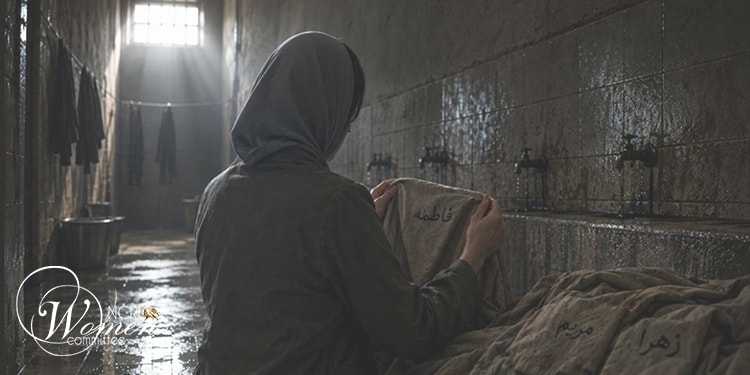
That day, when I entered the shower, I had absolutely no strength to bathe. But I saw a clothesline there with several pieces of clothing hanging from it. I went over and saw that the names of several of the girls were written on their collars. I read one of them: “Shouri.” I also saw a soap dish with the name of another girl written on it, and a washcloth nearby.
I was so happy to see these things that it was as if I had seen the girls themselves. I was so happy that I laughed to myself. Even though I had only five minutes left of my ten-minute allotment, I suddenly had so much energy that in those five minutes I managed to shower, wash my clothes, and get dressed. Then I stood there looking at those clothes.
When the guards came to take me away, they noticed that I was staring at the clothes. I deliberately kept looking at them to provoke them, as if to say, “Just look at how stupid and incompetent you are.”
The guard angrily yanked my chador and dragged me away, swearing as he said, “I don’t even know why they bring you damned woman to the shower in the first place!” And I was laughing to myself, thinking, “One-nil to me!”
In that ongoing battle, I had made a pact with myself: every day, I had to win at least one battle, one small victory. That feeling of victory, despite all the pain and suffering, was incredibly sweet.
To break us, the torturers would sometimes walk past us and deliberately mention the name of someone they knew we had been close to. They would say, “Look, so-and-so has given in and gone back to live her life, while this poor wretch is sitting here wasting away.”
Later, after we were brought out of the Gestapo cage, the girls in the ward told us that a man would walk around the ward every day, whispering with the collaborators. Loud enough for the girls to hear, he would mention the names of those being held in the cages and say things like, “Azam, Shouri,[1] Hengameh… or tomorrow I have an interview coming up…” In this way, they tried to destroy the morale of the girls in the ward.
They did this to everyone. On the other hand, the girls would find ways to let one another know they were still there. On their way to the bathroom, or when passing other cages, they would cough or sneeze, make some other excuse to produce a sound, or simply say “ow.” Of course, everyone knew that the price of doing this would be another beating. But the girls were willing to endure the beatings to maintain their connection with one another.
One night, they called my name and the names of five other women and took us outside. One of the women I remember was my PMOI sister and martyr, Sepideh Zargar, a nurse with twelve years of work experience. Because of the pressure she had endured over those months and the blows they had inflicted on her head, her eyesight had deteriorated severely, and she could no longer see anything without her glasses. Even those glasses were taken away from her most of the time.
Sepideh was later executed because she refused to submit to an interview.
They took us from Unit 1 to another unit, to a place beside a wall where there were several steel beams. They forced us to stand there in the corridor for several hours.
After several hours, I felt dizzy and no longer had the balance or strength to remain standing. When I told the guard who was there, he said, “You’re a hypocrite and you’re pretending!”
I knew I had fallen only from the sound of my own head hitting the ground. As I fell, I hit one of the other women, who also fell to the side. When we fell, the guards came over us, and I heard one say to another, “See if she’s still alive.”
And, somewhat alarmed, they said to each other, “These hypocrites will do anything to make it look as though we killed them!”
Conditions in the cage ward, or “Judgment Day” ward, were appalling, and we were deprived of even the most basic standards of hygiene. For example, we went twenty days without a shower in that ward. After that, when they finally sent us to shower, we were given only ten minutes to wash our clothes and bathe.
The torturers, who sought to humiliate and torment us with everything they did, gave us a plastic basin for washing our clothes. It was filled with filthy water that they had used to mop the floor. The female guard handed it to me and said, “Here, hypocrite! This is the filth from under your own feet. Empty it and use it!”
But I had absolutely no desire to wash my clothes in that basin, so I did not use it. In that extremely limited time, I had to wash my clothes by hand, take a shower, and get out. If we did not leave according to their schedule, they would open the shower door and say, “Are you coming out on your own, or do we have to drag you out?”
We had the same problem when we needed to use the toilet. They would take us to the bathroom only three times a day—morning, noon, and night—and only if they felt like it.
During the time in the cage, they would also take us to interrogation every so often as a means of creating fear and terror. They would remove us from the unit, march us around the facility, or take us to another unit. Sometimes they would put us in a vehicle and drive us around, creating the atmosphere of an execution, and say, “Make your final decision! Either you become a decent person, or you’ll be free forever!”
Another tactic was to take us to interrogation every day and make us stand there for several hours. They wanted to keep the prisoner in a constant state of fear and anxiety, as though the interrogation was always about to begin.
Another method of intimidation was to play audio recordings of other prisoners being tortured. They deliberately kept the prisoner in a constant state of anxiety and dread about interrogation. Their aim was to wear the person down through this pressure and eventually force them to give in and express remorse.
To be continued…
[1] Dr. Masoumeh Karimian, a PMOI member whom many prisoners knew as Shourangiz, or simply “Shouri.” According to numerous eyewitness accounts, this remarkable woman and physician was one of the legendary figures of resistance and perseverance in Khomeini’s prisons.
She was born in the Iraqi city of Karbala and apparently studied orthopedics in Germany. She worked for the Iranian Red Crescent and was imprisoned from 1981 until the massacre of PMOI prisoners in 1988.
She was ultimately executed at the age of 30 in the massacre of approximately 30,000 PMOI prisoners.