
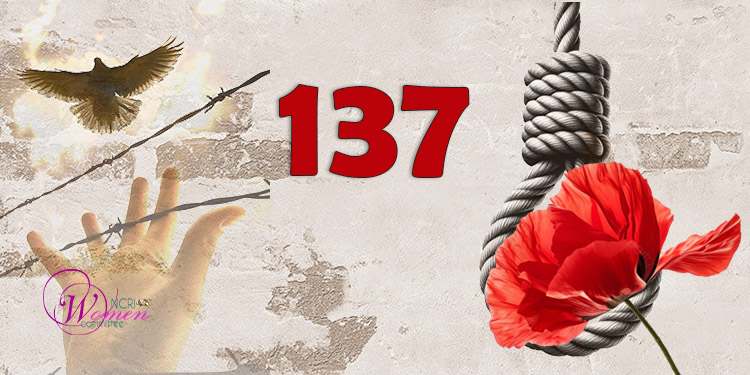
During the 137th week of the No to Executions Tuesdays Campaign, prisoners in 62 prisons across the country went on hunger strike on Tuesday, September 8, 2026, protesting the issuance and implementation of death sentences.
The protest movement continues as participating prisoners have faced security pressure, threats, restrictions on communication with the outside world, and punitive measures in recent weeks.
Over the past week, the authorities continued the killing of prisoners amid intensified repression and the implementation of death sentences, executing at least 11 people by hanging.
The Isfahan Revolutionary Court also sentenced Taraneh Rahimi to death, one of those arrested during the nationwide protests in January 2026.
Members of the No to Executions Tuesdays Campaign said in part of their statement that the intensification of repression and executions reflects the authorities’ fear of nationwide protests and uprisings to come.
Part of the statement issued during the 137th week of the No to Executions Tuesdays Campaign reads:
“The intensification of these acts of repression and executions, both individual and collective, reflects the authorities’ fear of nationwide protests and uprisings to come. The deepening economic crisis, three-digit inflation, the surge in the dollar exchange rate to 2.3 million rials, the official start of fuel price increases on Tuesday, and the continued shrinking of the daily livelihoods of workers and the toiling classes are, more than ever, painting a picture of the prospect of a social explosion.
Under these critical circumstances, the need to continue the ‘No to Execution’ Campaign, despite all the dangers and restrictions inside prison, has become more urgent than ever. We, the members of this campaign, once again call on all international institutions, awakened consciences, human rights defenders, and advocates for the abolition of the death penalty around the world to join us in solidarity and support.”
About the “No to Executions Tuesdays” Campaign
The No to Executions Tuesdays Campaign, now in its third year, has become the most widespread, enduring, and influential protest movements inside Iran’s prisons. Despite intensified security pressure, persistent threats, restrictions on communication, and punitive measures against participants, the protest movement has not been stopped.
A significant number of the striking inmates consists of female political prisoners serving their sentences in the women’s wards of Evin Prison, Qarchak Prison in Varamin, Sepidar Prison in Ahvaz, Adelabad Prison in Shiraz, Zahedan Prison, Yazd Prison, and Rasht Prison.