Friday, April 17, 2026
  • English
  • Français
  • فارسی
  • عربى
PODCASTS
NCRI Women Committee Women Resistance Freedom
  • Home
  • NEWS
    • Women’s News
    • Articles
    • Statements
  • PUBLICATIONS
    • Monthlies
    • Documents
    • Reference Library
  • ABOUT US
    • The NCRI Women’s Committee
    • Gender Equality
    • Women’s Platform
  • MARYAM RAJAVI
    • Maryam Rajavi
    • Maryam Rajavi Speeches
    • The Plan on Women’s Rights and Freedoms
    • Ten-Point Plan for the future of Iran
  • VANGUARDS
    • The Fallen for Freedom
    • Heroines in Chain
    • Women of Iranian Resistance
    • Famous Women
    • Women in History
  • EVENTS
    • IWD Conferences
    • Activities
    • IWD Speeches
    • Solidarity
  • VIDEO
    • Videos
    • IWD Videos
  • PODCAST
  • DONATE
  • CONTACT US
No Result
View All Result
NCRI Women Committee Women Resistance Freedom
  • Home
  • NEWS
    • Women’s News
    • Articles
    • Statements
  • PUBLICATIONS
    • Monthlies
    • Documents
    • Reference Library
  • ABOUT US
    • The NCRI Women’s Committee
    • Gender Equality
    • Women’s Platform
  • MARYAM RAJAVI
    • Maryam Rajavi
    • Maryam Rajavi Speeches
    • The Plan on Women’s Rights and Freedoms
    • Ten-Point Plan for the future of Iran
  • VANGUARDS
    • The Fallen for Freedom
    • Heroines in Chain
    • Women of Iranian Resistance
    • Famous Women
    • Women in History
  • EVENTS
    • IWD Conferences
    • Activities
    • IWD Speeches
    • Solidarity
  • VIDEO
    • Videos
    • IWD Videos
  • PODCAST
  • DONATE
  • CONTACT US
No Result
View All Result
NCRI Women Committee
No Result
View All Result
Home Heroines in Chain
In the Echo of Cries, I Chose Loyalty and Refused to Betray Prison memoirs of Azam Haj-Heydari from the book The Price of Being Human – Part Two

In the Echo of Cries, I Chose Loyalty and Refused to Betray

April 15, 2026
in Heroines in Chain

Prison memoirs of Azam Haj-Heydari from the book The Price of Being Human – Part Two

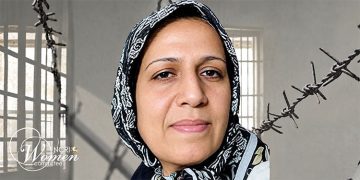
In the second installment of the prison memoirs of Azam Haj-Heydari, published in the book The Price of Being Human, the author continues recounting her arrest, the fabrication of charges against her, and the torture she endured in June 1981.

At that time, Azam was a 22–23-year-old teacher who had stepped onto the path of political struggle. She would eventually spend five years in prison, including time in the Temporary Judiciary Detention Center, Evin, Qezel Hesar, and Gohardasht prisons, where she was subjected to torture.

The Struggle Between Two Forces

Once again, on 14 June 1981,I was arrested along with one of my teammates, Sediqeh, while we were setting up book stands on the street. After brutally beating us, the Revolutionary Guards arrested us.

For three days they did not take us to any detention center. Instead, they kept driving us around the city in Revolutionary Guard patrol vehicles.

They threw Sediqeh, who was pregnant, and me between several men in the vehicle. During those three days they continuously beat us with batons, fists, and kicks while driving around the city.

Sediqeh eventually lost consciousness from the blows. Because she was pregnant, I tried to protect her, using my own body as a shield to reduce the force of the attacks against her. My face and head were completely bruised and swollen, and eventually I could barely move.

After 11 p.m., they would take us to one of the regime’s local revolutionary committee offices in northern Tehran known as the Vozara Committee and throw us into a cell until morning.

In one section of that committee building, several new cells had been constructed. The cell they put us in each night was completely empty, without any facilities, not even a mat. We lay on the bare concrete floor until morning.

When morning came, they would drag us back out, throw us onto the ground, and shove us under their feet inside the vehicle again. The insults and beatings continued while the car was moving, leaving us almost incapable of any movement.

Finally, on the third day at around 10 a.m., they threw Sediqeh and me out of the vehicle in an alley north of Mossadegh Street. We had no shoes, and our faces were swollen and wounded. They had also taken our money and handbags.

We had no choice but to start walking barefoot in the street.

Street vendors nearby saw us in that condition, and, out of sympathy, each gave us a pair of slippers. We put them on and continued walking.

We went to the home of a friend of mine, which was about five or six bus stops away. She warmly welcomed us. When she heard what had happened, she brought us food. We had eaten nothing for three days, and we devoured the meal quickly.

She then took us to a doctor who was a family friend. He dressed our wounds.

However, because our faces were injured and bandaged, for several days afterward whenever we walked in the street the Revolutionary Guards would stop us and interrogate us suspiciously.

On 18 June 1981, while crossing the street, I aroused the suspicion of Khomeini’s agents and was arrested again. This time I was detained for two days at a committee office in Tehran located under the Seyyed Khandan Bridge.

They threw me into a very small room and began beating me with rifle butts and batons.

They used a box cutter that was in my bag as an excuse, claiming that I had put it there to kill a Revolutionary Guard.

Within two hours they fabricated a complete case against me. It consisted of several copies of Mojahed newspaper, a few books and publications of the PMOI, and even a large bloody kitchen knife that they added to the file as supposed evidence.

Based on this fabricated case, they interrogated me and demanded:
“How many Revolutionary Guards have you killed with this knife?”

During those two days my eyes were constantly blindfolded. Several times at night they took me to Evin Prison and told me, “Now we will send you to hell. Killing Monafeqin (a derogatory term meaning “hypocrite” the regime uses for the Mojahedin) is our job, and with this case file you are a proper Monafeq.”

The Pain Passes, the Shame Remains

They would take me blindfolded to various places, basements and other unknown locations, hang me from heights, and beat me.

At the same time, they played terrifying sounds, screams, cries, and the moans of people being tortured, to shake my nerves and force me to accept their fabricated case.

It was the first time I had ever encountered such scenes.

Before that, I had only read similar stories in the biographies of other members who were killed. I remembered that when I read those stories, those PMOI members seemed almost unreachable to me. Being like them was the highest aspiration I could imagine.

I dreamed that one day I might also resist torture for the freedom of my people and never betray them or their cause.

But when they first took me to a place where I never even understood where it was, and I kept hearing the screams, cries, and wails of people being tortured, and when they hung me up and beat me, I trembled deeply. Fear filled my entire being.

What frightened me most was the question: Would I be able to endure those terrifying tortures? Even hearing the screams of the victims was unbearable.

I prayed to God. I spoke to Him in desperation and begged Him to help me not lose my strength under torture and not lose the faith I had gained through so much hardship.

At night when I fell asleep, I would have nightmares that I had failed under torture. I would wake up suddenly, sit for a while, and ask myself: If they come right now and take me for interrogation, am I ready to endure it and not surrender?

At first, I felt helpless in front of the torturers.

But then I would think: if Fatemeh Amini, Mehdi Rezaei, Badizadegan, and so many others had endured such torture, then it must be possible. Why shouldn’t I be able to do it as well?

And then I would feel strength return to me.

Once they took me to a cell where someone had written on the wall: “The pain of torture passes, but the shame of betrayal remains.”

Reading those words made me tremble. I said to myself: My God, do not place me among the accursed.

Whenever I prayed and reached the Quran verse “Do not place us among those who have incurred Your wrath,” I would think of those who had eventually betrayed their comrades.

But after I was whipped for the first time, much of my fear disappeared.

What became clear to me was that the decisive factor in the face of the executioners’ torture is the human will—whether a person decides to endure, even at the cost of their own life, or to surrender.

And I had made my decision: I would endure. I would not surrender.

To be continued…
ShareTweetPinShareSendShare

Related Posts

Ghazal Aghaei Lindi

April 16, 2026
Ghazal Aghaei Lindi was killed on January 9, 2026

Ghazal Aghaei Lindi was killed on January 9, 2026, during nationwide protests, after being struck by live ammunition fired by the regime’s repressive forces in front of the...

Read moreDetails

Young Female Kurdish Fighter Killed in Drone Attack by Revolutionary Guards

April 15, 2026
Ghazal Mowlan, Komala Peshmerga, killed in IRGC drone attack

Ghazal Mowlan, a member of the Peshmerga forces of the Komala Party of Iranian Kurdistan, has died on April 15, 2026 from severe injuries sustained during a drone...

Read moreDetails

January 2026 Uprising: Four Detained Protesters Are Sentenced to Death

April 14, 2026
January 2026 Uprising: Four Detained Protesters Are Sentenced to Death

The clerical regime's Judiciary has sentenced another four detained protesters from the January 2026 uprising to death and ordered their properties confiscated. Bita Hemmati, and her 34-year-old husband,...

Read moreDetails

Week 116 of “No to Executions Tuesdays” Amid Internet Shutdown

April 14, 2026
Week 116 of “No to Executions Tuesdays” Amid Internet Shutdown

The “No to Executions Tuesdays” campaign has entered its 116th consecutive week, marked by the ongoing weekly hunger strikes of prisoners across 56 prisons in Iran. The campaign...

Read moreDetails

Farzaneh Tavakkoli

April 13, 2026
Farzaneh Tavakkoli, a resident of Arak, was killed on January 9, 2026

Farzaneh Tavakkoli, a resident of Arak, was killed on January 9, 2026, after being directly shot by the regime’s criminal security forces during popular protests in the city....

Read moreDetails
Next Post
Ghazal Mowlan, Komala Peshmerga, killed in IRGC drone attack

Young Female Kurdish Fighter Killed in Drone Attack by Revolutionary Guards

Documents

A Report to CSW70: Gender-Based Discrimination Under Iranian Law

A Report to CSW70: Gender-Based Discrimination Under Iranian Law

March 8, 2026

Structural Inequality and State-Sanctioned Oppression of Women Gender-Based Discrimination Under Iranian Law” is the title of the NCRI Women’s Committee’s...

Annual Report 2026: From Protests, to Uprising, and the Role of Iranian Women

Annual Report 2026: From Protests, to Uprising, and the Role of Iranian Women

March 3, 2026

On the eve of International Women’s Day 2026, the NCRI Women’s Committee presents its Annual Report 2026, offering a recap...

Iranian women Who Lost Their Lives in Iran’s January 2026 Uprising

Iranian Women Who Lost Their Lives in Iran’s January 2026 Uprising

January 25, 2026

Names That Must Not Be Forgotten Iranian women played a central and courageous role in the January 2026 uprising, standing...

Monthlies

March 2026 Report: How Iranian Women Are Shaping the Resistance
Monthlies

March 2026 Report: Courage Under Fire

April 3, 2026
January 2026 Report: Women at the Core of the Uprising
Monthlies

January 2026 Report: Women at the Core of the Uprising

January 31, 2026
December 2025 Report: A Year in Review: Iranian Women’s Resistance Against Religious Dictatorship
Monthlies

December 2025 Report: A Year in Review: Iranian Women’s Resistance Against Religious Dictatorship

January 5, 2026
November 2025 Report: Under the Clerical Regime, Nowhere Is Safe for Women in Iran
Monthlies

November 2025 Report: Under the Clerical Regime, Nowhere Is Safe for Women in Iran

November 30, 2025

Articles

Mothers Who Gave Their Lives for Freedom during January 2026 Uprising in Iran

Mothers Who Gave Their Lives for Freedom during January 2026 Uprising in Iran

April 6, 2026

Among those killed during the January 2026 uprising in Iran there are mothers whose names stand out—women who took to...

Amid the harshest trials and tribulations, your inspiring voice made my steps more steadfast

Amid the harshest trials and tribulations, your inspiring voice made my steps more steadfast

April 5, 2026

A letter from Vahid Bani Amerian to Aziz, the mother of the martyred Rezaeis Ms. Zahra Norouzi, who is known...

Ferdows Mahboubi (Mother Mosanna): 50 Years of Dedication to PMOI

Ferdows Mahboubi (Mother Mosanna): 50 Years of Dedication to PMOI

April 2, 2026

Ferdows Mahboubi (Mother Mosanna), one of the steadfast supporters of the People's Mojahedin Organization of Iran (PMOI), passed away in...

The Fallen for Freedom

Ghazal Aghaei Lindi was killed on January 9, 2026
The Fallen for Freedom

Ghazal Aghaei Lindi

April 16, 2026
Farzaneh Tavakkoli, a resident of Arak, was killed on January 9, 2026
The Fallen for Freedom

Farzaneh Tavakkoli

April 13, 2026
Shabnam Ferdowsi was killed on January 8, 2026, during the nationwide protests
The Fallen for Freedom

Shabnam Ferdowsi

April 12, 2026
Samaneh Mirzaei, a resident of Tehran, was killed on January 9, 2026
The Fallen for Freedom

Samaneh Mirzaei

April 10, 2026

ABOUT US

NCRI Women Committee

We work extensively with Iranian women outside the country and maintain a permanent contact with women inside Iran. The Women’s Committee is actively involved with many women’s rights organizations and NGO’s and the Iranian diaspora.
The committee is a major source of much of the information received from inside Iran with regards to women. Attending UN Human Rights Council meetings and other international or regional conferences on women’s issues and engaging in a relentless battle against the Iranian regime’s misogyny are part of the activities of members and associates of the committee.

CATEGORIES

  • Activities
  • Articles
  • Documents
  • Famous Women
  • Heroines in Chain
  • IWD Conferences
  • IWD Speeches
  • IWD Videos
  • Maryam Rajavi
  • Maryam Rajavi Speeches
  • Monthlies
  • Podcast
  • Reference Library
  • Solidarity
  • Statements
  • The Fallen for Freedom
  • Videos
  • Women in History
  • Women in Leadership
  • Women of Iranian Resistance
  • Women's News

BROWSE BY TAG

Child marriage coronavirus education execution forced hijab Gender Gap Generation Equality Honor killings Iran Teachers Maryam Akbari Monfared Nurses Plan on Women's Rights and Freedoms Poverty Prisoners Protests rural women Saba Kord Afshari The girl child Violence against women Women's Leadership Women Heads of Household Zeinab Jalalian

The copyright of all the material published on this website has been registered under © 2016 the Women’s Committee of the National Council of Resistance of Iran. To obtain permission to copy, redistribute or publish the material published on this website, you should write to the NCRI Women’s Committee. Please include the link of the original article on our website, women.ncr-iran.org.

Welcome Back!

Login to your account below

Forgotten Password?

Retrieve your password

Please enter your username or email address to reset your password.

Log In

Add New Playlist

No Result
View All Result
  • Home
  • News
    • Women’s News
    • Articles
    • Statements
  • Publications
    • Monthlies
    • Documents
    • Reference Library
  • About Us
    • The NCRI Women’s Committee
    • Gender Equality
    • Women’s Platform
  • Maryam Rajavi
    • Maryam Rajavi
    • Maryam Rajavi Speeches
    • Ten Point Plan for Iran
    • The Plan on Women’s Rights and Freedoms
  • Vanguards
    • The Fallen for Freedom
    • Heroines in Chain
    • Women of Iranian Resistance
    • Famous Women
    • Women in History
  • Events
    • IWD Conferences
    • Activities
    • IWD Speeches
    • Solidarity
  • Video
    • Videos
    • IWD Videos
  • Podcast
  • Donate
  • Contact us
  • فارسی
  • عربی
  • Français

The copyright of all the material published on this website has been registered under © 2016 the Women’s Committee of the National Council of Resistance of Iran. To obtain permission to copy, redistribute or publish the material published on this website, you should write to the NCRI Women’s Committee. Please include the link of the original article on our website, women.ncr-iran.org.