


Ada Lovelace is celebrated today as the world’s first computer programmer, a woman whose imagination outpaced her century. In an era when mathematics was considered a male domain, she envisioned machines that could do far more than crunch numbers—machines capable of creating, composing, and transforming human knowledge. Her story is one of brilliance, rebellion, and intellectual foresight unmatched in the Victorian age.
Early Life: Genius Born into Contradiction
Born in 1815 as Augusta Ada Byron, she was the daughter of the famed poet Lord Byron and the mathematically gifted Lady Anne Isabella Milbanke. Her parents separated soon after her birth, and Ada grew up under the strict guidance of her mother, who feared Ada might inherit her father’s unpredictable temperament. She insisted on rigorous training in mathematics, logic, and science, hoping to “correct” any poetic impulses.
Ironically, this combination of logic and imagination would become the foundation of Ada’s innovative genius.
A Mind Drawn to Machines
As a teenager, Ada Lovelace became fascinated with engineering. She sketched designs for a flying machine and immersed herself in cutting-edge scientific ideas. Her life changed dramatically in 1833 when she met Charles Babbage, the mathematician and inventor now regarded as the “father of the computer.”
Babbage was captivated by Ada’s intellect, famously calling her “the Enchantress of Numbers.” Their partnership would soon produce one of the most prophetic scientific documents of the 19th century.
The Analytical Engine and the Birth of a Programmer
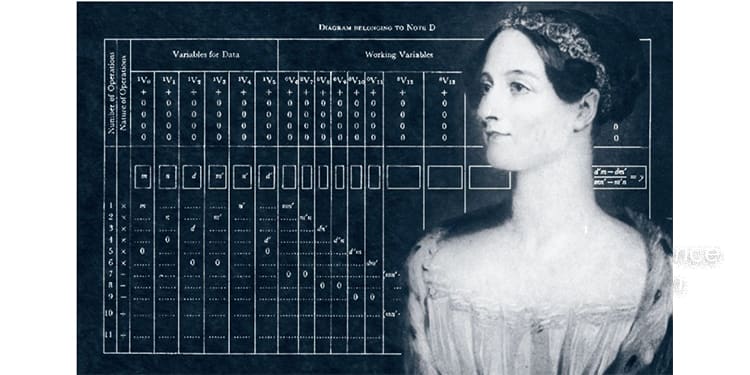
In 1842, Ada Lovelace translated an article on Babbage’s proposed invention, the Analytical Engine—a mechanical device capable of general computation. But she went far beyond translation. Her extended notes, labeled A through G, were longer than the original article and revealed a deeper understanding of the machine’s potential than even Babbage himself had articulated.
In Note G, she outlined a sequence of operations that the Engine could execute to compute Bernoulli numbers, widely recognized as the first algorithm specifically designed for a machine. This groundbreaking insight earned her the title of the world’s first computer programmer.
More astonishing was Ada’s vision that future machines could manipulate symbols, compose music, generate art, and assist human creativity, a prediction that foreshadowed modern computing and even artificial intelligence.
A Legacy Discovered Ahead of Its Time
Ada Lovelace died young, at just 36, but her intellectual legacy survived. Her work was rediscovered in the 20th century, inspiring early pioneers during the emergence of electronic computing. Today she is honored as:
- A foundational figure in computer science
- A trailblazer for women in STEM
- A visionary who saw the true potential of computers a century before they existed
Her name now graces programming languages, university halls, tech awards, and the annual Ada Lovelace Day, which celebrates women in technology.
Why Ada Lovelace Still Matters
In a world driven by algorithms and digital creation, Ada Lovelace remains a timeless symbol of human imagination fused with scientific rigor. She reminds us that innovation is not just about machinery, it’s about vision, curiosity, and the courage to imagine what others cannot yet see.