

From the memoirs of Hengameh Haj Hassan – Part 18
⚠️ Content warning: This section of the Face to Face with the Beast contains descriptions of torture, psychological abuse, and the mental toll of long-term imprisonment.
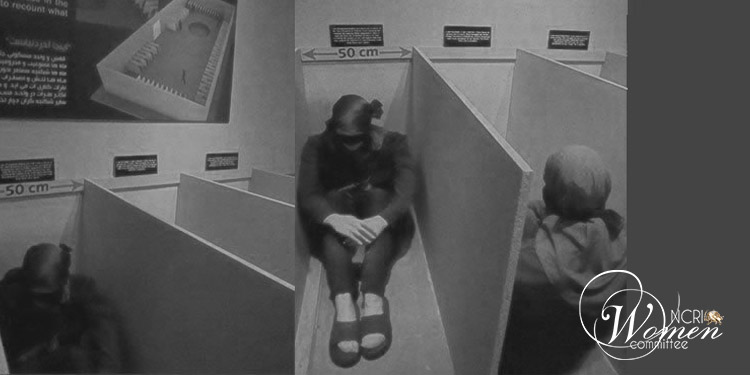
In Part 17 of Face to Face with the Beast, Hengameh Haj Hassan described the crushing psychological torment of the cage in Ghezelhesar Prison: endless enforced silence, blindfolds that cut prisoners off from the outside world, sleep deprivation, and sudden outbursts of violence by guards and collaborators. She struggled with despair, even considering suicide, but clung to her resolve not to break under the regime’s demands.
In this installment, she continues her account of the suffocating days and nights inside the cage and recalls how the regime’s notorious “repentance-making” (tawab-sazi) program finally collapsed.
Days and Nights in the Cage
The conditions were unbearable. Sometimes I felt I couldn’t take it anymore—I was losing my patience! Oh, this damned blindfold! I felt as if my eyelashes were stabbing into my eyes; I wished I had no eyes so I wouldn’t feel them. God, help me! What is this weakness?
Sitting had become agony. I had been forced to sit for months, and my whole body ached. No matter how I shifted, it was as if needles were stabbing into me from the ground. I tried putting my hands underneath me, but they quickly became numb and tingled.
As I was lost in these thoughts and complaints, I suddenly sensed someone above me.
“Hengameh, hello!”
I recognized the childish, whiny voice—it was Sho’leh, a traitor who had once been in my ward at Evin Prison and was now one of Haj Davood’s informers. She was doing her dirty work among the cages and coffins here.
“Oh! You’re still sitting?” she said.
Forgetting my earlier complaints, I smiled and replied, “Yes! Do you have a problem with that?”
Flustered, she muttered, “She’s still laughing? You really have some nerve,” and walked away.
So, they were waiting for us to collapse, for us to no longer endure sitting. These vultures were watching like scavengers circling a corpse. But God helped me again, placing the enemy right before my eyes. This is the rule of struggle—you can never forget or underestimate the enemy, or else you will be devoured.
I adjusted my blindfold so that, from above, it looked fully in place, but in reality, my eyelids were free beneath it. That small trick was enough to give me some relief. As for sitting, I found a solution: the knitted sweater my dear aunt—our “Makhala” (a nickname combining “Mah” from her name Mahi and “khaleh,” meaning aunt)—had sent me. It was soft and thick. I used it as a cushion during the day and a pillow at night. How thoughtful she had been, knitting exactly what I would need most in this place.
Then I heard the crunch of dry bread being chewed. I listened carefully—it came from my left side. It had to be Zohreh! During prayer time I had glimpsed the corner of her chador; yes, it was her. So Zohreh had also been thrown into the cage. Haj Davood would never leave her alone. That sound of sobbing and of a body hitting the wall—it must have been her.
It was Ramadan. I don’t know how much time had passed by then, but I was waiting for Haj Davood’s scheme to collapse so he’d be forced to abandon this so-called repentance-making device and invent new cruelties.
One evening at Iftar, one of the girls suddenly screamed and began rambling nonsense—crying and laughing at the same time. She had lost her mental balance. I didn’t know who she was or what happened afterward, but they took her away. It was yet another case of someone’s mind unraveling. I reminded myself: Be careful, Hengameh. This is exactly what Haj Davood wants—to break our minds through blindfolds, relentless pressure, and endless fears.
Spring passed, then summer arrived. I have now been here nearly seven months. For several days, Haj Davood hadn’t appeared. The whispering among the collaborators had grown louder, but they seemed listless, no longer tormenting the girls with the same zeal. They looked bored, as if their hearts weren’t in it anymore. Doors opened and shut more often than usual, and I heard footsteps and breathing—people were coming and going.
One morning they called me out. To my surprise, they said I had a visitor. After seven months, my poor parents had finally been allowed to come. In the visitation room, we were separated by glass, with a guard at their side and another by mine. The moment my father saw me, he broke down in tears. My mother, strong as always, held herself together.
“Don’t cry,” I told them. “I’m fine. My only worry is your suffering.”
My father could barely speak through his tears. I realized they had spent seven months running from office to office, appealing to every branch of the regime, until finally they secured this visit. Many other parents were still left in total darkness about their children.
When both guards were distracted, I flashed the victory sign to my father. His eyes lit up, and he smiled through his tears. “Don’t worry about me,” I said. “I’m no longer a child. Only your sadness troubles me.” I wanted them to understand that this ordeal was far from over. As I returned to the cage, I felt certain something had changed—otherwise, why allow the visit now?
The Collapse of the “Repentance-Making” Machine
Not long after, I heard someone breathing above me and then a man’s unfamiliar voice: “Salaam.”
“Who are you?” I asked.
“Why don’t you answer a salaam?”
“Who are you?”
“Just a servant of God.”
I realized he must be a cleric or a guard—some new official. But I wanted to find out more. At the same time, I no longer cared to measure my words.
He said, “We’ve come to review your situation.”
“I didn’t request anything,” I replied.
He pressed on: “Sister, don’t attribute these matters to Islam.”
I answered, “Don’t worry—we haven’t. Otherwise, we wouldn’t be here.” I don’t think he understood what I meant.
He continued: “I’ve come because complaints have reached Mr. Montazeri’s office.[1] Now tell me—what are you doing here? What’s your condition?”
His ridiculous question made me laugh.
“Sir,” I said, “my eyes are blindfolded. Yours are open. You can see everything for yourself. Why are you asking me? Please, leave. I have nothing to say. Goodbye.” I lowered my head. He muttered a “Goodbye, sister,” and left.
That was all I needed to know. Soon after, they began clearing out the cages. One day, they gathered us all into a room in Unit 3. They called it “quarantine”—or maybe we gave it that name, I can’t recall. Clearly, Haj Davood had used his cages there too, though the boards had been removed. Only the makeshift prayer corner, made from army blankets, remained—a silent trace of his failed machine.
To be continued…
[1] Hossein-Ali Montazeri: At the time, the designated successor to Khomeini and a senior cleric. He occasionally intervened when reports of extreme abuses reached him, though his influence was limited and eventually he was ousted.