

Maryam Rajavi’s speech at Call-for-Justice Conference at Ashraf 3 – July 15, 2019
Mr. Sid-Ahmad Ghozali, Mr. Juan Garce, Mr. Tahar Boumedra, Mr. Peter Murphy, Father Brian, the defense lawyers of Ashrafis, and everyone who is seeking justice for the victims of the 1988 massacre, I salute you all.
And I greet you sisters and brothers, especially the more than 900 former political prisoners tortured under the dictatorships of the shah and Khomeini, many of whom are present here today.
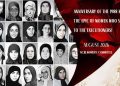
We are approaching the 31st anniversary of the martyrdom of 30,000 political prisoners massacred on Khomeini’s fatwa for the crime of adhering and remaining loyal to their pledges under the name of a “Mojahed” and their ideal, which is, freedom of the people of Iran.
Thousands of salutes to those young souls, those lovers of freedom and beauty, those clear mirrors of Iranian people’s aspirations.
(Translation of a piece of Persian Poetry)
Although those friends do not remember me
I do remember them a thousand times
Although a hundred rivers of tears flow from my eyes
I hold dear their living memories which impregnated numerous gardens

The victims of the 1988 massacre are the valiant conscience of Iran’s history. They are the gem of honesty, sacrifice and loyalty kept dear in the heart of our nation whose true existence is indebted to it.
In the heat of this carnage, in one of the wards of the Prison of Ahvaz, two blood-thirsty mullahs by the names of Jazayeri and Abdollahi bellowed, “You must make up your mind. Khomeini is on one side and Massoud Rajavi is on the other. Which side are you on?”
From the end of the hall, a young woman cried out, “Long live Massoud, down with Khomeini.” She was Sakineh Delfi, 26, a heroine from among the children of Abadan.
Upon hearing her cry, revolutionary guards poured all over her and badly brutalized her. The next morning, 349 of the 350 inmates in this ward were hanged.
This is how the gem of honesty and sacrifice came into being, was enriched and turned into a moral treasure for Iran’s nation, for her freedom and her future.
So, we will repeat the poem written by Mahmoud Hassani, from Shahrood. As he was passing through the Death Tunnel of Evin Prison along with 60 of his Mojahed brothers, he whispered,
When in the dark of night, you see a bright meteor in the sky,
Do not forget the blazing flames who were extinguished in the cold nights of Evin,
So that a star would rise at dawn.
A blood-drenched encounter between the Middle Ages and tomorrow’s generation
The massacre of the PMOI and other combatant political prisoners was a blood-drenched encounter between the Middle Ages and tomorrow’s generation, the generation that created the 1979 revolution, who represented a nation resolved to have a society based on freedom and equality, but ran into the monster of religious tyranny and the invasion of pillage and repression.
The massacre in 1988 was the horrifying scene of such historic confrontation. But it was not the end. Despite its excruciating pain and agony, it was the beginning of a new confrontation which still continues and will ultimately write the fate of the Iranian nation with the word, freedom.
From this vantage point, one can see that the 1988 massacre is tied to Iran’s freedom and future. It is entwined with the stoned rights of human beings in Iran, with the resistance for freedom and equality, with the betrayal of foreign proponents of appeasement, with the disgraceful cowardice of those who surrendered to the regime, and of course it is tied to the regime’s overthrow. Because when the Iranian people’s Call-for-Justice movement compels these criminals to go public with the dossier of this atrocious crime, that is the day when the rule of Velayat-e Faqih will end.
Time and again, we have heard in the witness testimonies that the imprisoned heroes hailed Massoud when they faced their torturers and executioners. They whispered together the sentences they had memorized from his speeches, and during their visitations, they used their own sign language to get any news from him.
In repeating this most crimson name of our time, they had and continue to have a message. Their message to their succeeding generations and the youth who hear their unfinished stories, is this: Follow the path and the ideal of Massoud Rajavi, a path that leads to a society devoid of all abuse and oppression, devoid of repression and tyranny, devoid of ignorance and deception. The path and ideal that is summarized in the sacred word, freedom.
Khomeini’s intention in ordering the 1988 massacre was to uproot the Mojahedin
You know that as Khomeini wrote in his edict, his intention in ordering the 1988 massacre was to uproot and obliterate the Mojahedin. To this end, he deployed his killing machine in several arenas:
The most intense killings of the 1988 massacre began in Evin and Gohardasht prisons and were specifically aimed at PMOI members. Khomeini’s heir at the time, Hossein Ali Montazeri, described the killings in these two prisons as “slaughter… which has not taken place anywhere else in the world.”
On August 25, 1988, the President of the National Council of Resistance of Iran, Massoud Rajavi sent a telegram to UN Secretary General Javeir Pres de Cuellar, in which he disclosed, “On August 14, 15, 16, alone, 860 corpses belonging to the executed political prisoners were transferred from Evin Prison in Tehran to the Behesht-e Zahra Cemetery.”
Another important part of the massacre was the widespread killings which took place in prisons located in provincial capitals and other cities based on a second edict from Khomeini. In that edict, Khomeini said the regime’s judges must not lose any time by sending the prisoners’ files to provincial capitals. And that they must have the PMOI members executed in whatever prison they were.
The latest list of victims compiled by the PMOI/MEK indicates that the 1988 massacre took place in at least 110 cities.
In the exhibition which depicts the Iranian people’s historical fight with the mullahs’ religious tyranny, there is a remarkable scene. The maps of Iran’s provinces, one by one, show that all of them without any exceptions, were scenes of countless executions whether in the 1988 massacre or during the unremitting executions which took place in the 1980s and afterwards.
That is, the people of Iran with any ethnic nationality, any religion, from any city and province, have paid the heaviest price and are united for the regime’s overthrow and achieving freedom.
It is not an accident that these cities and provinces are hotbeds of constant uprisings and protests, and the cities rise up one after the other in protest.
Our society has such a fervid fire in her heart, leaving Khamenei at an impasse. So, the regime’s overthrow is the definite and certain fate for the mullahs.
Arrest and execution of former prisoners or supporters of the PMOI/MEK
Another important incident taking place outside the prisons but parallel to the massacres inside, was the widespread arrests of former prisoners or supporters of the PMOI/MEK, and their subsequent executions.
In the same month when the massacre started, the NCRI President wrote in a telegram to the UN Secretary General, disclosing that simultaneous with the mass executions of political prisoners, an extensive wave of political arrests had been launched in various Iranian cities which included the arrests of over 10,000 persons.
Subsequently, Prof. Kazem Rajavi, the great martyr to the cause of Human Rights in Iran –who was the NCRI’s representative at the formal session of the UN Commission investigating political disappearances at the United Nations Palace in Geneva—said in his speech, “In the midst of accepting the UN Security Council resolution (for the ceasefire in the Iran-Iraq war), the Khomeini regime has directed its wrath towards supporters of the Iranian Resistance inside Iran. Such that since the day of the announcement of the ceasefire, hundreds of persons from various cities have been abducted every day, and secretly sent before the firing squads or incarcerated in prisons.”
And yet, another part of this massacre, were the emergency trials of supporters of the Mojahedin in western Iran.
On July 24, 1988, Khomeini issued a secret edict to hold emergency trials under the pretext of “investigating war crimes.” He appointed mullah Ali Razini as head of this court. The complete text of this secret edict was divulged three months later by the Iranian Resistance.
In the following days, however, the court rapidly changed its course and took aim at supporters of the Mojahedin in western Iran. The victims were residents of western regions of Iran who had supported the Mojahedin. Also young men and women from other provinces who had gone to the western regions to aid the Mojahedin.
On August 17, 1988, the NCRI President sent another telegram to the UN and leaders of the five permanent members of the Security Council warning against widespread executions of individuals who had not been involved in the battles of the National Liberation Army, and were being executed merely for supporting the PMOI/MEK.

Silence and giving impunity to the ruling murderers by the West for the policy of appeasement
In recounting these incidents, I would like to recall that the Iranian Resistance actively engaged in the exposure of the 1988 massacre on the international level since the very first weeks, urging reaction by the world and especially western governments. However, they maintained silence vis-à-vis these calls because they had just initiated their policy of appeasement.
In fact, one of the most harmful consequences of the policy of appeasement was giving impunity to the ruling murderers, whose crimes started in the early 1980s, climaxed during the 1988 massacre and continues to this date.
Giving impunity to the clerical regime’s leaders gave them the opportunity to deny this crime according to an organized plan, just as they carried out the massacre of prisoners and the arrestees according to a well-planned scheme.
You know that since 1988, the Iranian regime has taken numerous measures to eliminate the traces of the mass graves belonging to the victims of the 1988 massacre, all across Iran. They have built new buildings and roads on these grave yards, or have bulldozed them and turned them into new cemeteries. They have arrested and tortured the families who sought to find the graves of their loved ones.
A considerable amount of information, even pictures and images of such destructions have been published. The international community, however, has not reacted, instead choosing to maintain its silence.
The regime ruling Iran has evaded publishing the information and details of the massacre of political prisoners, but has remained immune from international accountability.
They have refused to provide families, the addresses of the graves of those executed. They have destroyed the mass graves, but have remained immune from any form of accountability.
The highest officials in charge of this crime and members of the Death Committees are among the senior officials presently running this regime, including the regime’s Chief Justice and head of the Judiciary, the Head of the Supreme Court and the so-called Justice Minister. All of them, however, are immune.
A number of them, including the mullahs’ supreme leader Ali Khamenei, defend the 1988 massacre. They even say that they are proud of it. And still, they enjoy impunity.
As Amnesty International pointed out in its report last December on the 1988 massacre that Iran faced an immunity crisis, and that the continuity of crimes in Iran are directly related to the impunity the Iranian regime officials enjoy.
Granting immunity to the regime’s leaders and turning a blind eye on their crimes are the very reasons they have become emboldened in exporting terrorism and in warmongering.
Time to end three decades of impunity of regime’s leaders
The time has come for the international community to end three decades of impunity for the clerical regime leaders in Iran and hold them accountable for their crimes.
The time has come for referring the dossier of human rights violations in Iran, particularly the executions of the 1980s and the 1988 massacre, to the UN Security Council.
The time has come for Khamenei and his accomplice to face justice for their crimes against humanity.
The time has come for the United Nations to launch an international fact-finding mission for the 1988 massacre in Iran.
And the time has come for the world to recognize the right of the people of Iran to resistance and struggle to overthrow the mullahs’ religious fascism.
I urge the international community, the UN Security Council, the UN Human Rights Council and its member states, as well as other relevant United Nation agencies, the European Union, all advocates of human rights and justice to rise up and end the immunity of those responsible for the 1988 massacre.
How could the world tolerate sitting in the United Nations side by side with those directly involved in the massacre of tens of thousands of prisoners? How could they negotiate and do commerce with them? This is a travesty of human rights. This is providing room for extremism and fundamentalism. This is trampling justice and democracy, not only in Iran but throughout the Middle East and all around the world. The massacre of political prisoners in Iran has been the worst massacre of prisoners since the Second World War.
Call-for-Justice movement for the victims of the 1988 massacre, movement of the oppressed, and of those suppressed
I call on all Iranians in Iran and abroad to help advance and expand the Call-for-Justice movement for the victims of the 1988 massacre, to any extent and in any form. This is the movement of the oppressed. This is the movement of those suppressed. This is the movement of the bereaved.
Anyone who has tasted any number of days in prison and captivity, anyone who has been flogged, and any woman who has been outraged or humiliated, is a member of this movement. And anyone whose conscience is wounded by so many crimes, is a member of this movement.
One day, we raised the banner of peace vis-à-vis Khomeini’s warmongering and belligerence, and insisted so long that we managed to pour the poison chalice of ceasefire in the Iran-Iraq war down Khomeini’s throat thanks to the operations of the National Liberation Army.
Another day, we rose up against the mullahs’ ominous bomb-making program. And we persevered so long that we poured the poison chalice of the nuclear deal down Khamenei’s throat.
Now, we have vowed to stand firm on this call for justice. We will persevere until we pour the poison chalice of human rights and the poison chalice of the 1988 massacre down the throat of this regime. Yes, 1,000 chalices of poison serving the cause of 1,000 Ashrafs to bring down the mullahs and establish freedom.
The Call-for-Justice movement carries on. We will continue until all the details of this horrible crime are revealed, until the graves of all our sisters and brothers are found, until the regime of massacre is overthrown by the people of Iran, their resistance units and their great Army of Freedom.
We salute the martyrs
And we hail freedom