
Wednesday, August 26, 2026
  • English
  • Français
  • فارسی
  • عربى
PODCASTS
NCRI Women Committee Women Resistance Freedom
  • Home
  • NEWS
    • Women’s News
    • Articles
    • Statements
  • PUBLICATIONS
    • Monthlies
    • Documents
    • Reference Library
  • ABOUT US
    • The NCRI Women’s Committee
    • Gender Equality
    • Women’s Platform
  • MARYAM RAJAVI
    • Maryam Rajavi
    • Maryam Rajavi Speeches
    • The Plan on Women’s Rights and Freedoms
    • Ten-Point Plan for the future of Iran
  • VANGUARDS
    • The Fallen for Freedom
    • Heroines in Chain
    • Women of Iranian Resistance
    • Famous Women
    • Women in History
  • EVENTS
    • IWD Conferences
    • Activities
    • IWD Speeches
    • Solidarity
  • VIDEO
    • Videos
    • IWD Videos
  • PODCAST
  • DONATE
  • CONTACT US
No Result
View All Result
NCRI Women Committee Women Resistance Freedom
  • Home
  • NEWS
    • Women’s News
    • Articles
    • Statements
  • PUBLICATIONS
    • Monthlies
    • Documents
    • Reference Library
  • ABOUT US
    • The NCRI Women’s Committee
    • Gender Equality
    • Women’s Platform
  • MARYAM RAJAVI
    • Maryam Rajavi
    • Maryam Rajavi Speeches
    • The Plan on Women’s Rights and Freedoms
    • Ten-Point Plan for the future of Iran
  • VANGUARDS
    • The Fallen for Freedom
    • Heroines in Chain
    • Women of Iranian Resistance
    • Famous Women
    • Women in History
  • EVENTS
    • IWD Conferences
    • Activities
    • IWD Speeches
    • Solidarity
  • VIDEO
    • Videos
    • IWD Videos
  • PODCAST
  • DONATE
  • CONTACT US
No Result
View All Result
NCRI Women Committee
No Result
View All Result
Home Reference Library
Iran: The End of the Anti-Violence Against Women Bill

Iran: The End of the Anti-Violence Against Women Bill

August 26, 2026
in Reference Library

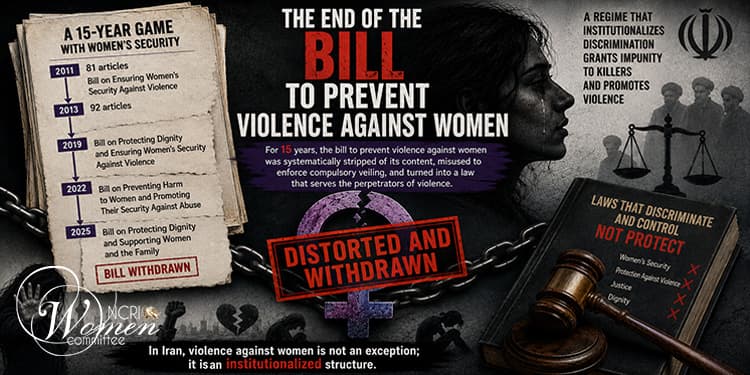
Over 15 years, Iran’s proposed Anti-Violence Against Women bill was systematically gutted, hijacked by hijab-enforcement clauses, and transformed into a legal framework that empowered abusers.

The clerical regime has not only institutionalized numerous barriers within its laws that prevent women from accessing justice, but by refusing to enact protective legislation, it has in practice fueled the ongoing cycle of violence against women.

It must be emphasized from the outset that in Iran under this dictatorship, and given the existence of overarching discriminatory laws, even if a bill or supplementary legislation aimed at safeguarding women were somehow to gain approval, it would not be implemented in practice. Nevertheless, examining the process and fate of the bill to prevent violence against women, and the mullahs’ 15-year political game with it remains highly significant.

Playing Games with Women’s Safety

The only piece of legislation under the clerical regime meant to benefit women was a bill aimed at preventing violence against women. After being shuffled between state institutions for 14 years, it was ultimately withdrawn by the government altogether.

Every time a crime against women sparked public outrage, this bill resurfaced in state-controlled media. The parliament, the government, or the judiciary then claimed to prioritize its review, but in practice they stripped away parts of its preventive content, passed it on to another body, and ultimately consigned it to deliberate oblivion.

Originally drafted in 2011 under the title Bill to Secure Women’s Safety Against Violence, the proposal began with 81 articles and expanded to 92 in 2013. However, through continuous revisions, it was ultimately reduced to just 30 articles.

Even a brief look at the changes in the bill’s title over the years is enough to reveal the lack of any genuine will to ensure women’s safety.

  • Title of the bill in 2011: The Bill to Secure Women’s Safety Against Violence
  • Title of the bill in 2019: The Bill onProtection, Dignity, and Provision of Security for Ladies Against Violence
  • Title of the bill in 2020: The Bill on Protection of Dignity, and Support for Women against Violence
  • Title of the bill in 2022: The Bill on Preventing Harm to Women and Promoting Their Security Against Abuse
  • Title of the bill in 2025: The Bill to Preserve Dignity and Support Women and the Family (Vokala Press website June 7, 2025)

In other words, the most essential substantive terms—“safety” and “violence”—have effectively been erased from both the title and the text of the bill. Instead of supporting women against violence, the bill’s content has shifted toward strengthening the family based on the “inherent authority of men,” along with the inclusion of regulations on dress codes for employees of various organizations and ministries.

Sexual Apartheid in the Laws of Iran’s Clerical Regime – part 1

Ashraf Geramizadegan, former advisor on legal and parliamentary affairs in the Directorate for Family and Women’s Affairs, says on this matter:

“Over all these years, we have seen parts of this bill being cut from both ends under the pretext of ‘protecting the sanctity of the family.’ In my view, this shows that there have always been mindsets that want us women to remain behind and unable to claim our rights.” (Fararu November 28, 2024)

Azam Ghadiri, the sister of Mansoureh Ghadiri, an IRNA journalist who was killed by her husband in 2024, says:

“It means that when people hear a woman screaming in her own home, they don’t allow themselves to call the police. This is the normalization of violence.” (Fararu November 28, 2024)

Mohsen Borhani, a legal scholar and professor expelled from Tehran University, states:

The bill has no concern called violence against women. It has largely turned into a kind of moral or disciplinary outlook toward women, rather than eliminating the factors that produce violence against them. In the 2025 law, actions against the husband are also included as crimes. Where is violence against women, and where is criminalization in favor of men? Many of the criminal provisions that existed in the original bill to eliminate violence are removed in the final version.”
He adds:
“The legislator presents the existence of this law as a favor to women, while in reality the presence or absence of this law makes no difference at all.” (Vokala Press website June 7, 2025)

In June 2025, the Pezeshkian government, fearing intense social backlash similar to the 2022 uprising,withdrew this heavily mutilated bill from parliament. Zahra Behrouz-Azar, Head of the Directorate for Women and Family Affairs, stated:

“The bill to support women against violence was withdrawn by the cabinet because serious substantive changes had been made to it.” (Fararu August 26, 2025)

Majid Ansari, Deputy to the President for Legal Affairs, also described the bill as having been “distorted” or “hollowed out.” (Fararu June 11, 2025)

Five months after the withdrawal of the violence bill, in May 2025, media outlets reported that sections of the Hijab and Chastity Law had been appended to the bill purportedly aimed at supporting women. (Iscanews October 21, 2025)

When misogynistic members of parliament lost hope of enforcing the Hijab and Chastity Law, they resorted to every possible tactic to insert their desired repressive provisions—previously suspended by a decision of the regime’s Supreme National Security Council—into the framework of the bill to prevent violence against women. This maneuver took place despite the government’s explicit request to withdraw the bill. (Entekhab October 12, 2025)

Ahmad Fatemi, a member of the parliamentary Social Affairs Commission, openly admitted:

“Provisions related to women-only universities and special women’s centers from the Hijab and Chastity Law have been incorporated into the bill to support women.” (Iscanews October 21, 2025)

Moreover, phrases such as “the priority of men’s chaste and honor-based way of life” in the bill on preventing violence against women have been imported from the Hijab and Chastity Law. This encourages men to commit violence against women, because gheyrat (male “honor”) in a patriarchal culture means the complete commodification of women as the property of the men in their families. (Khabarfori October 18, 2025)

Zohreh Lajevardi, the daughter of the notorious Butcher of Evin Prison, Assadollah Lajevardi, and the “Head of the Women and Family Committee of the Social Commission” (!), while openly displaying indifference toward the killing of and violence against women, said: “Our main objective in this bill is to reduce family gaps and prevent the spread of social harms.” She added: “The family must not be turned into an arena for judicial conflict,” and also spoke of “preventing the creation of conditions that lead women to flee the family and to situations that pave the way for infidelity within the family environment.” (Khabar Online October 22, 2025)

Maryam Baghi, a jurist and civil rights activist, explains: “The bill includes criminalization of forming, encouraging, and even mandating the non-formation of a family. In other words, if a woman speaks about choosing to remain single, it is considered encouragement of celibacy and has been criminalized.” She adds: “The bill on preventing violence also contains directives on women’s dress codes, for example, regulations governing the clothing of female medical staff and women who visit medical centers. The requirement that female patients be treated by female doctors and male patients by male doctors is another provision imported into this text from the Hijab and Chastity Law.” (Entekhab October 12, 2025)

In early January 2026, Zahra Behrouz Azar once again told reporters: “If the government’s proposed amendments are not applied to the text and the bill does not move toward achieving its objectives, it will be definitively withdrawn.” (ILNA January 3, 2026)

In June 2026, the government spokesperson officially confirmed that a formal request for the bill’s complete withdrawal had been submitted to parliament, pointing out that “its core nature had been inverted into a mechanism directed against women’s rights.”

This 15-year political maneuvering around the anti-violence legislation confirms a stark reality: under the ruling fundamentalist and authoritarian framework in Iran, there is no genuine commitment or institutional capacity to protect women’s dignity and safety. Ultimately, the state itself operates as the primary origin and driver of violence against women.

Tags: Violence against women
ShareTweetPinShareSendShareShare

Related Posts

Victims at Home: Report on 15 Women Killed in One Month

August 26, 2026
Victims at Home: Report on 15 Women Killed in One Month

Misogynistic laws lie at the root of violence against women in Iran Victims at Home: Report on 15 Women Killed in One Month: The roots of the tragedies...

Read moreDetails

“May Your Tongue Be Severed”: Family of Jina Mahsa Amini Fires Back at Iranian Official’s Misogynistic Attack

August 17, 2026
Mahsa Amini Jina Mahsa Amini

A member of the clerical regime’s parliament, in a recent interview with a state-run media outlet, insultingly used the phrase "went to hell" to refer to the state...

Read moreDetails

Iran: Eight Years in Prison for Killing His Daughter

August 8, 2026
Eight Years in Prison for Killing His Daughter

Justice Undermined and State-Sanctioned Impunity for Honor Killings in Iran The sentencing of Fatemeh Soltani's father to just eight years in prison for murdering his daughter has highlighted...

Read moreDetails

Sexual Apartheid in the Laws of Iran’s Clerical Regime

August 6, 2026
Sexual Apartheid in the Laws of Iran’s Clerical Regime – part 1

Sexual Apartheid in the Medieval Laws of the Clerical Regime At a time when the world is moving toward the abolition of the death penalty, and when the...

Read moreDetails

State Killing in Iran: 3 Members of a Family Killed in Arbitrary Shooting

July 29, 2026
State Killing in Iran: 3 Members of a Family Killed in Arbitrary Shooting

Maryam Aslani, Somayeh Tavakkoli, and Mehdi Tavakkoli were killed in state killing, after being directly targeted in an arbitrary shooting carried out by intelligence forces of the Revolutionary...

Read moreDetails

Documents

Call for Immediate Action to Halt the Death Sentence of Arghavan Fallahi

Sign our Statement to Halt the Death Sentence of 25-Year-Old Political Prisoner Arghavan Fallahi

July 10, 2026

Statement Calling for Immediate Action to Halt the Death Sentence of 25-Year-Old Political Prisoner Arghavan Fallahi We express our profound...

The Ineffectiveness of Population Policies in Iran: Economy, Aging, and the Overlooked Rights of Women

The Ineffectiveness of Population Policies in Iran: Economy, Aging, and the Overlooked Rights of Women

July 10, 2026

Abstract: A compilation of official data, media reports, and disclosures published in April, May, and June 2026 demonstrates that Iran...

Crushed by Design: Structural Crises and Inequitable Policies Push Female-Headed Households to the Edge

Crushed by Design: Structural Crises and Inequitable Policies Push Female-Headed Households to the Edge

May 18, 2026

Introduction Life for the Iranian people under the religious dictatorship is fraught with hardship and peril from every perspective. Whether...

Monthlies

July 2026 Report: Death Sentences for Women Rising Up to Overthrow the Mullahs' Regime
Monthlies

July 2026 Report: Death Sentences for Women Rising Up to Overthrow the Mullahs’ Regime

July 31, 2026
June 2026 Report: Working Iranian Women Erased from Labor Market
Monthlies

June 2026 Report: Working Iranian Women Erased from Labor Market

July 5, 2026
May 2026 Report: The Enduring Resistance of Iranian Women
Monthlies

May 2026 Report: The Enduring Resistance of Iranian Women

May 31, 2026
April 2026 Report: Mass Arrests of Women: Targeted Repression in Time of Crisis
Monthlies

April 2026 Report: Mass Arrests of Women in Iran

April 30, 2026

Articles

Victims at Home: Report on 15 Women Killed in One Month

Victims at Home: Report on 15 Women Killed in One Month

August 26, 2026

Misogynistic laws lie at the root of violence against women in Iran Victims at Home: Report on 15 Women Killed...

Iran Healthcare Workers Protest Against Severe Livelihood and Structural Crises

Iran Healthcare Workers Protest Against Severe Livelihood and Structural Crises

August 19, 2026

In the summer of 2026, an Iran healthcare workers protest wave highlights how the country’s health system faces chronic financial...

More than 4000 Prominent Political and Social Figures Call for the Revocation of Arghavan Fallahi’s Death Sentence

More than 4,000 Prominent Political and Social Figures Call for the Revocation of Arghavan Fallahi’s Death Sentence

August 17, 2026

More than 4000 prominent political and social figures, including elected representatives, university professors, educators, lawyers, judges, authors, artists, leaders of...

The Fallen for Freedom

Mojgan Mahdavi: From U.S. Academia to the Frontlines of the Iranian Resistance
The Fallen for Freedom

Mojgan Mahdavi: From U.S. Academia to the Frontlines of the Iranian Resistance

August 21, 2026
Mehrnoush Esfandiari, a 32-year-old mother from Gazanak
The Fallen for Freedom

Mehrnoush Esfandiari

August 20, 2026
Nasrin Shahrabi: A Lifetime Dedicated to Fighting Religious Fascism in Iran
The Fallen for Freedom

Nasrin Shahrabi: A Lifetime Dedicated to Fighting Religious Fascism in Iran

August 19, 2026
Zeinab Moayyedi, known fondly as "Mahboubeh" by her family, was born in 1998
The Fallen for Freedom

Zeinab Moayyedi (Mahboubeh)

August 19, 2026

ABOUT US

NCRI Women Committee

We work extensively with Iranian women outside the country and maintain a permanent contact with women inside Iran. The Women’s Committee is actively involved with many women’s rights organizations and NGO’s and the Iranian diaspora.
The committee is a major source of much of the information received from inside Iran with regards to women. Attending UN Human Rights Council meetings and other international or regional conferences on women’s issues and engaging in a relentless battle against the Iranian regime’s misogyny are part of the activities of members and associates of the committee.

CATEGORIES

  • Activities
  • Articles
  • Documents
  • Famous Women
  • Heroines in Chain
  • IWD Conferences
  • IWD Speeches
  • IWD Videos
  • Maryam Rajavi
  • Maryam Rajavi Speeches
  • Monthlies
  • Podcast
  • Reference Library
  • Solidarity
  • Statements
  • The Fallen for Freedom
  • Videos
  • Women in History
  • Women in Leadership
  • Women of Iranian Resistance
  • Women's News

BROWSE BY TAG

Child marriage coronavirus education execution forced hijab Gender Gap Generation Equality Honor killings Iran Teachers Maryam Akbari Monfared Nurses Plan on Women's Rights and Freedoms Poverty Prisoners Protests rural women Saba Kord Afshari The girl child Violence against women Women's Leadership Women Heads of Household Zeinab Jalalian

The copyright of all the material published on this website has been registered under © 2016 the Women’s Committee of the National Council of Resistance of Iran. To obtain permission to copy, redistribute or publish the material published on this website, you should write to the NCRI Women’s Committee. Please include the link of the original article on our website, women.ncr-iran.org.

Welcome Back!

Login to your account below

Forgotten Password?

Retrieve your password

Please enter your username or email address to reset your password.

Log In

Add New Playlist

No Result
View All Result
  • Home
  • News
    • Women’s News
    • Articles
    • Statements
  • Publications
    • Monthlies
    • Documents
    • Reference Library
  • About Us
    • The NCRI Women’s Committee
    • Gender Equality
    • Women’s Platform
  • Maryam Rajavi
    • Maryam Rajavi
    • Maryam Rajavi Speeches
    • Ten Point Plan for Iran
    • The Plan on Women’s Rights and Freedoms
  • Vanguards
    • The Fallen for Freedom
    • Heroines in Chain
    • Women of Iranian Resistance
    • Famous Women
    • Women in History
  • Events
    • IWD Conferences
    • Activities
    • IWD Speeches
    • Solidarity
  • Video
    • Videos
    • IWD Videos
  • Podcast
  • DONATE
  • Contact us
  • فارسی
  • عربی
  • Français

The copyright of all the material published on this website has been registered under © 2016 the Women’s Committee of the National Council of Resistance of Iran. To obtain permission to copy, redistribute or publish the material published on this website, you should write to the NCRI Women’s Committee. Please include the link of the original article on our website, women.ncr-iran.org.