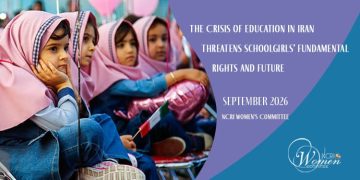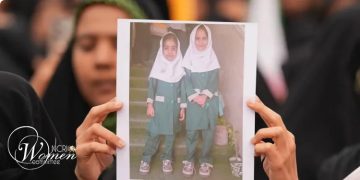

International Day of the Girl Child is an opportunity to highlight the fundamental rights of all children to education, security, health, play, and an age-appropriate future. For many girl children in Iran, however, childhood is defined by a continuous cycle of deprivation and harm—ranging from early child marriage and forced school dropouts to child labor, severe poverty, and domestic violence.
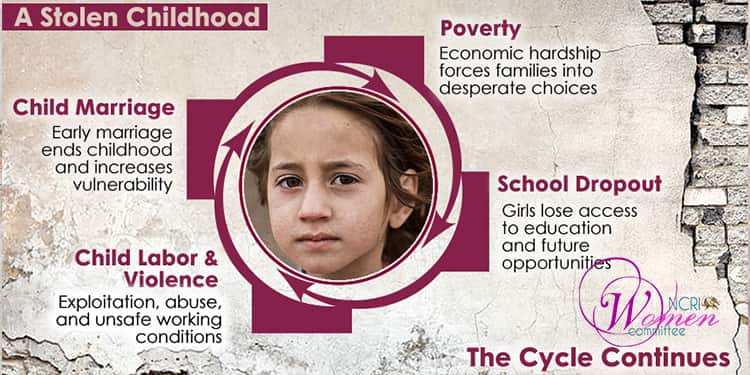
These issues are deeply interconnected. Poverty creates the conditions for school dropouts and child labor, while early child marriage halts a girl child’s education and leaves her vulnerable to early pregnancy and violence. Combined, these factors perpetuate an ongoing cycle of poverty and marginalization passed down to the next generation.
When Poverty Robs Girl Children of Education
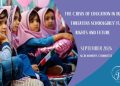
Education is one of the most critical pathways out of poverty yet escalating economic pressure forces girl children out of school. In families facing severe livelihood hardships, a child may be driven into the labor market instead of studying and playing, or early child marriage halts her education altogether.
This crisis is not limited to losing a few years of schooling. Dropping out drastically restricts a girl’s future opportunities, confining her to low-paying, precarious employment in adulthood. This creates a vicious cycle where poverty leads to school dropouts, and dropping out guarantees the perpetuation of poverty.
Poverty in present-day Iran, however, is not restricted to a specific social stratum or a small segment of society; the vast majority of the population lives below the poverty line. The state-run Iran Online reported on August 18, 2026, that out of Iran’s population of 90 million, approximately 87.5 million people qualify for electronic food coupons (Kalabarg). This monthly subsidy of one million Tomans per person is barely enough to purchase just two trays of eggs.
Child Marriage: A Premature End to Childhood
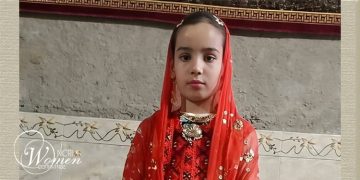
One of the most severe crises confronting girl children in Iran is early and forced marriage. Under Article 1041 of the Civil Code, the marriage of girls under 13 years of age is legally permitted with the consent of their legal guardian and the discretion of a court.
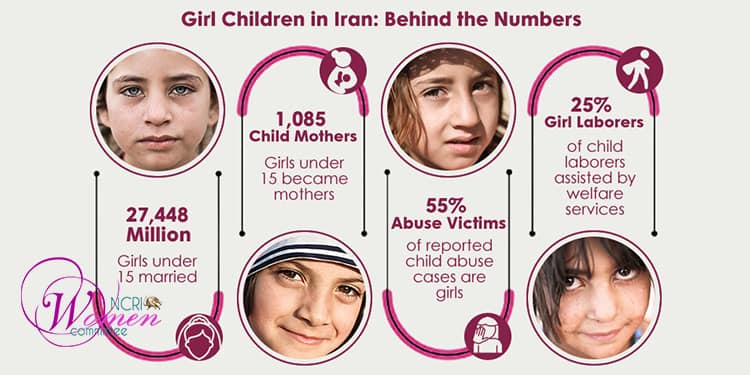
Official statistics demonstrate that child marriage remains widespread. According to data from Iran’s National Statistical Center (NSC), from winter 2021 to autumn 2022 (spanning one-year), at least 27,448 girl children under the age of 15 were married. Furthermore, from mid-March to December 2022 (a nine-month period), over 20,000 marriages of girls under 15 were officially registered, and within that same time frame, 1,085 girls under the age of 15 became mothers.
These figures represent only officially registered marriages and fail to reflect the full extent of unregistered forced marriages; nevertheless, they reveal the devastating scope of child marriage across the country.
Early marriage deprives a girl child of her education and natural childhood, subjecting her to premature adult responsibilities. Adolescent pregnancy, severe physical and psychological trauma, an increased risk of domestic violence, and the loss of educational and economic opportunities are among the catastrophic consequences associated with child marriage.
At the same time, extreme economic hardship in families intensifies the pressure for early child marriage, where a daughter’s marriage is increasingly viewed as a desperate means to relieve household financial burdens. In this way, poverty and child marriage continuously reinforce one another.
Violence: Even Where It Should Be the Safest Place
Child marriage and poverty are not the only crises confronting girl children in Iran. Child abuse and domestic violence represent another bitter and pervasive reality in the lives of many young children.
According to official sources, child abuse is the most common form of domestic violence in Iran.
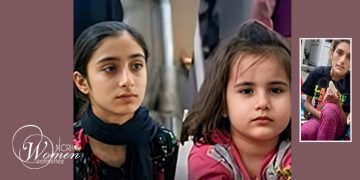
In June 2026, the horrifying case of two young girls, 7-year-old Aylin and 15-year-old Narin, in Sanandaj drew intense public attention to the extreme dimensions of child abuse in Iran. According to published reports, following local reports and the intervention of the Social Emergency Hotline, the two sisters were rescued after being locked inside their home’s bathroom and rushed to a hospital, displaying signs of severe beatings and bone fractures across their bodies.
This tragic case serves as a stark reminder that the home, which ought to be the safest sanctuary for a child, can instead turn into a site of unimaginable violence.
Statements published by the deputy head of the State Welfare Organization confirm that girl children are disproportionately exposed to child abuse, with 55 percent of all officially reported child abuse cases involving girl children. (Khabar Online, May 5, 2025)
Combating child abuse cannot be limited to reacting after violence has already taken place. Early identification, comprehensive child protection, access to social and psychological services, and effective legal intervention mechanisms are essential pillars of genuine child welfare—all of which are completely non-existent under the ruling clerical regime in Iran.
Girl Children Entrapped in the Cycle of Child Labor
Severe poverty and economic strain force children into the labor market. In Iran, child labor is not confined to children seen on the streets. A significant portion of these children work in small workshops, private homes, seasonal jobs, and other informal sectors of the economy, where oversight and child protection are virtually non-existent.
From carpet weaving and manufacturing workshops to street vending, waste picking, and service jobs, children are engaged in economic sectors that largely remain hidden from official statistics. (Toseeirani.ir, June 14, 2026)
Among the most alarming statistics is that 38 percent of child laborers began working between the ages of 5 and 7, a critical period that should be dedicated to education, play, and healthy childhood development. (Shargh newspaper, June 15, 2026)
Hassan Mousavi Chalak, Deputy for Social Health at the State Welfare Organization, acknowledged that one-quarter of the child laborers covered by the organization are girls. (Tasnim News Agency, June 11, 2025)
Girl child laborers face unique, severe risks. Beyond educational deprivation and financial hardship, they are acutely vulnerable to physical and sexual abuse. To reduce these dangers and avoid drawing attention to themselves, some young girls even cut their hair short and dress in boys’ clothing. (ISNA, May 3, 2021)
Child labor is therefore not merely a household income issue; it is a nexus of interconnected deprivations—poverty, forced school dropouts, premature labor, physical insecurity, and the systematic destruction of future opportunities.
A Crisis Far Beyond Statistics
What makes the situation of girl children in Iran so alarming is not merely the isolated figures of early marriages, child labor, or incidents of child abuse, but the deep interconnections among these phenomena.
A girl child living in an impoverished family may be forced out of school and driven into the labor market due to severe economic pressure. Another may be married off at a tender age, forfeiting her fundamental right to education and economic independence. Yet another child may fall victim to domestic violence at home, remaining trapped in harm’s way for prolonged periods due to the complete absence of effective protection mechanisms.
In such conditions, each of these crises exacerbates the next, forging a vicious cycle of deprivation from which escape is virtually impossible.
Furthermore, access to transparent data remains a critical concern. The regime’s suppression and halting of official statistics regarding child marriage and births to underage mothers make it increasingly difficult to accurately assess trends and expose the full magnitude of these abuses. (Etemad daily, September 8, 2024)
Childhood Is Every Child’s Right
International Day of the Girl Child must not merely be an occasion to recount hardships; it must serve as a firm reminder of the fundamental rights guaranteed to every child: the right to education, security, health, healthy development, play, and the freedom to choose one’s own future.
Ending child marriage, combating violence against children, and eradicating child labor are not isolated challenges. To break this vicious cycle of deprivation, their interconnected root causes, including severe poverty, school dropouts, and the total breakdown of child protection, must be confronted directly.
Child marriage in Iran is an organized, state-sponsored crime. This phenomenon has flourished under the shadow of fundamentalist Sharia laws and the system of Velayat-e Faqih (clerical rule), serving as an integral mechanism for the suppression of women and the subjugation of society.
Behind every single statistic lies a stolen childhood, a shattered future, and a silenced human soul. The suffering of girl children in Iran will never be brought to an end through superficial reforms or empty promises. The sole path to ending this ongoing tragedy is the overthrow of the corrupt, misogynistic regime ruling Iran.