
Exploitation of widows in Iran
Introduction: The survival of the mullahs’ regime rests on two fundamental pillars: overt suppression in society and institutionalized misogyny within its laws. The direct consequence of these two levers is the displacement of millions of female-headed households below the absolute poverty line and their severe exploitation in non-standard labor markets.
However, this is not the whole story; through arbitrary executions and total disregard for work safety in its monopolized industries, the regime’s machinery has itself become a driver of “systematic widowhood” in society. In this second installment of our series of articles, we examine the links between poverty, exploitation, executions, and the tragic work disasters in Tabas and Bandar Abbas.
The Clerical Regime Is Directly Responsible for Widowing Women
Just like in every other area of destruction, the corrupt clerical regime provides no statistics on widows—but it is no secret that it is the primary cause of the growing number of widowed women and the descent of Iranian women into deep poverty and suffering.
A large number of Iranian women are forced into widowhood as a result of misogynistic laws entrenched in the country’s legal system. Under Article 1041 of the Islamic Republic’s Civil Code, a girl’s father, grandfather, or even a judge has the authority to permit her marriage as early as age 13—or even younger. Often, these girls are married to men old enough to be their fathers.
According to Shahr Khabar news agency, on October 16, 2024, more than 19,000 women and girls had been married to men at least 15 years older than themselves in the previous year alone. This occurs within a legal and economic framework overwhelmingly structured to benefit men, leaving women without meaningful protections or autonomy.
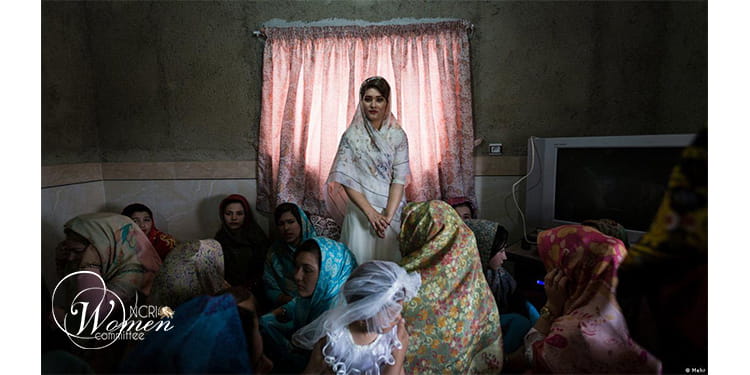
Moreover, the laws of the clerical regime in Iran do not prohibit polygamy. The regime’s so-called “Family Protection Law” merely sets conditions for taking additional wives—conditions that are easily circumvented. Temporary marriage (sigheh) is also legal and explicitly institutionalized under Article 1152 of the Civil Code, which defines its duration. Furthermore, men have the unrestricted right to divorce their wives at any time, without cause or mutual consent.
These discriminatory laws have led to a rise in the number of divorced women, many of whom face social and legal hardships similar to those of widows. The overall result is the weakening of the family structure and an increase in the number of women who are left without support.
In addition to these systemic legal injustices, many women become widows due to the regime’s own acts of violence and the disasters caused by its policies and negligence. Consider just three disasters:
1.Women Widowed Due to Criminal Executions
In 2015, Shahindokht Molaverdi, then head of the Directorate for Women and Family Affairs, stated that in a village in Sistan and Baluchestan province, southeastern Iran, all the men had been executed for drug-related offenses. The village was Roshanabad, located in the Sarjangal district of Zahedan. Women and children left behind by these executions were abandoned without any social support and became vulnerable to severe poverty, trafficking, and revenge violence. (Mehr– February 23, 2016)
The disclosure of such a village by a government official is only the tip of a massive iceberg. From 2015 to 2025, the Iranian regime has carried out hundreds of other executions each year. None of the victims received fair trials; these killings were intended solely to instill fear and prevent uprisings or the overthrow of the illegitimate clerical regime. Each execution shatters a family.
Executions continue at an alarming rate. In 2024 alone, the number of executions reached 1,153. The executions in March 2025 were six times higher than in the same month the previous year, and those in April 2025 were four times higher than the same month the previous year. (Mojahedin website – March 26 and April 21, 2025)
The cruelest facet of executions and repression in Iran targets political prisoners and their families. One such case is that of Mostafa Salehi, a political prisoner who was arrested for participating in the nationwide protests of December 2017 and was later secretly executed. The clerical regime not only provided no support to his wife and children, but also subjected them to continuous harassment, treating them as targets of its ruthless vengeance.

In September 2020, a court informed Mostafa Salehi’s family that they must pay 5 billion rials (approximately $100,000 at the time) as diyah (blood money) and threatened that their home, orchard, and possessions would be confiscated if the amount was not paid.
The diyah was calculated based on minor scratches and bruises claimed by the regime’s hand-picked plaintiffs. Despite enduring a full year of solitary confinement and brutal torture, Mostafa Salehi never accepted any of the accusations during his trials. (Mojahedin website – September 12, 2020)
2. Women Left Behind After the Tabas Coal Mine Explosion
On September 21, 2024, an explosion occurred at the Madanjou Coal Mine in Tabas, South Khorasan Province in eastern Iran, killing 53 workers. Due to the authorities’ refusal to implement basic workplace safety measures, at least 53 families were destroyed in an instant.
On November 15, 2024, the regime’s Minister of Labor admitted that all those killed in the Madanjou mine were living in poverty.
Even the surviving miners are suffering from serious physical and psychological issues. Some sustained brain injuries and are now unable to return to work. (ILNA– December 30, 2024)
The wife of one of the injured workers said their lives had been ruined and they had no money for medical treatment.
Another wife said: “My husband used to work two weeks at the mine and two weeks in Neyshabur, northeastern Iran, but it still wasn’t enough to cover our household expenses. Now, after months of following up, the Social Security Organization gave us 70 million rials (roughly $140 at today’s rates) as compensation for his medical leave. With what we get from Madanjou, we can barely pay rent and monthly installments.”
(ILNA– December 30, 2024)
One woman, Seyyedeh Khadijeh, whose husband survived the explosion, said, “A miner’s wife is a homemaker with no jobs and no job skills. My husband’s wages never covered the needs of our five children. The only thing I knew how to do was clean and chop herbs, and I tried to earn some money that way.”
This is just one instance of a workplace accident, which tragically happens all too frequently in Iran.
Zeinat, the widow of a miner killed in the Zemestan-Yurt coal mine explosion of 2017, believes that the wives of the Madanjou victims are likely to share her fate. She says, “I have two sons who are just coming of age. When they deposited their father’s diyah into our account, on one hand there was the question of how to spend their share, and on the other hand there were the interferences of my father-in-law and brothers-in-law.
Don’t think diyah is some huge amount—what mattered was that man, who is no longer with us. He was there, and despite all the poverty and hardship, we could make do. But now, one says do this, another says do that.”
She recalled that harrowing year and the shock that hit her entire village:
“Most women in the village had husbands working at Zemestan-Yurt mine. They tried to stop their men from going back, saying, ‘Stay and work the farmland.’ But agricultural work is seasonal, and you can’t survive on those wages. I was the only woman in our village with a high school diploma. But in all these years, I haven’t been able to find any job—not even working the fields.” (State-run media – November 15, 2024)
Beyond financial hardship, child custody has become another cruel wound for the widows. One woman wrote, “Grandfathers who had no idea how hard we raised these children now want to take them away—just because of the diyah, the aid money, and the pensions. They question my comings and goings. Do they love my son more than I do?”
It is very clear that those in charge have no interest in updating laws to fit today’s societal realities.
Another miner’s widow said her father-in-law had taken her children from her, and her brothers-in-law were also trying to win custody. (Khabarban news site – November 4, 2024)
3. Widowed Women from the Bandar Abbas Explosion
On April 26, 2025, a massive explosion took place in Bandar Abbas, southern Iran, killing hundreds and leaving hundreds more injured or disabled. All signs point to the involvement of the Revolutionary Guard Corps (IRGC) in the illegal transport of fuel used in missile manufacturing. The Washington Post estimated the blast’s energy was equivalent to 50 tons of TNT.
Eyewitnesses said, “There were easily 300 to 400 bodies burned at the fuel terminal, leaving no trace behind.” (Mojahedin website – May 4, 2025)
A large number of female workers were also killed. According to eyewitnesses, 50 women employees from just one neighboring company went missing. Hospitals are full of severely injured victims. One witness said, “Out of 30 women at our company, 23 were killed—some had their eyes blown out, others lost limbs, and some were beyond recognition.”
(NCRI Women’s Committee – May 1, 2025)
Each number is the story of a family that will now sink even deeper below the poverty line. The explosion unleashed a wave of destitution, unemployment, and abandonment. The families of the victims, especially the widows, are facing severe economic and psychological crises. Many were already living in poverty—and now, they are left entirely without support. Some cannot even afford basic necessities like food or water.
Most of the dead were day laborers working the lowest-ranking jobs: no contracts, no insurance, no protections. Now, their families do not knowwhere to turn, what rights they have, or how to demand them. Many do not even know if they are eligible for diyah, what paperwork is required, or which authority is responsible for their cases.

Families living in impoverished areas like 2000 district, 22 Bahman, or Tappeh Allah Akbar have not even received a single phone call. They are not only grieving, but also helpless, forgotten, and fearful of what is ahead.
It may seem unbelievable: a family that has identified the body of their loved one but cannot afford the cab fare to go collect it. A funeral where a single box of tissues is passed around 80 mourners.
There was no tea, no cold water. Their financial resources are depleted—and their dignity has been shattered.
One young woman said, “My husband died. I’m pregnant. But my only worry is whether I will have the money to renew the rent. For some families, even getting the diyah may take six months, depending on inheritance procedures and document verification. And that is assuming they have all their ID paperwork. If not, the problem gets even worse.”
(Rokna– May 5, 2025)
Amid Grief, Crushing Poverty
Among the bereaved families, poverty is so deep and pervasive that merely describing it sends a chill down one’s spine. One such family is from Zahedan, a city in southeastern Iran, where they live in a structure that more closely resembles a shack than a house. The family consists of an elderly mother, a young widow, and a sister with a disability who, despite being thirty years old, is so frail that she appears to be a child. Their home is crumbling, and poverty seeps from its very walls. Hayatollah was the family’s sole breadwinner—now he is gone.
Most of these families are illiterate. What emerges is a staggering scale of suffering, poverty, vulnerability, alienation, and powerlessness in the face of injustice. There are no answers to the pressing questions: Why were so many undocumented, unregulated workers employed at one of Iran’s most critical ports? Why were industrial safety standards so weak and unenforced? Why did crisis-response infrastructure fail so catastrophically?
And now, who will be held accountable for this human tragedy? (Rokna – May 11, 2025)