Monday, March 9, 2026
  • English
  • Français
  • فارسی
  • عربى
PODCASTS
NCRI Women Committee Women Resistance Freedom
  • Home
  • NEWS
    • Women’s News
    • Articles
    • Statements
  • PUBLICATIONS
    • Monthlies
    • Documents
    • Reference Library
  • ABOUT US
    • The NCRI Women’s Committee
    • Gender Equality
    • Women’s Platform
  • MARYAM RAJAVI
    • Maryam Rajavi
    • Maryam Rajavi Speeches
    • The Plan on Women’s Rights and Freedoms
    • Ten-Point Plan for the future of Iran
  • VANGUARDS
    • The Fallen for Freedom
    • Heroines in Chain
    • Women of Iranian Resistance
    • Famous Women
    • Women in History
  • EVENTS
    • IWD Conferences
    • Activities
    • IWD Speeches
    • Solidarity
  • VIDEO
    • Videos
    • IWD Videos
  • PODCAST
  • DONATE
  • CONTACT US
No Result
View All Result
NCRI Women Committee Women Resistance Freedom
  • Home
  • NEWS
    • Women’s News
    • Articles
    • Statements
  • PUBLICATIONS
    • Monthlies
    • Documents
    • Reference Library
  • ABOUT US
    • The NCRI Women’s Committee
    • Gender Equality
    • Women’s Platform
  • MARYAM RAJAVI
    • Maryam Rajavi
    • Maryam Rajavi Speeches
    • The Plan on Women’s Rights and Freedoms
    • Ten-Point Plan for the future of Iran
  • VANGUARDS
    • The Fallen for Freedom
    • Heroines in Chain
    • Women of Iranian Resistance
    • Famous Women
    • Women in History
  • EVENTS
    • IWD Conferences
    • Activities
    • IWD Speeches
    • Solidarity
  • VIDEO
    • Videos
    • IWD Videos
  • PODCAST
  • DONATE
  • CONTACT US
No Result
View All Result
NCRI Women Committee
No Result
View All Result
Home Podcast
Iran’s Historic Transition: Why Women Must Lead the New Republic

Iran’s Historic Transition: Why Women Must Lead the New Republic

March 8, 2026
in Podcast

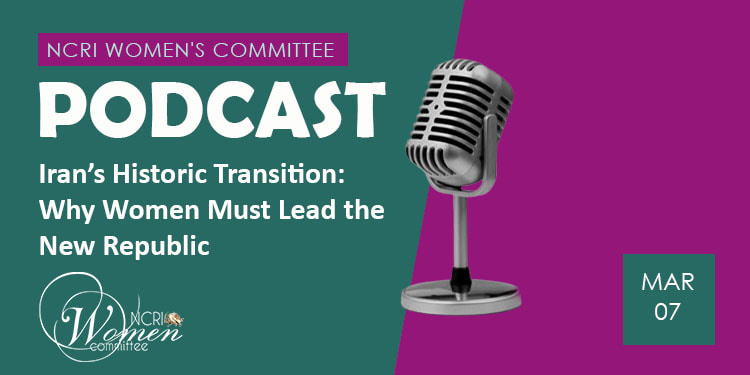
Iran’s Historic Transition: Why Women Must Lead the New Republic. Welcome to another episode of the NCRI Women’s Committee Podcast.

Since our previous episode, significant developments have taken place in Iran. A war erupted over the Iranian regime’s nuclear and missile programs, during which the mullahs’ Supreme Leader, Ali Khamenei, died. With his death, the era of religious tyranny that had dominated Iran for decades came to an end.

On the same day, February 28, the National Council of Resistance of Iran (NCRI) announced the formation of a provisional government aimed at transferring sovereignty to the people of Iran.

We now find ourselves examining a vast amount of information emerging from what is truly an unprecedented moment in Iran’s history. This episode focuses on two central themes that dominate this historic transition. First is the firm insistence that the people of Iran must determine their own future, free from any form of foreign intervention. Second is the argument that any genuine and legitimate alternative to the former regime must place women at the center of political and social decision-making.

The Price of Freedom

To fully understand the gravity of these demands, it is necessary to examine the immediate context in which this transition has unfolded.

Reports describing the recent events present a stark and harrowing picture of the price paid by the Iranian people. Much attention has focused on the popular uprising that erupted in January 2026. The figures associated with that uprising are staggering.

Thousands of people were killed in an attempt by the regime to suppress the protests. More than 50,000 individuals were arrested and imprisoned. Among those killed the names of more than 250 women have been documented and verified, along with hundreds of youths under the age of eighteen.

These losses are not presented merely as statistics. Rather, they represent the very reason why the Iranian people now demand complete control over their country’s future. The scale of the tragedy, combined with the brutality used to suppress the population, served as a catalyst for profound change and led to immediate international consequences.

International Repercussions

Following these events, the European Union designated the Islamic Revolutionary Guard Corps (IRGC)—the regime’s principal instrument of repression—as a terrorist organization.

This decision marked a significant diplomatic shift. Designating a state’s primary military institution as a terrorist organization freezes assets, removes diplomatic legitimacy, and signals a profound loss of credibility on the international stage. In effect, it fundamentally alters the global political landscape surrounding Iran.

Yet despite these developments, the Iranian people have consistently emphasized a different message: the future of Iran must be determined by Iranians themselves.

The Principle of National Sovereignty

At the heart of this transition lies a powerful assertion of national sovereignty. The guiding principle is simple but resolute: Iran belongs to its people, not to any regime.

There is a strong and explicit rejection of any externally imposed government. According to this perspective, no legitimate future for Iran can be designed or dictated from outside the country. Instead, it must emerge from within Iranian society itself—through the will and participation of its citizens.

In this context, the provisional government announced by the NCRI is intended to serve as a transitional mechanism.

The Role of the Provisional Government

The provisional government functions as a temporary bridge designed to manage the immediate transition of power. Its purpose is not to maintain authority indefinitely but to facilitate the orderly transfer of sovereignty to the Iranian people.

This process is guided by a ten-point plan that provides a framework for establishing democratic institutions. The plan envisions the formation of a constituent assembly that will draft a new constitution, which will then be submitted to the Iranian people for approval through a democratic referendum.

After forty-seven years of repression and the sacrifice of more than one hundred thousand lives, the Iranian people are determined not to return to the authoritarian systems of the past. They reject both the former monarchical dictatorship and the theocratic regime that followed it.

Instead, they seek to establish a democratic republic based on the separation of religion and state.

Women at the Center of Iran’s Democratic Future

This aspiration for democracy leads to the second major theme of this discussion: the central role of women in Iran’s future political system.

The materials examined in this episode repeatedly emphasize that a truly democratic republic cannot exist without fundamentally transforming the role of women in society. In fact, the advancement of women is not portrayed as a secondary outcome of the revolution but rather as one of its driving forces.

This year’s International Women’s Day has been dedicated to the rebellious women and youth of Iran who have played a decisive role in the struggle for freedom.

Importantly, these women are not portrayed as victims. Instead, they are described as the vanguard of change—courageous leaders who mobilize society, organize resistance, and often stand on the front lines of protest and sacrifice.

A Tradition of Women’s Leadership

This leadership is not a recent development. It is the result of decades of organized struggle.

Within the resistance movement itself, women currently constitute more than half of the resistance parliament, which consists of over 460 members. Such representation is rare even in many established democracies.

Moreover, women have not merely been symbolic participants. For decades they have played key roles in central councils, leadership structures, and strategic decision-making positions.

This long experience in leadership is regarded as one of the factors that enables the resistance movement to present itself as a credible alternative capable of governing a post-authoritarian Iran.

A Long-Standing Vision for Women’s Rights

One of the most striking aspects of the resistance movement is its long-standing commitment to gender equality.

Nearly thirty-eight years ago, the movement adopted a comprehensive charter on women’s rights and freedoms. At the time, such a document was remarkably forward-looking, particularly in the political environment of the Middle East during the mid-1980s.

The charter outlines several key principles. It calls for the abolition of all forms of compulsion, including compulsory hijab and compulsory religious observance. It demands equal pay for equal work, equal rights in marriage and divorce, and the freedom of women to pursue employment without discrimination.

The charter also mandates the complete prohibition of any form of sexual exploitation of women.

Underlying these principles is a fundamental idea: the freedom of women to make their own choices must be fully protected by law.

Gender Equality as a Test of Democracy

Taken together, these ideas lead to a deeper conclusion about the nature of democracy itself.

Historically, authoritarian regimes—whether monarchical or theocratic—have shared a common characteristic: the systematic exclusion of women from positions of real political power. Both systems relied on patriarchal structures to maintain control. Women were legally barred from serving as judges or running for the presidency.

In this context, the presence of women in leadership roles becomes more than a progressive policy objective. It becomes a crucial test of whether a political system is genuinely democratic.

Fascism and authoritarianism are inherently hostile to women’s empowerment. Therefore, any political movement that claims to represent a democratic alternative must demonstrate its commitment by ensuring meaningful participation and leadership for women.

Without such participation, democratic institutions risk collapsing back into authoritarian rule.

A Question for the World

This perspective raises an important question for the global community.

If the true measure of democratic progress is the political power entrusted to women, how would other established democracies measure up to the standards being demanded today by the women of Iran?

In many ways, the struggle of Iranian women challenges the entire world to reflect on its own political systems and structures of power.

Supporting the Struggle for Freedom

As we conclude this episode, we invite our listeners to consider how they can support the Iranian people and the courageous women who continue to risk everything for the fundamental right of self-determination.

Bearing witness to this struggle is important, but practical support can help bring about meaningful change.

We encourage you to support the work of the NCRI Women’s Committee. Donations directly contribute to the ongoing efforts of Iranian women who are striving for freedom, equality, and democracy.

To learn more about how you can contribute, please visit our website at wncri.org.

Thank you for joining us for this deep exploration of Iran’s historic transition. We look forward to continuing this conversation in future episodes. Until then, goodbye.
Tags: Women's Leadership
ShareTweetPinShareSendShare

Related Posts

Elisabetta Zamparutti at IWD 2026: The Courage of Iranian Resistance Women to Sacrifice Their Lives for Freedom

March 9, 2026
Elisabetta Zamparutti at IWD 2026: The Courage of Iranian Resistance Women to Sacrifice Their Lives for Freedom

On Saturday, February 21, 2026, on the eve of March 8, International Women’s Day, the NCRI Women’s Committee hosted an international conference in Paris entitled “Women’s Leadership: An...

Read moreDetails

Karen Smith at IWD 2026: The Future of Iran: Rule of Law, Gender Equality, and Women’s Leadership

March 8, 2026
Karen Smith at IWD 2026: The Future of Iran: Rule of Law, Gender Equality, and Women’s Leadership

On Saturday, February 21, 2026, on the eve of March 8, International Women’s Day, the NCRI Women’s Committee hosted an international conference in Paris entitled “Women’s Leadership: An...

Read moreDetails

Maryam Rajavi Discusses Iran’s Transitional Roadmap in Interview with Frankfurter Rundschau

March 8, 2026
Maryam Rajavi Discusses Iran’s Transitional Roadmap in Interview with Frankfurter Rundschau

Maryam Rajavi, the President-elect of the National Council of Resistance of Iran, said in an interview with the German newspaper Frankfurter Rundschau that political change in Iran must...

Read moreDetails

Ana Helena Chacón Echeverría at IWD 2026: The Struggle of Iranian Women is a Universal Demand for the Right to Live Without Fear

March 8, 2026
Ana Helena Chacón Echeverría at IWD 2026: The Struggle of Iranian Women is a Universal Demand for the Right to Live Without Fear

On Saturday, February 21, 2026, on the eve of March 8, International Women’s Day, the NCRI Women’s Committee hosted an international conference in Paris entitled “Women’s Leadership: An...

Read moreDetails

Fiona O’Loughlin at IWD 2026: Iran’s January Uprising Is Rooted in Decades of Struggle and Resistance

March 7, 2026
Fiona O’Loughlin at IWD 2026: Iran’s January Uprising Is Rooted in Decades of Struggle and Resistance

On Saturday, February 21, 2026, on the eve of March 8, International Women’s Day, the NCRI Women’s Committee hosted an international conference in Paris entitled “Women’s Leadership: An...

Read moreDetails
Next Post
Maryam Rajavi Discusses Iran’s Transitional Roadmap in Interview with Frankfurter Rundschau

Maryam Rajavi Discusses Iran’s Transitional Roadmap in Interview with Frankfurter Rundschau

Documents

A Report to CSW70: Gender-Based Discrimination Under Iranian Law

A Report to CSW70: Gender-Based Discrimination Under Iranian Law

March 8, 2026

Structural Inequality and State-Sanctioned Oppression of Women Gender-Based Discrimination Under Iranian Law” is the title of the NCRI Women’s Committee’s...

Annual Report 2026: From Protests, to Uprising, and the Role of Iranian Women

Annual Report 2026: From Protests, to Uprising, and the Role of Iranian Women

March 3, 2026

On the eve of International Women’s Day 2026, the NCRI Women’s Committee presents its Annual Report 2026, offering a recap...

Iranian women Who Lost Their Lives in Iran’s January 2026 Uprising

Iranian Women Who Lost Their Lives in Iran’s January 2026 Uprising

January 25, 2026

Names That Must Not Be Forgotten Iranian women played a central and courageous role in the January 2026 uprising, standing...

Monthlies

January 2026 Report: Women at the Core of the Uprising
Monthlies

January 2026 Report: Women at the Core of the Uprising

January 31, 2026
December 2025 Report: A Year in Review: Iranian Women’s Resistance Against Religious Dictatorship
Monthlies

December 2025 Report: A Year in Review: Iranian Women’s Resistance Against Religious Dictatorship

January 5, 2026
November 2025 Report: Under the Clerical Regime, Nowhere Is Safe for Women in Iran
Monthlies

November 2025 Report: Under the Clerical Regime, Nowhere Is Safe for Women in Iran

November 30, 2025
October 2025 Report: Death Sentence for a Female Political Prisoner The Resistance of Female Political Prisoners Inspires Iranian Women and Girls in Their Struggle Against the Regime of Executions and Massacre
Monthlies

October 2025 Report: Death Sentence for a Female Political Prisoner

October 31, 2025

Articles

Maryam Rajavi Discusses Iran’s Transitional Roadmap in Interview with Frankfurter Rundschau

Maryam Rajavi Discusses Iran’s Transitional Roadmap in Interview with Frankfurter Rundschau

March 8, 2026

Maryam Rajavi, the President-elect of the National Council of Resistance of Iran, said in an interview with the German newspaper...

March 8: International Women's Day and the Leading Role of Iranian Women in the Struggle for Freedom

March 8: International Women’s Day and the Leading Role of Iranian Women in the Struggle for Freedom

March 6, 2026

March 8 is celebrated worldwide as International Women's Day, a day that honors over a century of women's fight for...

A Free Iran Starts with Women in Charge

A Free Iran Starts with Women in Charge

March 5, 2026

Maryam Rajavi’s movement puts women in leadership and demands equality as a foundation, not a slogan — a direct assault...

The Fallen for Freedom

Sonya Salehi-Rad was killed on January 8, 2026, during the nationwide popular protests in Shiraz
The Fallen for Freedom

Sonya Salehi-Rad

February 10, 2026
Arezoo Abedi was killed on January 9, 2026, during the nationwide popular protests
The Fallen for Freedom

Arezoo Abedi

February 10, 2026
Arnika Dabbagh, from Gorgan, was killed on January 9, 2026
The Fallen for Freedom

Arnika Dabbagh

February 7, 2026
Maedeh Moradi Kia, a resident of Tehran, was killed on January 9, 2026
The Fallen for Freedom

Maedeh Moradi Kia

February 7, 2026

ABOUT US

NCRI Women Committee

We work extensively with Iranian women outside the country and maintain a permanent contact with women inside Iran. The Women’s Committee is actively involved with many women’s rights organizations and NGO’s and the Iranian diaspora.
The committee is a major source of much of the information received from inside Iran with regards to women. Attending UN Human Rights Council meetings and other international or regional conferences on women’s issues and engaging in a relentless battle against the Iranian regime’s misogyny are part of the activities of members and associates of the committee.

CATEGORIES

  • Activities
  • Articles
  • Documents
  • Famous Women
  • Heroines in Chain
  • IWD Conferences
  • IWD Speeches
  • IWD Videos
  • Maryam Rajavi
  • Maryam Rajavi Speeches
  • Monthlies
  • Podcast
  • Reference Library
  • Solidarity
  • Statements
  • The Fallen for Freedom
  • Videos
  • Women in History
  • Women in Leadership
  • Women of Iranian Resistance
  • Women's News

BROWSE BY TAG

Child marriage coronavirus education execution forced hijab Gender Gap Generation Equality Honor killings Iran Teachers Maryam Akbari Monfared Nurses Plan on Women's Rights and Freedoms Poverty Prisoners Protests rural women Saba Kord Afshari The girl child Violence against women Women's Leadership Women Heads of Household Zeinab Jalalian

The copyright of all the material published on this website has been registered under © 2016 the Women’s Committee of the National Council of Resistance of Iran. To obtain permission to copy, redistribute or publish the material published on this website, you should write to the NCRI Women’s Committee. Please include the link of the original article on our website, women.ncr-iran.org.

Welcome Back!

Login to your account below

Forgotten Password?

Retrieve your password

Please enter your username or email address to reset your password.

Log In

Add New Playlist

No Result
View All Result
  • Home
  • News
    • Women’s News
    • Articles
    • Statements
  • Publications
    • Monthlies
    • Documents
    • Reference Library
  • About Us
    • The NCRI Women’s Committee
    • Gender Equality
    • Women’s Platform
  • Maryam Rajavi
    • Maryam Rajavi
    • Maryam Rajavi Speeches
    • Ten Point Plan for Iran
    • The Plan on Women’s Rights and Freedoms
  • Vanguards
    • The Fallen for Freedom
    • Heroines in Chain
    • Women of Iranian Resistance
    • Famous Women
    • Women in History
  • Events
    • IWD Conferences
    • Activities
    • IWD Speeches
    • Solidarity
  • Video
    • Videos
    • IWD Videos
  • Podcast
  • Donate
  • Contact us
  • فارسی
  • عربی
  • Français

The copyright of all the material published on this website has been registered under © 2016 the Women’s Committee of the National Council of Resistance of Iran. To obtain permission to copy, redistribute or publish the material published on this website, you should write to the NCRI Women’s Committee. Please include the link of the original article on our website, women.ncr-iran.org.