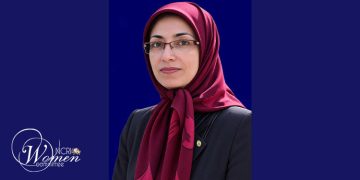

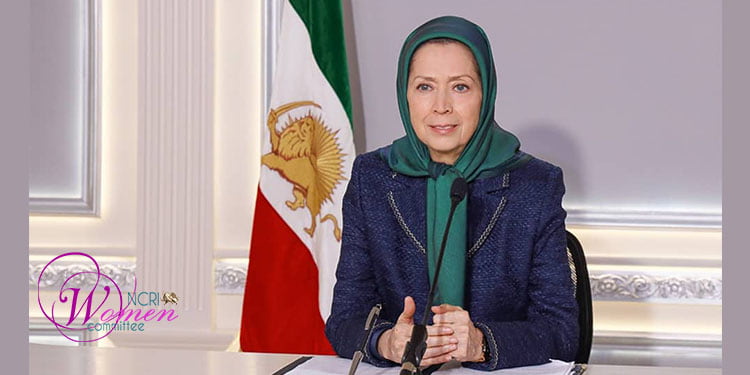
Maryam Rajavi, the President-elect of the National Council of Resistance of Iran, said in an interview with the German newspaper Frankfurter Rundschau that political change in Iran must come “only through the Iranian people and their organized resistance.”
She firmly rejected the deployment of foreign military forces on Iranian soil, while warning that the country is at a particularly sensitive and volatile moment.
Referring to the difficult conditions faced by the Iranian population, Rajavi noted that civilians, especially children and the elderly, are confronting severe hardships. She called on all parties involved to prioritize the protection of human life and civilian infrastructure. Despite these circumstances, she said, public dissatisfaction with the ruling establishment remains widespread and resistance networks continue their activities even under wartime conditions.
In another part of the interview, the President-elect of the National Council of Resistance urged members of Iran’s armed forces to stand with the people and called on the Islamic Revolutionary Guard Corps to lay down their arms, arguing that such a step could help prevent further bloodshed. She also stressed that the transitional government proposed by the National Council of Resistance would not pursue revenge. Only those responsible for acts of bloodshed, she said, should be held accountable before the law. According to Rajavi, any such proceedings would guarantee the right of defense for the accused and take place in the presence of international observers. She further reiterated the council’s support for the abolition of the death penalty.
Addressing the question of political legitimacy, Rajavi argued that in circumstances where free elections are impossible, resistance to the ruling system becomes the only credible measure of legitimacy.
The full translation of Frankfurter Rundschau’s interview with Maryam Rajavi follows below:
Struggle over Iran’s future: NCRI President-elect Maryam Rajavi in interview
Ms. Rajavi, you are certainly in contact with people living in Iran. What is the situation of ordinary people in the days after the first U.S. strikes?
The people in Iran, especially civilians, children, and the elderly, are in a difficult situation. That is why I have stressed that under these circumstances all parties involved must above all protect people’s lives, help those affected, and preserve civilian infrastructure. But there is another reality as well: the firm will of the people in Iran to overthrow this regime. Precisely in these days, the resistance units are active in various ways despite the harsh conditions of war. This society carries within it both pent-up anger and hope for change.
Why did you reject military intervention from outside?
We have a fundamental position that we have always insisted on. Change in Iran is possible only through the people and the organized resistance. There is no need for foreign troops on Iranian soil. The people of Iran must determine their own destiny.
But do you nevertheless now see an opportunity for resistance and a democratic change?
The “opportunity for change” arises from the explosive condition of society, the weakening of the regime, the readiness of the population, and the expansion and cohesion of the resistance. The January uprising was the result of these fundamental factors. The Resistance Units of the People’s Mojahedin Organization (PMOI) played a decisive role in this. In recent days as well, they have attacked many centers of repression in various cities. One of their most significant operations was the clash of 250 PMOI forces with security forces at Khamenei’s heavily protected headquarters and the regime’s command centers in the Pasteur district of Tehran. The real war is the war between the Iranian people and the regime of the mullahs.
You are calling on “patriotic personnel of the army” to turn away from the regime. And you are calling on the Revolutionary Guards to lay down their arms. How realistic is that, if many of these people might fear the—more than understandable—anger of the Iranian people?
We distinguish between the people, the rank and file of the armed forces, and the criminal leaders of the regime. I call on patriotic personnel of the army to stand with the people. I have urged members of the Revolutionary Guards and other forces protecting the regime to lay down their arms and surrender to the people. This is a political and national appeal aimed at preventing further bloodshed. The NCRI and its provisional government do not seek revenge. We have explicitly made clear that only those whose hands are stained with blood must answer to justice. They will enjoy all rights, especially the right to defense, and these proceedings will take place in the presence of international observers. You know that our program provides for the abolition of the death penalty. This is an initiative that no other movement has undertaken during a phase of resistance.
You have announced this provisional government. In your view, what is your legitimacy for doing so?
From our point of view, legitimacy is based on the votes of the people. But in a situation where there is no possibility of gauging public opinion through free and fair elections, and where a bloody dictatorship rules, the only criterion of legitimacy is resistance. Therefore, the legitimacy of this step derives from this movement’s long and uninterrupted struggle against this regime. It is based on more than one hundred thousand members and supporters of this resistance who have sacrificed their lives for Iran’s freedom.
“In the current political situation in Iran, the standard for trust is not merely a claim”
You emphasize that the National Council of Resistance and the “provisional government” are not seeking power. Reza Pahlavi says the same. However, the NCRI expresses fundamental doubts about Pahlavi’s claim.
Trust is the result of the price each political current pays in the struggle against the regime. The National Council of Resistance of Iran and the organizations and figures that support it have paid a heavy price in the struggle to overthrow the regime, including one hundred thousand dead and hundreds of thousands of political prisoners. The son of a dictator who was overthrown once and for all by the Iranian people does not thereby gain credibility. How are people supposed to trust someone who is not only unwilling to condemn the one-party system and the crimes of his father, or even distance himself from them, but is in fact proud of that record?
But why should people in Iran trust your initiative more?
In the current political situation in Iran, the standard for trust is not merely a claim; what matters are structure, program, written commitment, accountability, and actual performance. The NCRI has presented a clear program for the transitional period: a provisional government, elections within at most six months to a constituent assembly, and afterward power will pass to the elected representatives of the people.
Why do you believe the National Council of Resistance has more support in Iran than Pahlavi—and the backing it needs?
First, I would like to stress that in times of dictatorship, when there is no possibility of calling the population to the ballot box, there are no usual democratic standards by which to measure the popularity of a political current. Anyone who claims otherwise under such conditions is engaging in charlatanism. Look at the lists of those executed by this regime over more than four decades. In the massacre of 30,000 political prisoners in 1988, more than 90 percent of them belonged to the People’s Mojahedin Organization, the driving force of the NCRI. Look at Iran’s prisons today: currently 18 members of the MEK are on death row, and many more are in prison and being tortured. Over the past year, the PMOI’s Resistance Units have carried out 3,000 anti-repression operations.
And yet we see video footage of people chanting “Long live the Shah.”
Under the current conditions, we are witnessing a political and media staging designed to introduce artificial alternatives—something from which the Iranian regime is the principal beneficiary. Quite apart from that, there is abundant evidence and indications, including forensic investigations (a link was provided by the NCRI on request as an example; editor’s note), that many of the images and videos you mention are fake and have been dubbed afterward. There is also irrefutable evidence that the Iranian regime has staged such productions to divide the population and has spread precisely this narrative.
Some critics view the NCRI and the PMOI with skepticism—partly for historical reasons, partly because of allegedly very strict and hierarchical structures within the organization. How do you respond to that?
The Iranian Resistance and the PMOI have not only been the main victims of the Iranian regime’s physical repression, but throughout the past four decades have also been the target of systematic, state-directed lies, propaganda, and demonization. Many of our members have also been murdered outside Iran, including in Europe. Discipline is a necessity in such a struggle. If there were no democratic structures in the NCRI, it would have been impossible for different political currents within the NCRI to fight together for 44 years.
The standard for judgment must be neither the regime’s propaganda nor sweeping judgments, but rather the actual performance of the NCRI and its members. The members of the Iranian Resistance movement are all volunteers who have consciously chosen, in the struggle against the regime of the mullahs, to give up many personal comforts, privileges, and advantages of a normal life—even in Western countries. Resistance for freedom is the result of such a conscious decision. No conscious volunteer can be forced into struggle through coercion.
You are calling for a democratic process to form a new government in Iran. What could this process look like? And when could it begin in practice?
Our roadmap is clear. First: the establishment of the provisional government on Iranian soil. Second: the holding of free and fair elections within at most six months to form a legislative and constituent assembly. Third: the end of the provisional government and the transfer of power to the elected representatives of the people. Fourth: the drafting of a new constitution and the determination of the future democratic republic. Fifth: the formation of a government that, on the basis of the new constitution and under the supervision of institutions arising from the will of the people, assumes responsibility for the country. In our view, this process can begin immediately as soon as the conditions for establishing a transitional structure inside Iran exist.
How dangerous is it these days for Iranians to protest and possibly rise up against the regime?
The expectation that people would take to the streets en masse during heavy bombardment is unrealistic. In addition, out of fear of the population’s anger, the regime has tightened security measures in the cities. This regime has repeatedly shown, in response to protests, that it is prepared to carry out massacres, repression, and the severing of all communication channels. At the same time, the Iranian people have shown that they will be satisfied with nothing less than the overthrow of the regime.