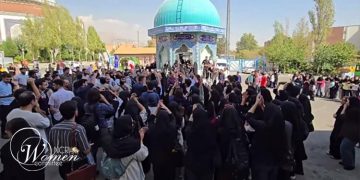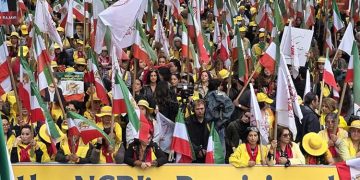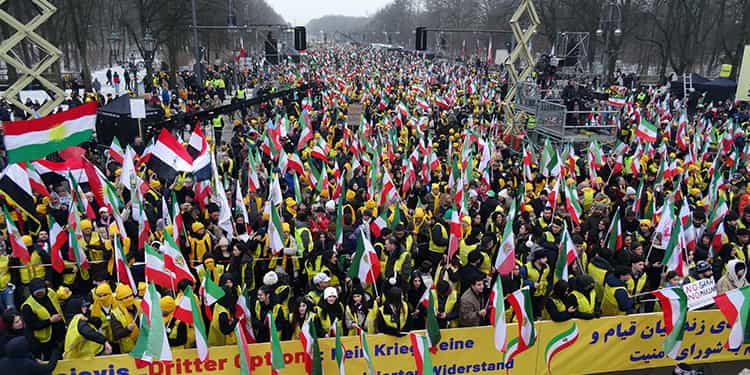
Iranians March and Rally in Berlin – On Saturday, February 7, 2026, marking the anniversary of the 1979 anti-monarchical revolution, freedom-loving Iranians held a magnificent march and rally at the Brandenburg Gate in Berlin.
The rally was organized in solidarity with the nationwide uprising of the Iranian people, and to honor the martyrs of the January 2026 uprising. Despite sub-zero temperatures, flight cancellations, and disruptions to public transportation, a sea of the event became a focal point for international media attention.
The organizing committee announced that approximately 100,000 people participated in the demonstration between 1:00 p.m. and 4:00 p.m., adding that thousands more were unable to attend due to adverse weather conditions.
At the gathering, Iranian diaspora communities, supporters of democratic change, and international political figures came together to reject all forms of dictatorship, whether monarchical or religious, and to support a democratic future shaped by the Iranian people themselves.
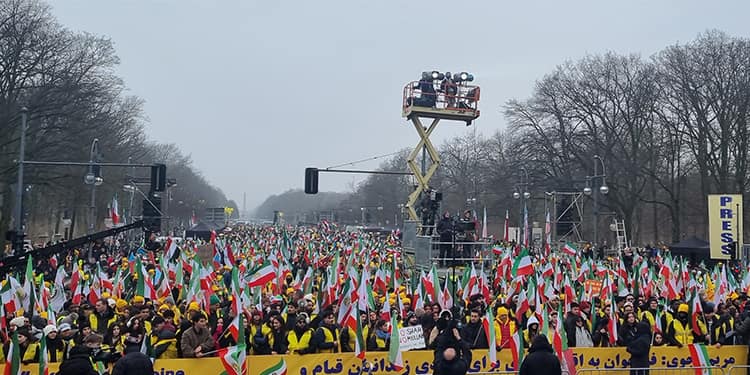
One of the most striking features of the demonstration was the strong and visible presence of women and youth, who stood at the forefront of the rally, demonstrating their active role in the struggle for freedom, justice, and equality.
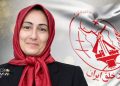
The keynote speaker was Mrs. Maryam Rajavi, President-elect of the National Council of Resistance of Iran. Also, in attendance and delivering speeches were Charles Michel, former President of the European Council and former Prime Minister of Belgium; Sabine Leutheusser-Schnarrenberger, former German Federal Minister of Justice; and Peter Altmaier, former German Federal Minister for Economic Affairs and Energy.
Mike Pompeo, former U.S. Secretary of State, addressed the rally online.
Representatives of Khabat Kurdistan Organization, the Kurdistan Democratic Party of Iran, and Iranian communities abroad also spoke at the rally.
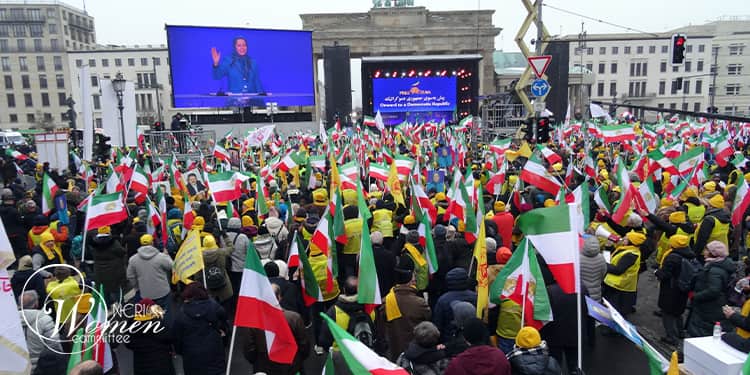
Maryam Rajavi: What Our People Want Is Freedom and Equal Leadership for Women
In her remarks, Maryam Rajavi emphasized that the message of the Iranian people and the Resistance has always been clear: “No appeasement and no war. Regime change and sovereignty of the republic of the people, by the people and their organized Resistance.”
She recalled that since 2002, the National Council of Resistance of Iran has called for the formation of a National Solidarity Front to overthrow religious despotism, a coalition of republicans committed to the separation of religion and state who reject the entirety of the velayat-e faqih regime.
Emphasizing the possibility of unity despite political differences, she said: “We have long believed that we can, and must, come together in a national solidarity front in the name of Iran, under the flag of Iran, and for the highest interests of the Iranian people.”
Elsewhere in her speech, she declared: “The spirit and constant refrain of what our people demand is: freedom, freedom, and freedom. It is the active and equal participation of women in leadership, and justice for all; the equal participation of all, especially Iran’s ethnic nationalities, in rights and governance, including Kurds, Baluchi, Turkmens, and Arabs.”
She called on world leaders to: recognize the Iranian people’s struggle and resistance units; take immediate action at the UN Security Council to prevent the execution of uprising detainees and political prisoners; guarantee the people’s access to free internet; refer the case of Ali Khamenei and other regime leaders to international courts; close regime embassies and expel agents of the IRGC and Ministry of Intelligence; and cut off the financial lifelines of the clerical regime.
In conclusion, Rajavi stressed that the anti-monarchical revolution proved the people’s power can overcome even the largest repression machines, and that today Iran’s democratic revolution, more conscious and more powerful than ever, is moving decisively toward victory.
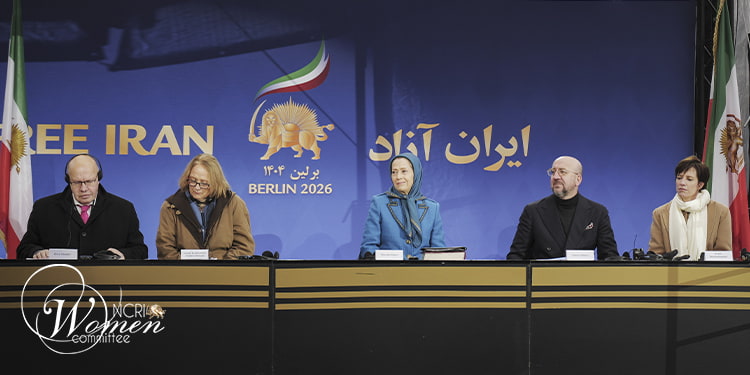
Charles Michel: No Wall Can Stop a Nation’s Freedom
Charles Michel, recalling the fall of the Berlin Wall, said nothing can halt freedom and that the Iranian people are not alone in their path. He added that the Iranian people’s steadfastness has awakened the international community and helped prevent the regime from acquiring nuclear weapons and expanding its repressive agenda.
He stressed that freedom is the people’s right and that across Iran, regardless of gender or nationality, people are standing with one voice for a better future.
Mike Pompeo: Any Deal with This Regime Is a Betrayal of a People Dying for Freedom
Mike Pompeo stated that Iran’s freedom can only be realized through a government that truly represents the will of its people. He emphasized that while the Iranian people will pay a heavy price for freedom, Iran will ultimately be liberated by democratic and freedom-loving forces.
He described Rajavi’s Ten-Point Plan as a roadmap for transferring power to the people and told Western governments that any deal with the regime constitutes a betrayal of the millions of Iranians risking their lives for freedom. He added that a democratic alternative exists, and although the exact timing of freedom is unknown, that day will come.
Peter Altmaier: A Free Iran Is Possible
Peter Altmaier stated that a free Iran is achievable and that a bright future awaits the Iranian people. He emphasized that placing the IRGC on the terrorist list was only a first step and that more actions are needed.
According to him, implementing Rajavi’s Ten-Point Plan can guarantee freedom, democracy, and equal rights for all Iranians.
Sabine Leutheusser-Schnarrenberger: You Cannot Negotiate with a Regime That Imprisons Its Own People
Sabine Leutheusser-Schnarrenberger stressed that in any negotiations with Iran’s government, the first demand must be the release of all detainees. She said normal relations cannot be maintained with a regime that imprisons and represses its own citizens.
She called for increased political pressure, targeted sanctions, and the severing of financial channels that, in her words, “fill the mullahs’ pockets every day.”
Naghmeh Rajabi: The Revolution for Freedom Continues—Neither Crown Nor Turban
Naghmeh Rajabi, representing Iranian communities, referred to the anniversary of the anti-monarchical revolution and said freedom-loving Iranians rose up against oppression and corruption and overthrew the Shah’s dictatorship. She called for recognition of the Iranian people’s legitimate right to self-defense and of resistance units against the IRGC and all repressive forces of the regime. She demanded the closure of regime embassies and the expulsion of its “terrorist diplomats” from various countries.
She stated that the thuggery and violent rhetoric of fascist monarchist currents mirror the brutality of the IRGC against Iranian youth. “We speak the words of the people in the streets, not the words of censoring media. The Iranian people’s message is clear: ‘Death to the oppressor, whether Shah or Supreme Leader.’”
Hiva Mohammadi: We Turn Grief into Anger and Anger into Organized Struggle
Hiva Mohammadi, another representative of Iranian communities, recalled the massacres of the 1980s, the 1988 massacre of political prisoners, and the Ashraf massacre, stating that the “crime” of the fighters was that they never surrendered. She emphasized that the January uprising is the result of a long path of resistance and that the sorrow of these crimes will be transformed into anger and an organized movement to overthrow the regime. Saluting the martyrs of freedom, she said: “You have gone, but your path continues.”
Jalal Khoshkelam: The Iranian People’s Will for Freedom Is Unbreakable
Jalal Khoshkelam, representing the Komala (Khabat) Kurdistan Organization, saluted freedom fighters and stressed that the Iranian people’s resistance continues and that their will for freedom is unbreakable. According to him, the regime has effectively declared war on the nation through repression and killings, and pro-freedom forces must be more united and determined than ever.
Sasan Khatouni: No to the Dictatorship of the Past, No to the Despotism of Today
Sasan Khatouni, representing the Kurdistan Democratic Party of Iran, referred to the history of Kurdish resistance and said that the Kurdish people, both under the monarchy and under the velayat-e faqih system, have consistently faced torture, executions, and repression. He rejected any return to the past and called for recognition of the Kurdish people’s struggle and for unity among all pro-democracy forces to continue the fight until freedom is achieved.