The Most Prevalent Form of Violence Against Women and Girls in Iran: Enforcing the Compulsory Hijab and the New Hijab and Chastity Law
Coinciding with the 16 days of activism to eliminate violence against women and girls, the November monthly report focuses on the most prevalent form of violence against women in Iran.
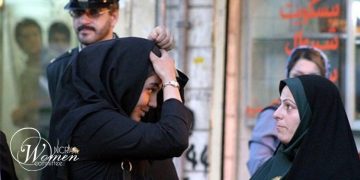
While other forms of violence affect specific strata of women and girls, activists and dissidents, students, etc., the violence entwined with enforcement of the compulsory veil impacts all women from all ages, all walks of life, and in every city and village across the country. Those who violate this mandatory dress code are subjected to violence by Hijab patrols.
Inflicting this form of violence against Iranian women is both sanctioned by the state and institutionalized in the law.
As Iranian women and girls increasingly resist the mandatory imposition of the veil, the regime’s agents have escalated their brutality in enforcing this practice to unprecedented levels.
Last year, Zhina (Mahsa) Amini was killed due to the brutality of guidance patrols who violently arrested and transferred her to a Morality Police detention center. This year, Hijab monitors assaulted a 17-year-old student, Armita Geravand, inside a metro train, which led to her death.
The regime’s security and intelligence forces were highly vigilant and took control of the situation early on, to prevent the outbreak of another nationwide protest over the death of this innocent girl.
The Iranian regime presents a paradox: it thrives on the suppression of women, evident in its stringent enforcement of the compulsory veil, yet faces widespread opposition from the majority of Iranian women who seek autonomy in their attire choices. By intensifying the enforcement of the Hijab despite this resistance, the regime risks triggering a formidable uprising—an outcome it greatly fears, as it could swiftly spiral beyond its control.
In this edition of the NCRI Women’s Committee’s monthly reports, we’ll delve into the implications of the regime’s new Hijab and Chastity Law on Iranian women and society at large.
As we are publishing this report, it has been reported that the Governorate of Qom has issued a directive, instructing female government employees to attend work with the head-to-toe black chador and without any make-up. (The state-run didbaniran.ir, December 2, 2023)
How Was the New Hijab and Chastity Law Adopted?
On May 24, the Iranian state media published the text of the “Protection of Hijab and Chastity” Bill comprised of 15 articles. This was the bill proposed by the Iranian Judiciary and delivered to Raisi’s government.
On June 8, the government finished making minor changes and passed the bill renamed, “Supporting Hijab and Chastity” to the parliament for double-priority adoption. However, the parliament saw flaws in the bill as it only dealt with penalties. Therefore, the parliament passed the bill to the Legal Commission for examination.
On July 27, the Iranian state media published the text of the bill finalized in 70 articles by the parliamentary commission. On August 6, the parliament announced receipt of “The Bill to Support the Family through the Promotion of the Culture of Hijab and Chastity” for deliberations.
Fearing public reactions, the clerical regime’s parliament refrained from debating the bill in its open session and invoked Article 85 of the constitution which permits the formation of a committee to approve legislation for “experimental” implementation.
The Legal Commission concluded its deliberations on August 20, and the clerical regime’s parliament adopted the new Hijab bill in an open session on September 20, 2023. One hundred and fifty-two (152) members of the parliament voted in favor, 34 against, and seven abstained. The new bill will be enforced for three years on a trial basis after being approved by the Guardian Council.
On October 24 and November 25, 2023, the Guardian Council returned the bill to the parliament to resolve the shortcomings and ambiguities in the bill. Therefore, the bill is not yet officially passed into law until approved by the Guardian Council.
The Bill to Support the Family through the Promotion of the Culture of Hijab and Chastity
According to mullah Moussa Ghazanfarabadi, the chair of the parliamentary Legal Commission, “The bill has five chapters. The first chapter deals with generalities; the second chapter defines the general duties of executive organs. The third chapter defines the special obligations of executive agencies like the national radio and television and the Ministry of Culture and Islamic Guidance. The fourth chapter outlines the general duties and social responsibilities, and the fifth chapter outlines the crimes and offenses.”
As it is evident from the name of the bill, the restrictions imposed on women’s freedom of choice regarding their attire are justified under the pretext of protecting the foundations of the family.
In Chapter One, Article 1 of this bill states, “Family is the main center for growth and progress of human beings and their calm. Therefore, any behavior that promotes ‘nudity,’ ‘unchastity,’ ‘removal of hijab,’ ‘malveiling,’ and actions against public chastity, which would lead to the disruption of the calm of the woman and the man in the family, promotion of late marriages, spread of divorce and social ills, and devaluation of family violate paragraphs 1 and 7 of the Constitution, and are banned according to the rulings of this law and others.”
In Chapter Two, this law obliges all government agencies to hold educational terms for their staff and teach them the “style of Islamic life based on the couple’s commitment to each other and promotion of the culture of Hijab and Chastity.”

In Chapter Three, the law obliges more than 30 government ministries and organizations to carry out a long list of duties with regards to implementation of this law. They include the Ministry of Culture and Islamic Guidance, the Organization of State Radio and Television, the Organization of Islamic Propaganda, the Ministry of Education, Ministry of Science, Research, and Technology, the Ministry of Health and Medical Education, the presidential directorate of Science, Technology, and Economy, the Ministry of Interior, the Interior Ministry’s HQ for Coordination and Leading the Implementation of the Hijab and Chastity Law, the municipalities and city councils throughout the country, the National Welfare Organization, the Ministry of Sports and Youths, the Ministry of Industries, Mines, and Commerce, the Ministry of Roads and Urban Development, the Ministry of Communication and Information Technology, the Ministry of Cultural Heritage, Tourism and Handicraft, the Ministry of Intelligence, the IRGC Intelligence, the State Security Force’s Intelligence Organization, the Planning and Budget Organization, the Administrative and Employment Organization, the presidential directorate on Women and Family Affairs, the State Security Force Command, the Judiciary Branch, the paramilitary Basij, and the Headquarters to Promote Virtue and Forbid Evil.
Each of these ministries and organizations has between 2 to 13 duties listed for them to educate their staff and the society at large about the Islamic style of life and promote the culture of hijab and chastity. Such duties include segregation of the workspace in offices and even in hospitals, enforcing the regime’s compulsory dress code in schools, offices, universities, hospitals, etc., and refraining from employing or providing services to individuals who do not observe the dress code.
Ironically, the Ministry of Intelligence, the IRGC Intelligence, and the SSF Intelligence are all involved in imposing the compulsory veil on Iranian women and girls.
In Chapter Four, entitled, “General Obligations and Social Responsibility,” Article 34 underlines that the recruitment, deployment, employment, promotion, ranking, appointment, etc. of individuals are conditional on their adherence in practice to Hijab and Chastity.
In Chapter Five, 33 articles are devoted to the harsh punishments and heavy financial fines handed down for those who choose to violate the Hijab and Chastity Law, including in cyberspace and social media. Business owners are obliged to control their employees’ observance of the veil.

More than 2,850 Hijab Monitors Recruited in Tehran’s Metro Stations
Even before the approval of the bill by the mullahs’ legislative hierarchy, the Iranian regime took measures to implement the strict rules outlined in the new Hijab and Chastity bill.
One of the semi-official dailies in Iran published the cliché of a highly confidential document by the Ministry of Interior, which indicated the presence of 2,850 Hijab Monitors or Hijab patrols in the metro stations. (The state-run Etemad daily newspaper, November 26, 2023)
The directive dated, May 30, 2023, addresses some of the government agencies, including Tehran’s Municipality, and the Metro Company of the Capital, and states, “Entry of individuals who remove their Hijab to government-run places is conditional on their observance of the legal dress code.”
The official IRNA news agency carried an interview with the Secretary of the Staff of Promotion of Virtue and Prohibition of Evil, on November 25, 2023. Mohammad Hossein Taheri Akordi told IRNA that Hijab Monitors are “Jihadi forces.” He said there are more than 2,850 Hijab Monitors in Tehran whose activities are the product of “coordination among the IRGC, Bassij, State Security Force (SSF), Tehran’s Municipality, and the Prosecutor’s Office.”
Taheri Akordi said the mandate of these Hijab Monitors is to give “verbal warnings.” He said they work voluntarily and without receiving any salaries.
However, it was reported in August that Tehran’s municipality had hired 400 Hijab patrols to be deployed in metro stations, with a monthly salary of 12 million Tomans. Their duty is to give warnings to the passengers and prevent them from getting on the metro wagons without covering their hair. They will also hand over the women with improper veiling or no veil to the police. (The state-run Rouydad24.ir, August 6, 2023)
IRNA cited Ahmad Vahidi, the Interior Minister, as saying, “Verbal promotion of virtue and forbidding of evil is a general duty. It is publicly and legally sanctioned and does not require any licenses.” He added, “The Ministry of Interior supports those who promote virtue and forbid from evil before the law.” (The official IRNA news agency, November 25, 2023)

Strict clothing restrictions for female university students
The new academic year saw stepped-up pressure and restrictions on Iranian students, and more arrests and suspensions.
Simultaneous with the new academic year and the opening of schools, the parliament’s approval of the new Hijab and Chastity Bill for a three-year trial period created a strict atmosphere in the universities.
Social media posts showed images of camouflaged vehicles on parade inside Tehran University while playing anthems from the Iran-Iraq wartime. Similar reports emerged from Amir Kabir, Al-Zahra, Allameh Tabatabaii, and Kharazmi universities in Tehran and Isfahan’s University of Art.
The Medical School of Kerman also posted a banner on the regulations for the clothing of its students. In the University of Shiraz, the authorities installed facial recognition technology in the university’s restaurants. The Shiraz University management spent 700 million Tomans to install this technology and identify the students who breach the clothing regulations.
More recently, in a shocking incident on November 20, 2023, at Melli University, masked security forces raided the library, psychology classrooms, and classes in the School of Literature and the School of Human Sciences, confiscating the student ID cards of female students who were not wearing the hijab. Students in this and other universities in Tehran went on a two-day protest strike and refused to attend their classes.

Punitive Measures for Violating Compulsory Hijab
Iranian women received harsh penalties, including termination from their jobs, being assigned to wash corpses in the morgue, and being forced to do janitorial work or attend psychiatric sessions for supposed “mental disorders” for failing to adhere to the compulsory dress code.
The Reuters news agency released footage showing a woman in Tehran’s Gisha district crying out for help after being harassed and assaulted by a woman agent of the state security forces, who attempted to violently arrest her and take her into a van.
International Censure of the New Hijab and Chastity Bill
The Office of the High Commissioner for Human Rights issued a statement, on September 1, 2023, in which a group of UN Human Rights Council-appointed experts slammed Iran’s draft Hijab law. The experts said the bill could amount to “Gender Apartheid.”
They expressed concern that the new Hijab law in Iran sanctions new punishments for women and girls who fail to wear the headscarf, or hijab, in public.
“The draft law could be described as a form of gender apartheid, as authorities appear to be governing through systemic discrimination with the intention of suppressing women and girls into total submission,” the UN human rights experts said.
They reiterated that the proposed parliamentary Bill to Support the Family by Promoting the Culture of Hijab and Chastity and existing restrictions are inherently discriminatory and may amount to gender persecution.
“The draft law imposes severe punishments on women and girls for non-compliance which may lead to its violent enforcement,” the experts warned and added that the new hijab law would “disproportionately affect economically marginalized women.”
The experts urged the Iranian authorities to “reconsider the compulsory hijab legislation in compliance with international human rights law, and to ensure the full enjoyment of human rights for all women and girls in Iran.”
Amnesty International called on the Iranian authorities to “abolish compulsory veiling, quash all convictions and sentences for defying compulsory veiling, drop all charges against all those facing prosecution, and unconditionally release anyone in detention for defying compulsory veiling. The authorities must abandon plans to punish women and girls for exercising their rights to equality, privacy, and freedom of expression, religion, and belief.”
On November 3, 2023, the UN Human Rights Committee issued its findings on the Islamic Republic of Iran. The Committee was disturbed by legal provisions that continue to discriminate against women and girls, particularly the “Support the Family by Promoting the Culture of Chastity and Hijab Bill,” which imposes severe punishments on women and girls for violations of the mandatory dress code, including up to ten years in prison and flogging. It was also concerned about the redeployment of morality police to monitor the dress code in public. It urged the State Party to reform or repeal laws and policies that criminalize non-compliance with compulsory veiling, specifically the “Bill to Support the Family by Promoting the Culture of Hijab and Chastity”. It also asked the State party to disband the morality police.