

Friday, August 7, 2026
  • English
  • Français
  • فارسی
  • عربى
PODCASTS
NCRI Women Committee Women Resistance Freedom
  • Home
  • NEWS
    • Women’s News
    • Articles
    • Statements
  • PUBLICATIONS
    • Monthlies
    • Documents
    • Reference Library
  • ABOUT US
    • The NCRI Women’s Committee
    • Gender Equality
    • Women’s Platform
  • MARYAM RAJAVI
    • Maryam Rajavi
    • Maryam Rajavi Speeches
    • The Plan on Women’s Rights and Freedoms
    • Ten-Point Plan for the future of Iran
  • VANGUARDS
    • The Fallen for Freedom
    • Heroines in Chain
    • Women of Iranian Resistance
    • Famous Women
    • Women in History
  • EVENTS
    • IWD Conferences
    • Activities
    • IWD Speeches
    • Solidarity
  • VIDEO
    • Videos
    • IWD Videos
  • PODCAST
  • DONATE
  • CONTACT US
No Result
View All Result
NCRI Women Committee Women Resistance Freedom
  • Home
  • NEWS
    • Women’s News
    • Articles
    • Statements
  • PUBLICATIONS
    • Monthlies
    • Documents
    • Reference Library
  • ABOUT US
    • The NCRI Women’s Committee
    • Gender Equality
    • Women’s Platform
  • MARYAM RAJAVI
    • Maryam Rajavi
    • Maryam Rajavi Speeches
    • The Plan on Women’s Rights and Freedoms
    • Ten-Point Plan for the future of Iran
  • VANGUARDS
    • The Fallen for Freedom
    • Heroines in Chain
    • Women of Iranian Resistance
    • Famous Women
    • Women in History
  • EVENTS
    • IWD Conferences
    • Activities
    • IWD Speeches
    • Solidarity
  • VIDEO
    • Videos
    • IWD Videos
  • PODCAST
  • DONATE
  • CONTACT US
No Result
View All Result
NCRI Women Committee
No Result
View All Result
Home Heroines in Chain
Inside the "Cage Ward"

Inside the “Cage Ward”

August 6, 2026
in Heroines in Chain

Prison Memoirs of Azam Haj-Heydari from the book The Price of Being Human – Part Seventeen

In this installment of The Price of Being Human, Azam Haj-Heydari recounts her experiences in Unit 1 of Qezel Hesar Prison, a punishment block that became notorious as the Cage Ward.[1] She describes the inhumane conditions imposed there and the systematic campaign of psychological and physical torture carried out against female political prisoners under the command of Haji Davoud, one of the regime’s most notorious prison officials.

At the time, Azam was a young teacher in her early twenties who had joined the struggle against the Iranian regime. She spent five years imprisoned in the Judiciary’s Temporary Detention Center, Evin, Qezel Hesar, and Gohardasht prisons, where she was subjected to brutal torture by Khomeini’s guards.

Arrival at the Cage Ward

Fifteen of us were transferred to Ward 8, another solitary-confinement ward, though under slightly less restrictive conditions.

Then five of us, including me, were taken somewhere none of us had ever seen before.

The chief executioner of Qezel Hesar, Haji Davoud, addressed us.

“I’m taking you somewhere that’s just like Hell,” he said. “Today is Judgment Day. There, every one of you will answer for what you’ve done. You’ll stay there until you either die or come to your senses, choose life, and repent.”

By repentance, he meant publicly degrading ourselves.

“You’ll admit that you were immoral women,” he continued. “That you were looking for brothels, and that you found what you wanted in the Monafeqin[2] organization.”

With his grotesque laughter and his monstrous appearance—he looked more like a gorilla than a human being—Haji Davoud continued:

“I’ll keep you there until your hair turns as white as your teeth, and your teeth as black as your hair.”

Pointing to the walls of Qezel Hesar, which had been built and painted through forced labor by prisoners, he said:

“Look at these walls. Your work keeps making them new. But your youth is slipping away forever, and it will never come back.”

“Where is your Masoud? Where are your so-called heroic people? Why don’t they come rescue you?”

“Of course, we won’t even let you squeak in there. Even if your entire body becomes one great scream, no one will hear you. No one will come to your aid.”

“This is the end of the world. From here, you leave either for the cemetery—or as decent human beings.”

“That is your fate.”

By the time he finished speaking, we understood exactly why we had been brought there.

They believed this place would finally break us.

Only later did we learn that it was Unit 1 of Qezel Hesar Prison, later known among prisoners simply as the Cage Ward.

Seven and a Half Months Blindfolded

We stood in the reception area for nearly four hours.

To me, those four hours felt like forty.

I hurriedly reviewed everything in my mind.

Every friendship.

Every conversation.

Every connection I had made inside the prison.

I imagined the questions they might ask and rehearsed my answers.

Then I remembered an argument I had recently had with one of the collaborators.

A few days earlier, one of the women had drawn the emblem of the PMOI. A collaborator named Sharareh saw it and made a contemptuous remark.

I couldn’t tolerate it.

I jumped down from the bunk and confronted her.

I knew she had reported me.

I was so absorbed in my thoughts that when a guard suddenly called Hengameh’s name—the first woman standing in line—and dragged her away, I barely realized where I was.

From there, we were loaded into a minibus and taken to Unit 1.

When I finally saw what awaited us, fear gave way to reality.

Each of us was taken to a separate cubicle, blindfolded, and seated in a corner.

The ward consisted of three sections.

As far as I could estimate while blindfolded during trips to the toilets, each section held somewhere between forty-eight and fifty-five prisoners.

Everyday Haji Davoud walked through the rows.

Beginning at the entrance, he stopped over every prisoner in turn.

Depending on whatever complaints or reports his collaborators had submitted, he would “welcome” each prisoner with cables, punches, or kicks.

As he beat us, he repeated the same refrain:

“Today is Judgment Day. You’ll either become human—or you’ll go to Hell.”
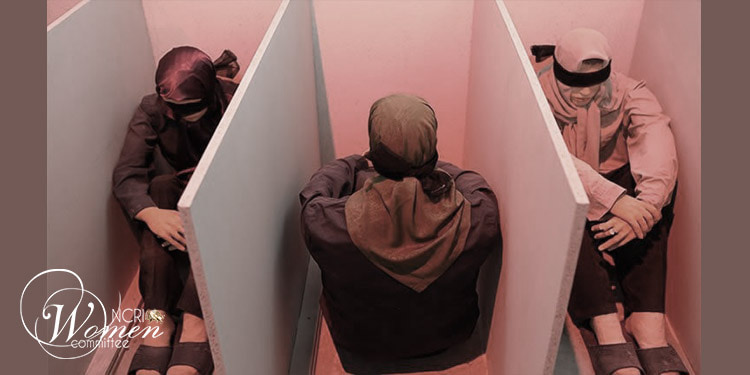
Face to Face with the Beast by Hengameh Haj Hassan (16) Cage ward
Recreation of the Cage, Museum of the Iranian Resistance

Life Inside the Cages

Let me describe this place they called the Cage Ward.

There were no ordinary prison cells.

Instead, the unit consisted of wide corridors and a huge hall where what looked like two hundred ping-pong tables had once been stacked nearly to the ceiling.

A year earlier, when we had first been transferred from Evin to Qezel Hesar, they had briefly taken us into that hall.

We laughed and joked among ourselves.

“How nice,” we said sarcastically. “They’re building us a ping-pong hall!”

At the time we had no idea why those tables were there.

Only after arriving at the Cage Ward did, I understand Lajevardi‘s sinister purpose.

Unable to build enough solitary cells for his plan to break political prisoners, he had converted the ping-pong tables into makeshift isolation cages.

The tables were stood upright in long rows through the corridors, each no more than about seventy centimeters apart. Their legs were welded together with metal bars.

On the floor lay filthy military blankets crawling with lice, giving off a foul odor. Their coarse fibers felt like wire digging into your skin.

Each narrow space between two tables became a cage for a single prisoner.

Blindfolded prisoners were forced to sit there twenty-four hours a day.

The cages were arranged diagonally so that neighboring prisoners sat as far apart as possible, making conversation nearly impossible.

Collaborators patrolled the corridors day and night, constantly watching to ensure no one spoke.

The cages were so cramped that even someone as small as I was—barely fifty kilograms—could not sit cross-legged.

Once I cautiously tried to shift into a cross-legged position to see how much room there actually was. Slowly I lowered my leg. Immediately I realized one of the wooden partitions was beginning to tip.

I froze.

The collaborator watching over me laughed.

“Careful, Monafeq,” she said. “You’re about to crush your beloved friend’s head.”

“If you’re trying to eliminate her so you’ll have more room, just say so.”

The space was so narrow that even my small frame barely fit.

There was only one possible position:

You hugged your knees against your chest and rested your head on them.

Hour after hour.

Day after day.

A Request for a Qur’an

The first time they took us out to perform ablutions before prayers, Haji Davoud himself was present.

I already knew we were expected to remain blindfolded at all times, sitting silently without permission to do anything.

But I wanted to understand the rules of this new place.

So I asked,

“May I have a copy of the Qur’an—or perhaps the Nahj al-Balagha?”[3]

Suddenly Haji Davoud burst into one of his grotesque fits of laughter.

“A Qur’an?” he mocked.

“Nahj al-Balagha?“

“Come here!”

A blow like a sledgehammer crashed onto my head.

“What else do you want?” he sneered.

“Poor Monafeq.”

“Go sit down and think about your miserable life.”

“It’s obvious you have no idea where you’ve been brought.”

Inside, I laughed at him.

“You’re the fool,” I thought.

“I know exactly where I am.”

“I only asked because I wanted to get under your skin.”

To be continued…


[1] Cage Ward  – The name prisoners gave to Unit 1 of Qezel Hesar Prison, where solitary confinement was replaced with tiny makeshift “cages” constructed from upright ping-pong tables. Prisoners remained blindfolded inside these narrow compartments for months under conditions of extreme physical discomfort, isolation, and constant surveillance. The Cage Ward became one of the most notorious instruments of psychological torture in Iran’s prison system during the early 1980s.

[2] Monafeqin / Monafeq– Literally “hypocrites.” The Iranian regime used these terms as derogatory labels for members and supporters of the People’s Mojahedin Organization of Iran (MEK/PMOI). The original Persian terms have been retained throughout this memoir because of their historical and political significance.

[3] Nahj al-Balagha– A revered collection of sermons, letters, and sayings attributed to Imam Ali ibn Abi Talib, the first Imam in Shi’a Islam. It is considered one of the most important texts in Shi’a religious thought after the Qur’an.


ShareTweetPinShareSendShareShare

Related Posts

Sexual Apartheid in the Laws of Iran’s Clerical Regime – part 1

August 6, 2026
Sexual Apartheid in the Laws of Iran’s Clerical Regime – part 1

Sexual Apartheid in the Medieval Laws of the Clerical Regime At a time when the world is moving toward the abolition of the death penalty, and when the...

Read moreDetails

Women’s Sports Clubs Sealed amid the Unemployment Crisis in Iran

August 5, 2026
Women's Sports Clubs Sealed amid the Unemployment Crisis in Iran

Four women's sports clubs in the city of Yazd have been sealed off by the Public Places Supervision Police. This repressive measure comes at a time when the...

Read moreDetails

Iran: Parisa Kamali, A Political Prisoner: “We Have Moved Beyond Fear”

August 5, 2026
Iran: Political Prisoner Parisa Kamali Denied Medical Care in Yazd Prison

Parisa Kamali, a female political prisoner held in Yazd Central Prison, has sent out an audio message condemning the continued use of executions and state repression in Iran....

Read moreDetails

Hunger Strike in 59 Prisons Across Iran: “No to Execution Tuesdays” Marks 132nd Week

August 4, 2026
Hunger Strike in 59 Prisons Across Iran: “No to Execution Tuesdays” Marks 132nd Week

The “No to Execution Tuesdays” campaign marked its 132nd week on Tuesday, August 4, 2026, with political prisoners in 59 prisons across Iran participating in a coordinated hunger...

Read moreDetails

Shiva Bordbar Javid

August 4, 2026
Shiva Bordbar Javid

Shiva Bordbar Javid was one of the young protesters who participated in the nationwide uprising in January 2026. She was martyred on the night of January 8, 2026,...

Read moreDetails

Documents

Call for Immediate Action to Halt the Death Sentence of Arghavan Fallahi

Sign our Statement to Halt the Death Sentence of 25-Year-Old Political Prisoner Arghavan Fallahi

July 10, 2026

Statement Calling for Immediate Action to Halt the Death Sentence of 25-Year-Old Political Prisoner Arghavan Fallahi We express our profound...

The Ineffectiveness of Population Policies in Iran: Economy, Aging, and the Overlooked Rights of Women

The Ineffectiveness of Population Policies in Iran: Economy, Aging, and the Overlooked Rights of Women

July 10, 2026

Abstract: A compilation of official data, media reports, and disclosures published in April, May, and June 2026 demonstrates that Iran...

Crushed by Design: Structural Crises and Inequitable Policies Push Female-Headed Households to the Edge

Crushed by Design: Structural Crises and Inequitable Policies Push Female-Headed Households to the Edge

May 18, 2026

Introduction Life for the Iranian people under the religious dictatorship is fraught with hardship and peril from every perspective. Whether...

Monthlies

July 2026 Report: Death Sentences for Women Rising Up to Overthrow the Mullahs' Regime
Monthlies

July 2026 Report: Death Sentences for Women Rising Up to Overthrow the Mullahs’ Regime

July 31, 2026
June 2026 Report: Working Iranian Women Erased from Labor Market
Monthlies

June 2026 Report: Working Iranian Women Erased from Labor Market

July 5, 2026
May 2026 Report: The Enduring Resistance of Iranian Women
Monthlies

May 2026 Report: The Enduring Resistance of Iranian Women

May 31, 2026
April 2026 Report: Mass Arrests of Women: Targeted Repression in Time of Crisis
Monthlies

April 2026 Report: Mass Arrests of Women in Iran

April 30, 2026

Articles

Sexual Apartheid in the Laws of Iran’s Clerical Regime – part 1

Sexual Apartheid in the Laws of Iran’s Clerical Regime – part 1

August 6, 2026

Sexual Apartheid in the Medieval Laws of the Clerical Regime At a time when the world is moving toward the...

Women's Sports Clubs Sealed amid the Unemployment Crisis in Iran

Women’s Sports Clubs Sealed amid the Unemployment Crisis in Iran

August 5, 2026

Four women's sports clubs in the city of Yazd have been sealed off by the Public Places Supervision Police. This...

The 1988 Massacre: The Greatest Unpunished Crime Against Humanity

The 1988 Massacre: The Greatest Unpunished Crime Against Humanity

July 28, 2026

The Glorious Epic of Resistance by PMOI Women in the Anti-Human Clerical Regime's Prisons The massacre of over 30,000 political...

The Fallen for Freedom

Shiva Bordbar Javid
The Fallen for Freedom

Shiva Bordbar Javid

August 4, 2026
Fatemeh Alizadeh, a 28-year-old pregnant woman
The Fallen for Freedom

Fatemeh Alizadeh

July 29, 2026
Sahar Bayat was killed on January 8, 2026
The Fallen for Freedom

Sahar Bayat

July 23, 2026
Saba Negahban, known as "Venus," was killed on Friday, January 9, 2026, by direct fire from the regime’s suppressive forces
The Fallen for Freedom

Saba Negahban

July 22, 2026

ABOUT US

NCRI Women Committee

We work extensively with Iranian women outside the country and maintain a permanent contact with women inside Iran. The Women’s Committee is actively involved with many women’s rights organizations and NGO’s and the Iranian diaspora.
The committee is a major source of much of the information received from inside Iran with regards to women. Attending UN Human Rights Council meetings and other international or regional conferences on women’s issues and engaging in a relentless battle against the Iranian regime’s misogyny are part of the activities of members and associates of the committee.

CATEGORIES

  • Activities
  • Articles
  • Documents
  • Famous Women
  • Heroines in Chain
  • IWD Conferences
  • IWD Speeches
  • IWD Videos
  • Maryam Rajavi
  • Maryam Rajavi Speeches
  • Monthlies
  • Podcast
  • Reference Library
  • Solidarity
  • Statements
  • The Fallen for Freedom
  • Videos
  • Women in History
  • Women in Leadership
  • Women of Iranian Resistance
  • Women's News

BROWSE BY TAG

Child marriage coronavirus education execution forced hijab Gender Gap Generation Equality Honor killings Iran Teachers Maryam Akbari Monfared Nurses Plan on Women's Rights and Freedoms Poverty Prisoners Protests rural women Saba Kord Afshari The girl child Violence against women Women's Leadership Women Heads of Household Zeinab Jalalian

The copyright of all the material published on this website has been registered under © 2016 the Women’s Committee of the National Council of Resistance of Iran. To obtain permission to copy, redistribute or publish the material published on this website, you should write to the NCRI Women’s Committee. Please include the link of the original article on our website, women.ncr-iran.org.

Welcome Back!

Login to your account below

Forgotten Password?

Retrieve your password

Please enter your username or email address to reset your password.

Log In

Add New Playlist

No Result
View All Result
  • Home
  • News
    • Women’s News
    • Articles
    • Statements
  • Publications
    • Monthlies
    • Documents
    • Reference Library
  • About Us
    • The NCRI Women’s Committee
    • Gender Equality
    • Women’s Platform
  • Maryam Rajavi
    • Maryam Rajavi
    • Maryam Rajavi Speeches
    • Ten Point Plan for Iran
    • The Plan on Women’s Rights and Freedoms
  • Vanguards
    • The Fallen for Freedom
    • Heroines in Chain
    • Women of Iranian Resistance
    • Famous Women
    • Women in History
  • Events
    • IWD Conferences
    • Activities
    • IWD Speeches
    • Solidarity
  • Video
    • Videos
    • IWD Videos
  • Podcast
  • DONATE
  • Contact us
  • فارسی
  • عربی
  • Français

The copyright of all the material published on this website has been registered under © 2016 the Women’s Committee of the National Council of Resistance of Iran. To obtain permission to copy, redistribute or publish the material published on this website, you should write to the NCRI Women’s Committee. Please include the link of the original article on our website, women.ncr-iran.org.