
Prison Memoirs of Azam Haj-Heydari from the book The Price of Being Human — Part 30
In this installment of her prison memoirs, Azam Haj-Heydari recounts how the women prisoners celebrated the news that Massoud Rajavi, the leader of the resistance, had left France for Iraq. Their joy was met with a brutal assault by the Revolutionary Guards, who sought to crush their morale and solidarity. The attack involved beatings, torture, and the destruction of their few personal belongings. The guards even piled up the prisoners’ books and set them on fire.
But the assault failed to achieve its purpose. When the authorities tried to publicly flog three prisoners in front of the others, approximately 150 women turned their backs in a collective act of resistance. Despite the severe beatings that followed, the prisoners refused to let the guards turn humiliation into a weapon against them. Their solidarity, they showed, was stronger than the violence intended to break it.
A Day of Joy
One of the happiest days was the day several of the traitors entered the ward alongside Alizadeh, a female Revolutionary Guard, shouting, “Hypocrites! Stop studying French and start learning Arabic! Your leader has gone to Iraq!”
That was how we learned that Massoud Rajavi had left for Iraq.[1] The ward erupted with joy. Perhaps at that moment, not all of us fully understood the political significance and consequences of his departure. But simply hearing news of our resistance leader and knowing that he was safe made us extremely happy.
Beyond all the political considerations, we could tell from the way the executioners and traitors were seething with anger that this move must have been in the interests of the people and the resistance. Otherwise, why would they be so furious?
Their next foolish move was to cut out a photograph of the resistance leader from the newspapers and stick it on the wall. Perhaps they did this so that the women would not think the news was false. The prisoners began coming over in groups to look at the photograph. As soon as they saw it, they hugged and kissed one another, and some wept with joy.
The hired informers prowled around the ward, watching our reaction so they could report back. They were so furious they could barely contain themselves. They walked among us, making sarcastic remarks and trying to provoke arguments so they could bring in Halvaei’s assault squad[2] and, as the saying goes, make us pay dearly for our happiness.
But nobody paid them any attention. We were focused on finding a way to get the news to the other two rooms and to the upper ward. We were worried that if the guards saw our reaction, they might stop the news from spreading to the other rooms and take down the photograph. But since the order to display it had come from higher up, the guards on the ground could not reverse the decision.
For those of us who were deprived of every source of information, without newspapers or visits from our families, such moments were a real gift.
Another unforgettable day during that six-month period was the day several women became ill. We were banging on the door, trying to get a guard to come and take them to the doctor. Suddenly, Alizadeh, the female guard in charge of the ward, who had a particular hatred for the prisoners, appeared. She opened the hatch in the cell door to see who was banging on it.
She left and returned with another guard. They opened the door, intending to take the sick women to the prison office.[3] But the women, who had been taking turns banging on the door, refused to let Alizadeh and the other guard pull them out.
The struggle continued for several minutes. Alizadeh eventually left empty-handed, screaming with rage.
We knew we would now have to brace ourselves for a major assault by the guards. We did not have to wait long—perhaps ten to fifteen minutes. The ward door burst open, and the assault squad, led by the notorious Halvaei, stormed in, shouting and screaming. They were accompanied by twenty to thirty male guards and a group of informers.
As soon as they entered, they began striking the bars, doors, and walls with the sticks and whips they were carrying, making as much noise as possible to heighten the atmosphere of terror. Then they opened the doors to all three rooms and attacked the defenseless prisoners. They beat the women with cables, batons, fists, and kicks, while shouting obscene insults at the top of their voices.
We were surrounded, with nowhere to run. Wherever we tried to escape, one of the guards was waiting, striking us with a cable or baton or throwing us aside with punches and kicks. They tossed us from one side to the other like balls. Their beating was so savage that several women lost consciousness and collapsed to the floor.
After beating and cursing us for about an hour, they turned on our bags and the few belongings we had. They threw everything onto the floor with unprecedented brutality. They dragged things around, tore them apart, and smashed them. They scattered our food on the floor, trampled it, and destroyed it. It was obvious that they wanted to wear us down and make us regret what we had done.
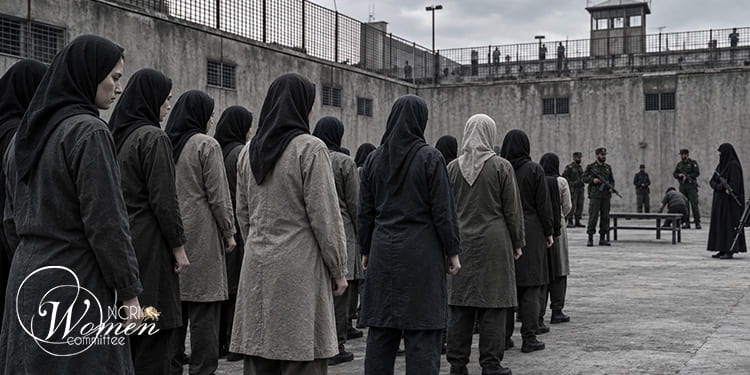
Once they had emptied our belongings and scattered everything across the floor, they forced us into the prison yard at baton point and lined us up around its perimeter. They brought a bench into the middle of the yard. Their intention was to publicly flog three women they particularly hated: Solmaz Azizi, Azam Taghdareh, and Razieh Ayatollahzadeh Shirazi. All three were later executed by the regime’s agents.
Once again, the solidarity and resistance of the women, there were about 150 of us, came to the fore. We all turned to face the wall and stood there.
The guards, who numbered more than sixty, were initially stunned by what they saw. For several minutes, they did not know how to react. Then they attacked us again, even more violently and hysterically than before, raining punches, kicks, whips, and baton blows on our heads and bodies. At the same time, they screamed and hurled every insult they could think of.
This savage beating continued for nearly two hours, until nightfall. Blood ran from the women’s heads and faces. Our bodies were bruised and battered. Several women had sustained serious injuries to their heads, arms, and legs, while others had lost consciousness.
The executioners were still not satisfied. They drove everyone back into the rooms, shut the doors, and deprived us even of our one daily period in the exercise yard.
Then it was the books’ turn. Apart from a few copies of the Quran, other books, and reference works such as dictionaries, we had very little reading material. The guards piled everything up in the prison yard, poured kerosene over the books, and set them alight.
Those same people who made such a show of their devotion to God and religion did not even hesitate to burn copies of the Quran.
That day, we watched from behind the bars as the Qurans burned alongside the other books. However, despite their brutality, the guards failed to find the books we treasured most. We had hidden them in secure places long before June 20, 1981, and they never discovered where we had put them.
Despite our bruised, wounded, and battered bodies, our spirits were high after the attack. We felt that we had won. We had prevented the criminal guards from carrying out one of their most inhumane methods of humiliation and torture: publicly flogging several prisoners in front of the others while accusing them of vile moral offenses.
Those moments of victory were so sweet that they made all the beatings, torture, and humiliation worthwhile. The pain and violence were fleeting, like foam on the surface of water. As soon as the guards left the ward, we would all start talking and laughing, telling one another what had happened and what each of us had been through.
Such a vibrant and resilient spirit was beyond Khomeini’s comprehension. The women’s actions struck at the heart of his regime. That was why the guards kept taking prisoners for interrogation over the ward’s collective activities and organization. While beating them, they would demand: “Tell us, who is your leader? Who gives you your orders and tells you to do these things and make yourselves miserable?”
In our hearts, we laughed at the executioner and thought: We are the ones who will make your lives miserable and bring you to your knees.
Even today, I am proud to have spent those years among those women. I miss every single one of them. I don’t know—perhaps their places have already been filled. All those sisters who are now in the National Liberation Army have grown from the very roots those women watered with their blood. They have taken their place.
To be continued…
[1] Massoud Rajavi’s departure for Iraq: Massoud Rajavi, then leader of the PMOI, left Paris for Baghdad on June 7, 1986, after living in France in exile since 1981. His departure followed pressure from the French government amid efforts to improve relations with Tehran. The news reached the prisoners at a time when they had very limited access to outside information.
[2] Mojtaba Halvaei Asgar, was security official serving as the deputy for discipline at Evin Prison. The memoir refers to him as the leader of the prison assault squad. He was one of the perpetrators of the 1988 massacre of political prisoners. He was also involved in the arrest and execution of PMOI supporters since the early 1980s.
[3] The prison office (zir-e hasht): Literally meaning “under eight,” this was a term used in Iranian prisons for the guard or administrative office through which prisoners were dealt with. It was not the name of a separate prison ward.