

Welcome to another episode of podcast of the Women’s Committee of the National Council of Resistance of Iran.
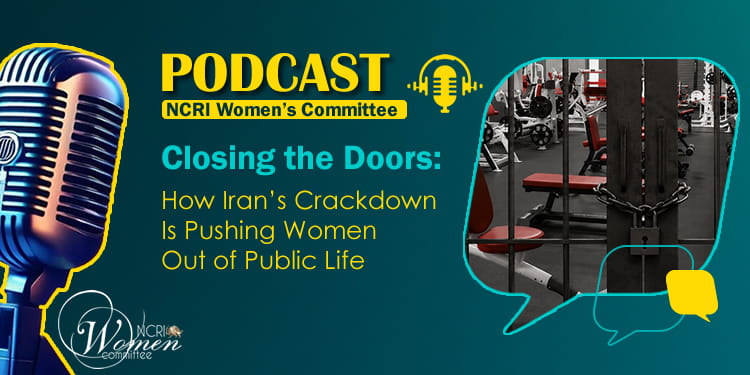
Let’s start with 08/01/2026. The source mentions that police in the city of Yazd completely shut down four women’s sports clubs. Like not just giving them a fine, actually sealing them off.
Yeah. They literally padlocked the doors and it wasn’t just that, authorities immediately filed legal cases against the managers for what they called “disciplinary violations,” which is you know incredibly nebulous terms.
It really is. It feels a bit like, I don’t know, getting a parking ticket, but then they crush your entire car. Like, why use such a vague administrative label to just destroy a business?
Well, the documents actually explain that. They highlight that this vagueness is a very deliberate tactic. By claiming disciplinary violations, the state’s repressive apparatus bypasses the need to prove a traditional crime.
Oh, I see. So it’s basically a loophole for them. Exactly.
It gives them the cover to enforce mandatory hijab laws or to fabricate charges like acts against chastity. It’s really just a guise for aggressively policing state mandated lifestyles.
Okay. So they’re weaponizing bureaucratic red tape. But, what really stood out to me in the text is the sheer scale of it all because it’s not just isolated to a few gyms in Yazd, right?
No, not at all. It’s part of a systemic shrinking of women’s social footprint. The documents show the fiber police, or FATA, are actively hunting down popular women led social media businesses. So female trainers, beauticians, content creators, things like that.
Wow. So, they’re going after their digital presence too. Yeah. They’re having their pages blocked and are being hauled in by state intelligence to sign these mandatory pledges. And the physical erasure mirrors the digital one perfectly.
In what way?
The reports talk about a surge in cafes being sealed, and even the physical removal of public seating and benches in parts of the Capital.
Wait, really? Removing public benches? How does taking away a place to sit actually help achieve their goals?
Think about it. A bench is basically an invitation to exist in public, right? To just linger without actively transiting from point A to point B. Right. By removing them, the state is deliberately shrinking women’s social breathing space. They’re trying to physically erase their presence from the public sphere by making it completely inhospitable.
That’s wild. So if there’s nowhere to sit, you can’t gather. And what makes this all so volatile is the timing. Because the text notes this is happening right as the Iranian economy is falling apart. It’s like a massive double burden.
It really is. The source highlights official statistics from the spring of 2026, and the numbers are just staggering. It says there was a decrease of 450,000 employed individuals.
And those people didn’t just lose their jobs, right? They stopped looking entirely. The text describes a massive wave of hidden unemployment where pure despair is just shrinking the labor pool. Right.
And look at who is dropping out. University graduates make up over 35% of the and youth unemployment is sitting at 23.4%.
So educated young women are bearing a hugely disproportionate brunt of this crisis.
Yes. And the core argument of our sources is that the regime has absolutely no economic solution to this stagnation. Instead of fixing the root causes of unemployment, they are relying entirely on security controls.
It’s like trying to put out a house fire by boarding up the window so nobody can see the smoke. They’re just using repression to contain public anger.
Exactly, to prevent an explosion of societal discontent.
Which leaves you, our listener, with a really interesting paradox to consider. If an establishment’s only response to staggering youth unemployment is to shut down the few spaces where highly educated women can work and gather, aren’t those women inevitably pushed into the underground, untaxed economy to survive?
That’s a great question.
Right, like doesn’t the state ultimately lose even more control over their daily lives by forcing them off the radar completely?
How sustainable is that before societal discontent just boils over?
It’s a strategy that might just accelerate the very loss of control it’s trying to prevent.
It certainly seems that way. Well before we go, we invite you to take action in support of the Iranian people’s resistance and its brave women. Yes, please encourage your networks to donate to the NCRI Women’s Committee to directly contribute to the genuine cause of Iranian women’s struggle.
You can visit the website wncri.org for more information. Thank you so much for joining us on this deep dive. Until next time, take care and keep asking the big questions.