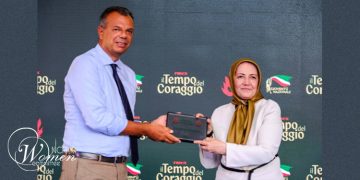
On Saturday, February 21, 2026, on the eve of March 8, International Women’s Day, the NCRI Women’s Committee hosted an international conference in Paris entitled “Women’s Leadership: An Imperative for a Free Iran and a Democratic Republic.” The conference, attended by women legislators, academics, thinkers, and prominent political figures, focused on women’s political participation and leadership as a decisive element in a democratic society.
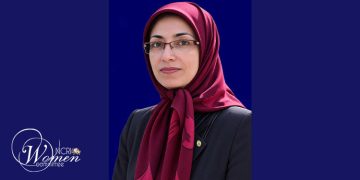
At this conference Karen Smith, former Special Adviser to the UN Secretary-General on the “Responsibility to Protect”, was present and delivered a speech. The full text of her speech is provided below:
Karen Smith: Iran’s Crackdown on Protesters: Decades of State Violence
Dear friends, it really is an impossible task to follow the inspirational and powerful speeches that we’ve heard, so I’m not really sure what I should say. I will try to keep my comments very brief. But before I continue, I would really just like to give a shoutout. I would like to really give a shoutout to the young people in the audience, but also in Iran, who I think are also leading the fight. So, I just want to say thank you so much for your courage and for showing us the way.
And like others have done, I would like to start by paying tribute to the courageous people of Iran who are standing up for their rights at great risk to themselves. In South Africa during the struggle for liberation, I’m from South Africa, a saying arose to reflect the strength of the women who played such an important role in fighting for democracy in South Africa. And that saying was the following: it was, “You strike a woman, you strike a rock.” And I think the same applies to the Iranian women as well.
I also wanted to underline the fact, as some others have pointed out, that the recent brutal crackdown on protesters was not an isolated incident but forms part of an ongoing, decades-long pattern of systematic, violent state repression. The UN Fact-Finding Mission on Iran has highlighted a worrying trend: the specific targeting of women activists, which involves detention, torture, and executions that may amount to crimes against humanity.
Karen Smith: Defending Women’s Rights in Iran: Upholding the UN’s 2005 Global Commitment
So, while gender equality, promoting women’s rights, is of course an important end in itself, it also means that support for women’s rights in Iran forms part of the commitment that all UN member states made in 2005 at the World Summit to not only protect their own populations from atrocity crimes, but also the populations of other states. But very importantly, they also signed up to prevent atrocity crimes from occurring in the first place. And I think all of us are under the obligation to remind the states that we’re from that they did make this commitment in 2005, and that included all UN member states unanimously, I should point out.
I think particularly in light of the very high risk of future severe human rights violations, the international community really has an obligation to prevent future atrocities from occurring in Iran. And this means addressing the ongoing culture of impunity that has allowed for the continuation and the recurrence of gross violations of human rights. In the UN context, and I will leave what can be done in the national context to all of the representatives here from national legislatures and other bodies, but in the UN context, this can take the form of ensuring that the situation in Iran remains on the agenda of the UN Human Rights Council and also on the agenda of the UN Security Council. And also, that the Fact-Finding Mission includes an assessment of possible atrocity crimes in its broader investigation.
But most importantly, the international community must collectively and consistently condemn Iran’s decades-long oppression of its people and, to echo the words of a previous speaker, really center the human rights situation in all its engagements with Iran, including Iran’s nuclear deal. Finally, there must be a recognition that any future peaceful Iran that also does not pose a threat to regional stability must be one based on the rule of law, on gender equality, and the full participation of women in all spheres of society, including in political leadership.