When the regime’s Supreme Leader is forced to confess, it means the scale of the crime has exceeded all attempts at concealment. In a speech on January 17, 2026, Ali Khamenei admitted to the massacre of “several thousand people.”
Although he immediately tried to distort reality by blaming this “massacre” on the United States, the very admission itself stands as an unintended seal of confirmation on what the people of Iran have written in blood on the streets: the commission of a crime against humanity on a massive scale.
Just two days later, on January 19, 2026, Gholamhossein Mohseni-Ejei, the regime’s Judiciary Chief, completed another link in the chain of this crime. He ordered judges to expedite verdicts against protesters—an instruction that means nothing less than the elimination of due process and the paving of the way for executions and heavy sentences. In this way, the street massacre became inseparably linked to a judicial massacre.
At the same time, the clerical regime has sought to prevent the disclosure of the scale of this atrocity by imposing a widespread shutdown of international internet access. With blatant arrogance, the spokesperson for President Pezeshkian’s government told journalists:
“Do not expect international internet access until Nowruz 1405. You must get used to the current situation” (Mizan News Agency – January 15, 2026).
Confessions from Within State Media
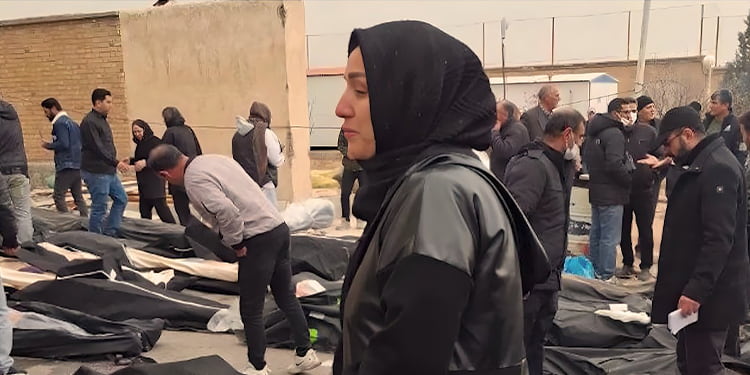
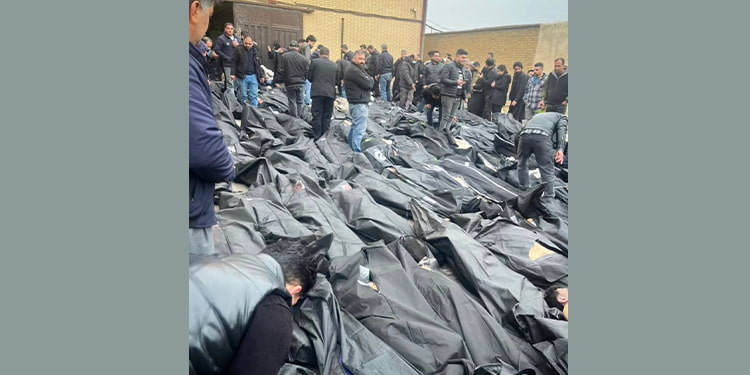
Despite heavy censorship, the magnitude of the killings was such that even state-controlled media could not remain completely silent. In a rare interview, Iran’s state radio and television acknowledged the abandonment of large numbers of victims’ bodies at the Kahrizak forensic center:
Host: “Why is it like this there? Why are the body bags and bodies left on the ground like this?”
An official of the Kahrizak morgue:
“Well, the incident that happened on Thursday—most of these individuals are from Thursday (January 8), meaning they are related to the deaths from that day… Anyone who wanted to find their loved one’s body had to come and look at the covers; if they couldn’t find it, they basically had to keep searching to see if they could. Some didn’t find them. Then they came again… Because some were still unidentified until Tuesday when we were there. I feel that the forensic medicine organization simply was not prepared for something on this scale… Everyone there was in shock; everyone was stunned. It was an extraordinary surprise.” (State Television, January 16, 2026)
Shots to the Head, the Heart, and the Eyes
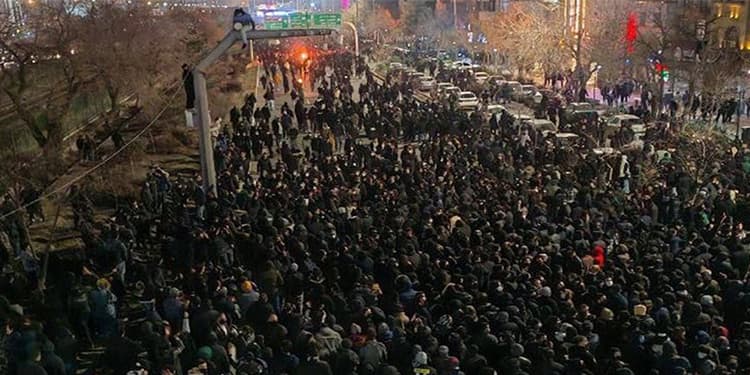
Field reports indicate that the Islamic Revolutionary Guard Corps (IRGC) and Khamenei’s proxy forces turned city streets into killing fields. Men, women, teenagers, and even defenseless children were shot at close range. Live ammunition was fired at heads, necks, hearts, and eyes. A five-year-old child was killed in his mother’s arms. Protesters were gunned down from rooftops and pedestrian bridges. Hospitals were stormed, doctors and medical staff arrested, and wounded protesters executed with finishing shots.
A doctor in Tehran who directly witnessed the events reported that security forces even attacked ambulances carrying injured protesters and killed the wounded by firing directly at them. According to him, the repression forces resorted to “every possible method” to kill people during those two days.
Some families, fearing that security forces would seize their loved ones’ bodies, were forced to bury them secretly in their own yards. Images leaked from the Kahrizak forensic center and Behesht-e Zahra cemetery reveal only a fraction of the reality concealed under the internet blackout.
In a deeply alarming development, evidence is emerging that the regime may be deploying chemical agents against its own population. Newsweek reported that former UK lawmaker Bill Rammell cited a “credible report” from Iranian-Kurdish sources indicating that “toxic chemical substances” have been used to suppress protests. According to these accounts, exposure to the substances has caused severe injuries, with some victims dying days later.
The Judiciary as a Machine of Repression
Simultaneously, the judiciary refused to allow detainees access to lawyers of their own choosing. Mohseni-Ejei ordered judges to accelerate rulings against protesters, an action observers warn amounts to the total removal of fair trial guarantees and a prelude to heavy sentences, including executions.
At the international level, Volker Türk, the UN High Commissioner for Human Rights, on January 2, 2026, called for “prompt, independent and transparent investigations” into all protest-related deaths and warned: “Impunity perpetuates the cycle of violence.”
Warnings from UN Experts and Amnesty International
UN human rights experts, in a statement issued in Geneva on January 13, condemned the use of “lethal and excessive force” against largely peaceful protesters, including live ammunition, metal pellets, raids on hospitals, and the arrest of schoolchildren.
Dr. Mai Sato, UN Special Rapporteur, wrote: “The dangerous rhetoric labelling peaceful protesters as ‘terrorists,’ ‘rioters,’ or ‘mercenaries’ seeks to justify brutal crackdowns. The exact death toll remains uncertain due to the shutdown, but it is likely to be in the thousands or more. Regardless of the exact number of deaths—even a single casualty is extremely serious.
Despite operating in a severely restricted civic space with immense personal risk, the people of Iran continue to demonstrate extraordinary courage in their pursuit of fundamental rights.”
Amnesty International announced on January 14, 2026, that Iranian authorities had committed “unlawful mass killings on an unprecedented scale.”
Its Secretary General, Agnès Callamard, stated: “This spiral of bloodshed and impunity must end. Even by the Iranian authorities’ own bleak record of committing gross human rights violations and crimes under international law during successive waves of protests, the severity and scale of killings and repression since 8 January is unprecedented.”
Europe Reacts
In Europe, Austrian Chancellor Karl Nehammer condemned the bloody crackdown and said: “The regime in Iran is cruel, violent, and gruesome, and is not reluctant to use brutality and cruelty and force against its own people. I vehemently condemn this, and those who have been promoting freedom in Iran have my full support.”
Roberta Metsola, President of the European Parliament, warned: “We are appalled by the deadly force used by the Iranian regime against the brave Iranians marching in the streets for their liberties and for their rights. This must stop, and at a European Union level we must step up our action.”
In the German Bundestag, Johannes Vogel stated: “A regime that maintains its power solely by shooting its own people has lost its international legitimacy.”
The World Must Not Remain Indifferent
In a letter signed by 14 former European leaders to EU officials, they wrote: “We call on the European Union to recognize the right of the Iranian people to resist tyranny and to establish a democratic republic.”
This massacre, as horrific as it is, is not the end. These bloodstains will turn into voices.
“We have no right to remain indifferent; This is not only Iran’s struggle, it is a global struggle: a struggle for human dignity, for freedom, and for justice.”