

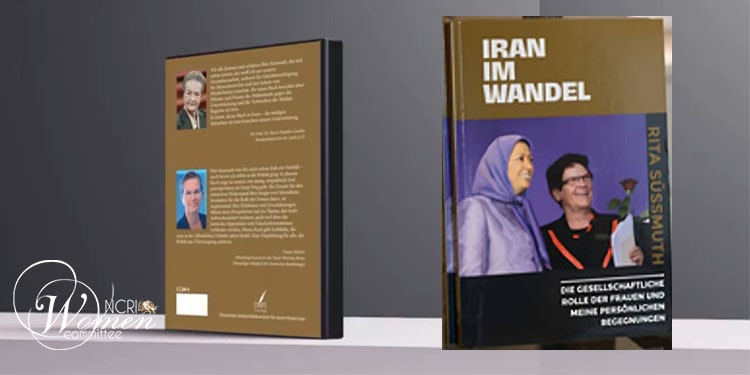
In a new and lasting report, Professor Rita Süssmuth, who served for ten years as the President of the German Federal Parliament, takes readers on a powerful journey into the struggles of the Iranian people for freedom and human rights in her book titled “Iran on the Verge of Transformation: The Social Role of Women and My Personal Experiences.”
In the introduction of her book, she writes that her intention was to be a voice for the women who have stood up against one of the most misogynistic dictatorships in the world, while also sharing her own experiences of resolute support for Iran’s democratic opposition.
Published in German, the 128-page book includes a preface and nine chapters. It is the result of 18 years of active engagement alongside the National Council of Resistance of Iran (NCRI) and the People’s Mojahedin Organization of Iran (PMOI/MEK). This work presents an honest and deeply human collection of observations, challenges, and political struggles in which she has been personally involved. The book serves as an invitation to all to view, through personal experience, a collective and global struggle for freedom and human rights in Iran.
The foreword is written by Dr. Christina-Maria Bammel, Bishop of the Protestant Church of Berlin-Brandenburg, who emphasizes the importance of the Iranian people’s resistance—particularly that of women—against religious fundamentalism.
The back-cover endorsement comes from Herta Däubler-Gmelin, former German Minister of Justice, who underscores the necessity of supporting this movement and the Iranian people’s aspiration for freedom.
From the Bundestag to the Women’s Movement in Iran: Rita Süssmuth and the Common Struggle for Democracy and Human Rights
Born in 1937, Rita Süssmuth is one of Germany’s most distinguished and influential politicians, having worked at the highest political levels for more than two decades. From 1988 to 1998, she held the office of President of the German Bundestag, marking the highest political position ever occupied by a woman in Germany at that time. She had also previously served as Minister for Youth, Family, and Health.
Professor Süssmuth is widely known for her firm positions on human rights, democracy, and social issues. Before entering politics, she had an accomplished academic career, earning professorships in philosophy, sociology, history, and educational sciences, while also serving as president of various universities and academic institutions in Germany and abroad.
In parts of her book’s introduction, she writes:
“If someone had told me that my life path would lead me to the highest political levels of Germany, I might have doubted it. But it seemed even more unlikely that my political experiences would one day become inseparably linked with Iran’s resistance movement.
In more than a decade of solidarity with this resistance, I was not only a politician or an academic, but sometimes also a student, sometimes a fighter, and always a human being struggling for higher values against injustice. I encountered three generations of women, each with their own unique story, yet all united by a single goal: freedom for Iran—inseparable from freedom for women.”
She continues:
“Dear readers, I invite you to join me on this journey—a journey that took me from doubt to certainty, from a superficial acquaintance to a deep bond. Today, Maryam Rajavi has become far more than a political leader for me; she is a sister in spirit and in the struggle.”
A Journey Through the Chapters: From Politics to Solidarity
At the end of Chapter One, which summarizes her five-decade-long entry into politics, Süssmuth writes under the title “Resistance in Iran, One of the Most Challenging and Inspiring Struggles of My Life”:
“Among all the confrontations I have experienced, supporting the Iranian Resistance has been one of the most important and intense. Why? Because this was not merely about a political movement. It was a fight for existence, for freedom, for human rights, for life itself. This movement was not advanced by people simply struggling for political rights, but by those fighting for their very survival, people standing up against a religious dictatorship that systematically oppressed women, brutally persecuted dissidents, and suffocated any form of democratic resistance through violence.”
She notes that her commitment to this struggle brought with it many challenges, political pressure, hostility, and opposition. Yet despite all the hardships, she emphasizes that this engagement has been one of the most vital and meaningful commitments of her political life, and one that continues to remain strong and fruitful.
In Chapter Two, under the title “The Moment That Changed Everything,” she recalls her first encounter with the Iranian Resistance in 2008:
Looking back, the year 2008 was a turning point for me. I no longer remember the exact date of that day, but the scene is still vividly etched in my mind. I was stepping out of the official car to enter my office on the well-known ‘Unter den Linden 71’ in Berlin, when suddenly a young woman approached me with quick steps. She wore a headscarf but spoke fluent German. With a firm tone, she asked me to sign a statement against executions in Iran and in support of human rights and freedom. I don’t know why, but at that moment I decided to stop. There are moments in life that unexpectedly set a new path before us—moments for which we have made no plan and from which we expect nothing, yet they change everything. This encounter was one of those key moments for me.
My driver, who was an employee of the German Federal Parliament, looked on at the scene in astonishment. But I listened carefully to the young woman’s words. Her arguments were logical and well-reasoned, yet what impressed me most was her conviction, her determination, and her unwavering faith in her cause. She spoke about repression and executions, but not with despair or resignation—rather with an astonishing inner strength. Her unshakable will to believe in a better future was reflected in her eyes.
As a woman who had devoted her entire life to the struggle for gender equality, this determination moved me deeply. I signed the statement. She smiled, visibly pleased with this small success. Yet as she walked away, I began to wonder: Why must these people stand outside parliament to gather signatures? Why could they not speak directly with members of parliament in their offices?
This first question led me into a process that, in the years that followed, would compel me to ask and answer dozens more.”
In Chapter Four, Süssmuth details her support for the NCRI and documents her efforts to remove the MEK from the terrorist list, candidly recounting the obstacles, pressures, and psychological warfare she faced along the way.
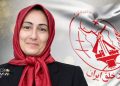
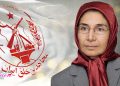
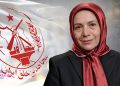
In Chapter Five, “My Experiences with Ashraf,” she introduces five women from Ashraf 3 in Albania, highlighting their courage and resilience:
“In my visit to Ashraf 3 and through my meetings with Iranian women who have dedicated years of their lives to the struggle for freedom and against oppression, I encountered stories of endurance, bravery, and sacrifice. These women had survived torture, prison, and immense suffering, and had become symbols of resistance. Their stories must be heard, for they are deeply inscribed in the history of Iran’s struggle.”
In Chapter Six, “My Encounters with Maryam Rajavi and Her Vision,” Süssmuth compares Rajavi’s leadership to historic figures such as Nelson Mandela:
“Throughout my political career, I have met many presidents, ministers, and party leaders. Almost all possessed charisma, competence, and political skills. But figures like Maryam Rajavi or Nelson Mandela are beyond ordinary politicians. They possess vision and foresight, striving for something fundamental: freedom. This is because they do not simply represent a political faction but embody the profound aspirations of a nation.”
Professor Süssmuth concludes her book with these words:
“A new history is being written here, one that must be heard. A brighter and more hopeful future for Iran, the region, and the world is taking shape. This future is no longer a distant dream; it is becoming more real every day. And this assures me, as Martin Luther King once said, that I am standing on the right side of hope.
This hope inspires countless people across the world, not only in Iran. Of course, this path has always been long and full of obstacles. Yet, the efforts made so far have been invaluable, for more and more people—even those not directly persecuted—are joining this struggle.
Among them, passionate pioneers play a decisive role, figures recognized for their achievements, like Maryam Rajavi.
We continue on our path. We do not surrender, but grow stronger and more influential across the world. We are not alone. Long live hope, the last thing that dies.”