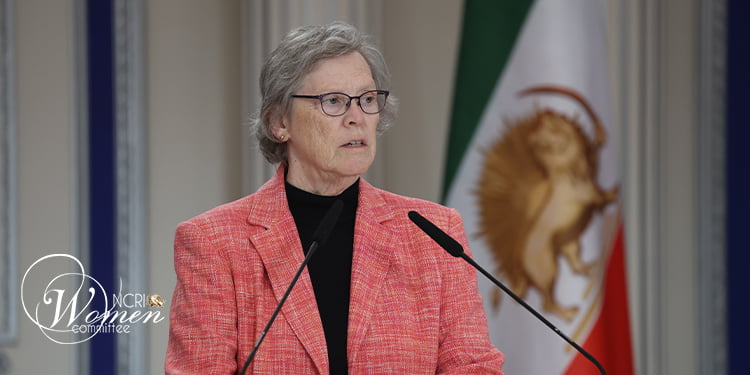
On Saturday, February 21, 2026, on the eve of International Women’s Day (IWD2026), the NCRI Women’s Committee hosted an international conference in Paris entitled “Women’s Leadership: An Imperative for a Free Iran and a Democratic Republic.”
The conference, attended by women legislators, academics, thinkers, and prominent political figures, focused on women’s political participation and leadership as a decisive element in a democratic society.
Ms. Donna Hughes, Professor of Gender and Women’s Studies, United States addressed the conference.
Donna Hughes: All Speakers Addressed the State of Women’s Rights in Iran, under the Regime of Gender Apartheid
This morning, we held a panel on the role of women in achieving freedom for women in Iran. We had fourteen speakers from European countries, Canada, and the United States. The speakers were highly qualified professionals, many of them attorneys with experience in parliaments. As you have heard here, they were highly accomplished women who have dedicated their lives to achieving justice, especially for women. All of them spoke about their knowledge of Iran and their expertise regarding the situation of women in Iran.
Almost all the speakers addressed the state of women’s rights in Iran, particularly under the regime of gender apartheid. They presented details about women’s lack of individual rights and family rights. These violations were often described in detail. Several speakers noted the high execution rate of women and the prevalence of violence against women. Some women were executed for their activism, and others were executed for acts committed in situations of domestic violence in which they killed someone in self-defense.
The Necessity of Accountability, Women’s Solidarity, and the Path to Change
One of the women clearly spoke about the need for accountability for atrocities and the importance of the rule of law. In the absence of internal mechanisms in Iran to ensure accountability, she discussed the importance of external mechanisms and how we can support them, either through human rights monitoring or through international human rights law.
All of the speakers discussed women’s leadership within the PMOI and the NCRI. All enthusiastically endorsed Maryam Rajavi and the role she has played in leadership and in shaping the ideas of women’s emancipation and empowerment.
The speakers emphasized the strong need for solidarity among women. One woman called for greater empathy toward women. She stated that if we use empathy and solidarity to promote international cooperation, we can combat authoritarianism and the absence of the rule of law and work toward strengthening both national and international rule of law.
We also heard from a former political prisoner from Iran. She told us that she endured three months in solitary confinement and was tortured. She came to realize that we need a critical understanding of freedom based on women’s experiences and their rights. She recognized Maryam Rajavi and all the MEK women for their strength. She emphasized that more women need to join the resistance units in Iran because, as she stated, we can and we must.
Dowlat Nowrouzi also discussed the aggressive deception promoted by the son of the Shah, Reza Pahlavi. No one else had mentioned this issue, but she provided a clear summary of the problem we are facing because of his use of social media and automated accounts.
Finally, we must call on the international community to acknowledge the Iranian people’s right to change their leadership. That was probably the most important point.
Thank you.