Prison Memoirs of Azam Haj-Heydari from the book The Price of Being Human – Part Sixteen
In this installment of The Price of Being Human, Azam Haj-Heydari recounts her transfer to Gohardasht Prison and describes the harsh conditions she and other political prisoners endured there.
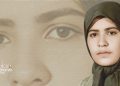
At the time, Azam was a young teacher in her early twenties who had joined the struggle against the Iranian regime. She spent five years imprisoned in the Temporary Judiciary Detention Center, Evin, Qezel Hesar, and Gohardasht prisons, where she was subjected to brutal torture by Khomeini’s guards.
Inside Gohardasht
After twenty days without even the most basic hygiene facilities, a prison guard came to my cell one day and shouted, “Hey, Monafeq![1] Get up. Time for a shower!”
“I don’t need one,” I replied.
He stormed in, cursing, snatched away my chador, and threw it into the shower room.
“So you won’t take a shower?” he sneered. “Then later you’ll go around spreading propaganda, claiming we never let you bathe!”
I said nothing. I stood silently in a corner of the shower room without moving.
About ten minutes later, I heard footsteps approaching. Terror gripped me.
A huge man appeared—thick beard, bulging eyes, towering over me. Laughing loudly, he slid open the hatch in the shower door and looked inside.
“So, Monafeq,” he sneered, “are you afraid of me? Why? You should be afraid of your leader.”
He opened the door and came toward me. He clamped a hand over my mouth, forced me into one of the shower stalls, and pinned me down. Despite my desperate struggle, he overpowered me and assaulted me.
For several minutes I fought back, striking his face with my fists and screaming. Finally, he slammed two hard blows into my head and walked away.
About half an hour later another guard arrived.
“So, you’re not taking a shower?” he said contemptuously. “Fine. To hell with you. Get back to your cell and rot.”
It was obvious they were working together. They would come, assault me in these degrading ways, then disappear for a while before returning again. This happened three times during the two months I spent in Gohardasht as punishment.
One day, while I sat blindfolded in my cell, someone—I never learned who—came to interrogate me.
“So,” he asked, “do you still want to be a Monafeq? Or have you changed your mind? If not, I’ll make you regret it.”
Four or five days later, one night, I heard someone singing.
The voice was beautiful.
She sang revolutionary songs. She recited verses from the Qur’an. She spoke to herself. She addressed Ashraf, Mousa, and the other martyrs as though they could hear her. She cried, laughed, prayed, and whispered her thoughts aloud.
I found myself deeply moved.
Again and again, I wondered, who is she?
She sang at the top of her voice without the slightest fear.
Finally, I called out, “What’s your name?”
“Mehri,” she answered.
“Why did they bring you here?”
“They say I’m insane,” she replied. “But they’re the ones who drove me insane. They raped me every day. They’re torturing my sister, and…”
Before Mehri could finish speaking, I heard the footsteps of the same executioner approaching. They took her away, and I never heard her voice again. I never learned who she was.
When I was transferred to Gohardasht, the prison had not yet begun receiving large numbers of prisoners. Through the slats covering my cell window, I could see male prisoners being taken into the cellblocks opposite mine.
About a month later, I began hearing women’s voices as well. Soon female guards also began appearing in our section.
A few days after that, I was transferred back to Qezel Hesar Prison.
I never saw any of the women who had been held in solitary confinement at Gohardasht again.
Conditions of Qezel Hesar Cells
By February 1984, I was being held in Ward 7 of Qezel Hesar.
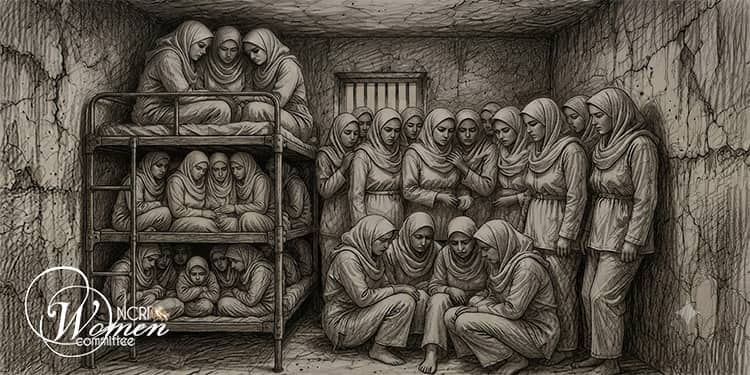
The cells had originally been built for one or two prisoners, but each now held twelve to fourteen women, sometimes even more.
The cell was only a few inches longer than a bunk bed and roughly two feet wider than the three-tiered bunk that filled most of the room. Fourteen people could barely even sit inside such a space.
Almost every day we were punished for one pretext or another, and the cell door was locked.
Sleeping had become a nightly engineering problem.
Several women slept crosswise on each bunk. From the waist up they lay on the mattress while the rest of their bodies hung over the edge. The taller women managed a little more comfortably. The shorter ones had to brace their feet against the opposite wall just to keep from dangling.
Others crawled underneath the bunks, lying in the opposite direction, with their heads sticking out beneath the feet of those sleeping above them while the rest of their bodies remained underneath the bed.
One or two women slept beside the door.
Whenever the cell doors were left open, conditions improved slightly because women could sleep in the corridor as well.
Even there we lay packed together like sardines, usually on our sides.
The guards and the collaborators walked among us throughout the night, making sure no one spoke.
If they reported that two prisoners had exchanged even a few words, both women were taken away for interrogation and tortured until they revealed what they had supposedly discussed.
20 Minutes of Hot Water for Shower and Tea
Qezel Hesar had another peculiar ritual.
Once each week, the shower water was heated—for exactly twenty minutes.
Shower day became an event.
For two or three hours before and afterward, the ward buzzed with unusual activity. The prisoner responsible for organizing the schedule called out names as women rushed toward the showers.
Nearly two hundred prisoners had only twenty minutes of hot water.
Others had a different responsibility.
They carried empty metal cheese tins to collect hot water for making tea.
Each cell had its own designated “tea keeper.” As soon as the hot water was turned on, she sprinted toward the showers with a cleaned cheese tin, filled it with hot water, and hurried back so the women in her cell could brew what we called bathhouse tea.[2]
If you missed those twenty minutes, there would be no tea at all that week.
The prison’s regular tea contained so much camphor[3] that crystals settled at the bottom of every cup. It scarcely tasted like tea anymore. But the tea we brewed ourselves with fresh hot water from the showers tasted like real tea.
Under conditions of absolute repression, we drank that simple cup of bathhouse tea with genuine joy.
The prison authorities hated seeing us happy.
Whenever the ward came alive with laughter and conversation, they tried to destroy the atmosphere with shouting, insults, or by dragging several prisoners away for beatings.
One day in February 1984, when the shower water was heated, we prepared bathhouse tea as usual.
We filled the metal tins with hot water, wrapped them in blankets to keep them warm, and waited for the tea to steep.
Several of us, including myself, were sitting on the top bunk when suddenly we heard the voice of the collaborator we called “the Gestapo.”
“No tea!” she screamed. “You’re forbidden to make tea!”
She was obviously looking for an excuse. Until then, no one had objected to bathhouse tea.
The women ignored her.
They filled the tins anyway, added the tea leaves, wrapped everything in blankets, and waited.
Furious, the Gestapo collaborator stormed downstairs to report us.
Twenty minutes later the ward door burst open.
Twenty-five names were called for interrogation, including mine and Hengameh Haji-Hassan‘s.
This was unusual.
Qezel Hesar was supposed to be where prisoners simply served their sentences—not where they were repeatedly interrogated.
We gathered our things and left the ward.
They kept us standing downstairs for nearly an hour.
As I waited, I wondered what they had planned for us this time.
Were they sending us back to Evin? To Ward 209? To Ward 311? To Gohardasht? Somewhere else?
My greatest fear was that they would interrogate us about activities inside the ward.
We had never arranged in advance what to say if questioned.
If they ask me, I thought, how can I answer without bringing more suffering upon the others?
A sentence someone had written on a prison wall came back to me:
“The pain of torture will pass, but the disgrace of betrayal will remain.”
I kept praying silently.
“God, help me keep my honor.”
By then we had already heard stories about the Residential Unit[4] and the new methods of interrogation and torture used there. We had seen some of their consequences ourselves.
I continued speaking to God in my heart.
“If there is any chance that I might break… if I might betray others… then let me die first. I do not want to save my own life only to sink into the disgrace of betrayal.”
To be continued…
[1] Monafeq– Literally “hypocrite.” The Iranian regime used the term as a derogatory label for members and supporters of the People’s Mojahedin Organization of Iran (MEK/PMOI). Throughout this memoir, the original Persian term has been retained to reflect its political and historical significance.
[2] Bathhouse tea – Prisoners had access to hot water for only about twenty minutes each week, when the communal showers were heated. They hurriedly collected the water in metal tins to brew tea, turning this small ritual into a rare moment of comfort and solidarity.
[3] Camphor – Prisoners commonly referred to the prison’s regular tea as “camphor tea” because it contained a noticeable amount of camphor. Many believed it was deliberately added by prison authorities to weaken or suppress prisoners physically and psychologically, although the authorities never acknowledged doing so.
[4] Residential Unit– The was the regime’s deceptively named punishment ward in Qezel Hesar Prison. Former prisoners describe it as a center of psychological torture, prolonged isolation, humiliation, and, in numerous testimonies, sexual violence against female political prisoners. The innocuous name concealed one of the prison system’s most feared punishment units.