

The Rising Wave of Femicide in Iran in 2026 and the Role of Misogynistic Laws and Policies in Perpetuating These Crimes
October 2026 Report: Femicide in Iran: While combating violence against women, criminalizing domestic violence, and protecting women at risk have become legal and social priorities in many countries around the world, women in Iran continue to face a system under the misogynistic clerical regime that denies them even the most basic legal protections.
The rising number of women murdered in Iran cannot be dismissed as a series of individual crimes or family disputes. These crimes do not occur in a vacuum. They are the product of a system in which discrimination against women is institutionalized, laws offer them no protection against violence, violence against women is not criminalized, and perpetrators enjoy effective impunity.
Nearly five decades of rule by the mullahs’ regime, marked by the promotion of patriarchal values and the obstruction of protective measures, have created conditions in which violence against women has become normalized and recurrent.
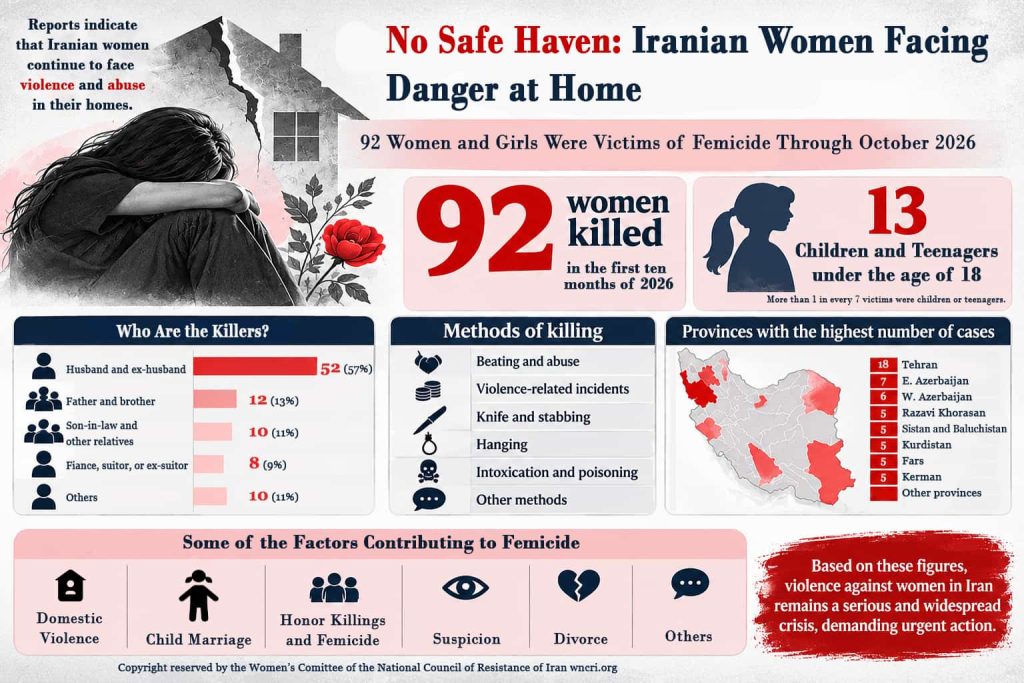
An examination of documented cases of women murdered in 2026 reveals that the home has become the most dangerous place for many Iranian women. Most victims were killed not by strangers, but by their husbands, former husbands, fathers, brothers, sons-in-law, and other men within their immediate families.
October 2026: One of the Deadliest Months for Women in Iran
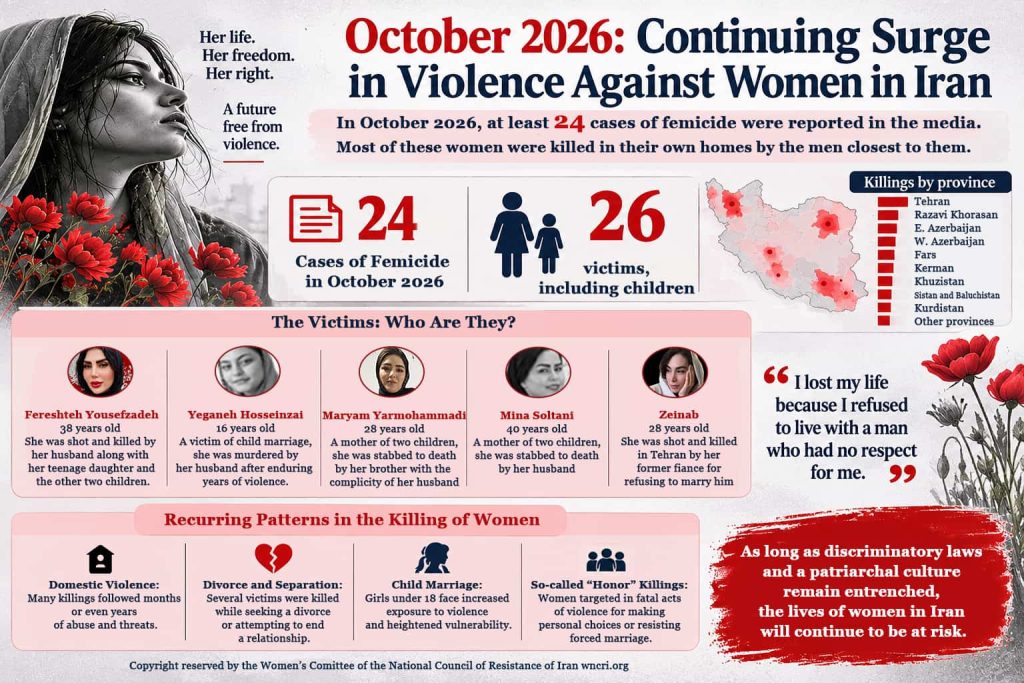
October 2026 became one of the darkest and bloodiest periods of the year for women in Iran. During the month, at least 24 murder cases involving more than 26 victims, including women and children, were recorded across the country. This horrifying figure means that, on average, one woman or child fell victim to domestic violence every day.
The roots of these crimes lie not in isolated incidents, but in a recurring structural pattern: the exercise of domination and control over women, opposition to their independence and right to divorce, the continuation of the child marriage crisis, the prevalence of so-called “honor killings,” and women’s complete lack of protection in the face of legal vacuums.
Clearly, these figures represent only a fraction of the actual scale of the problem and reflect only cases that have managed to reach the media. Given the authorities’ systematic concealment of information, the actual figures are far higher.
Media outlets and domestic experts have previously acknowledged that at least 66 percent of women in Iran experience domestic violence at some point in their lives (ISNA, November 16, 2018). They have also warned that “today, no home in Iran is safe” (Jahan-e Sanat, November 19, 2020).
With the deepening economic crisis and mounting financial pressures in recent years, the scale of this catastrophe has undoubtedly grown even more extensive and alarming.
Fereshteh Yousefzadeh: A Mother Shot Dead Alongside Her Children
On October 15, 2026, Fereshteh Yousefzadeh, a 38-year-old mother of three from Dehloran, became the victim of one of the most shocking murders of the year. Her husband, a member of the Revolutionary Guard Corps (IRGC), opened fire with a Kalashnikov rifle on his wife, her 14-year-old daughter Roza, and two other children in the family.
The main dispute centered on Fereshteh’s daughter from a previous marriage and her presence in the household. Fereshteh had left the family home some time earlier. However, when she returned to collect her belongings, she and the children were shot and killed.
Yeganeh Hosseinzai: A Victim of Child Marriage
Yeganeh Hosseinzai was only 16 years old. She lost her father when she was three. According to her mother, plans had been made for her to marry her cousin when she was just 10, and she was married at the age of 14.
Yeganeh’s mother repeatedly appealed to various authorities in an effort to prevent her daughter’s early marriage, but she was unable to stop it. (Rokna, October 20, 2026)
On October 9, 2026, Yeganeh’s husband beat her with a cable and a baton before strangling her to death.
Yeganeh’s short life offers a stark picture of the fate of many victims of child marriage in Iran: girls who are deprived of their right to education, childhood, and freedom of choice before reaching adulthood, and are trapped in a cycle of violence.
Maryam Yarmohammadi: Victim of a So-Called Honor Killing
On Qeshm Island, Maryam Yarmohammadi, a 28-year-old mother of two, was murdered by her brother.
According to reports, Maryam’s husband also collaborated with her brother in the crime. On the night of the murder, he took the children out of the house. Her brother then stabbed Maryam repeatedly in the neck, chest, and other parts of her body, killing her.
Even more disturbing than the murder itself was the reaction that followed. Some of Maryam’s relatives protested the arrest of the perpetrators. Her brother and husband were even listed as chief mourners in her death announcement.
This case offers a stark illustration of a culture in which violence against women is justified or normalized under the protection of discriminatory laws.
Mina Soltani: A Mother Murdered in Her Own Home
In Isfahan, Mina Soltani, a 40-year-old mother of two, was murdered by her husband.
Before committing the crime, the perpetrator lured his 21-year-old son out of the house under a pretext and locked his other son, aged 10, in a room. He then stabbed his wife repeatedly, killing her.
This crime is another example of a reality that was repeated time and again in 2026: women losing their lives inside their own homes, the very places that should be the safest environments for them.
When Rejecting a Marriage Proposal Ends in Murder
The murder of women in Iran is not confined to marital relationships.
In October 2026, Zeinab, a 28-year-old woman who had rejected a marriage proposal from her former fiancé, was shot and killed at a shopping mall in Tehran.
In numerous other cases documented in 2026, women have also fallen victim to deadly violence for seeking divorce, demanding their dowries, separating from their husbands, or rejecting marriage proposals.
From Domestic Violence to Murder
An examination of documented cases shows that murder was not the first form of violence experienced by the victims.
Many women had faced threats, coercive control, physical assault, psychological abuse, economic deprivation, and severe restrictions before being killed. In numerous cases, the victims had sought divorce or attempted to escape abusive relationships.
In other words, murder is the final link in a chain of violence that has continued in the absence of legal protection.
Child Marriage: A Pathway to Violence and Death
Among the victims in 2026 are numerous girls and women who had been subjected to child marriage.
From Jana Saadoei to Yeganeh Hosseinzai and several other victims, a similar pattern emerges: marriage at an early age, dropping out of school, economic dependency, persistent abuse, and ultimately murder.
Child marriage in Iran is legal and widespread. Forced and early marriage of girls is one of the most blatant forms of institutionalized violence against adolescent girls in Iran. This practice is a byproduct of the mullahs’ misogynistic regime and has become a social catastrophe as a result of the regime’s political and economic policies.
Why Do Perpetrators Feel They Can Act with Impunity?
Perhaps the most important question, however, is why these crimes occur so frequently and on such a scale.
The central question is not why a husband, father, or brother commits murder. It is why so many perpetrators are confident that they will not face serious and deterrent consequences.
A well-known example is the case of Mona Heydari. Mona was an adolescent girl who, after years of child marriage and domestic violence, was murdered by her husband in February 2022.
Images of Mona’s husband displaying her severed head in the streets of Ahvaz after beheading her shocked public opinion in Iran and around the world. Yet, the sentence imposed on her murderer was wholly disproportionate to the horrific nature of the crime, and he returned to normal life after a relatively short period.
The message this case sent to society was clear: even one of the most horrific murders of a woman does not necessarily result in a severe and deterrent punishment. Similar cases continue to occur.
In June 2025, Hanieh Behboodi, a champion arm wrestler, was murdered by her husband in Mashhad. Before killing her, he had also severed her hands. Hanieh was also a victim of child marriage and had a four-year-old daughter.
This is not merely a matter of individual acts of violence. The fundamental problem is that perpetrators of such crimes operate in an environment where existing laws neither protect women nor provide the necessary deterrent effect.
The failure to criminalize domestic violence, the continued stagnation of legislation intended to protect women, the shortage of shelters, the perception of women as men’s property, and institutionalized legal discrimination have all contributed to a culture of impunity.
Every time a murderer receives a lenient sentence, society is sent the message that women’s lives are not adequately protected.
Alarming Statistics for 2026
An examination of documented cases through the end of October 2026 reveals that:
- At least 92 women and girls have been murdered.
- At least 13 of the victims were under the age of 18.
- The majority of the murders were committed by the victims’ husbands, former husbands, fathers, or brothers.
- Numerous cases were directly linked to child marriage, forced marriage, and domestic violence.
- Tehran, Kurdistan, East Azerbaijan, West Azerbaijan, Sistan and Baluchestan, Razavi Khorasan, and Kerman are among the provinces where multiple cases of femicide have been recorded.
These figures include only cases reported by the media. The actual scale of the crisis is likely far greater.
Femicide in Iran Is Not an Individual or Family Matter
Although the knives, guns, ropes, and fire are wielded by husbands, fathers, brothers, or other male family members, the roots of these crimes lie in a system that treats women as second-class citizens, denies them legal protection, and effectively grants perpetrators of violence against women impunity.
The rising wave of femicide in 2026 once again demonstrates that as long as discriminatory laws, officially sanctioned patriarchal culture, and the misogynistic policies of Iran’s ruling regime remain in place, women will continue to pay for this repressive system with their lives.