
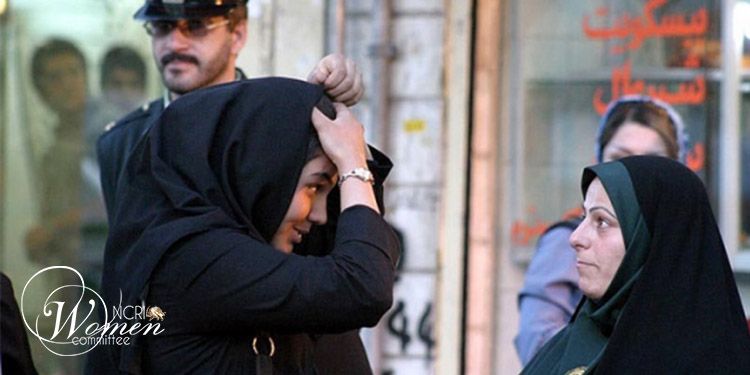
At a time when the clerical regime is facing deep economic and social crises and widespread public discontent, it continues to regard forced hijab as one of the tools for subjugating women and repressing and controlling society.
In recent weeks, clear signs of efforts to intensify this pressure have emerged, from schools and universities to the streets and businesses. At the same time, statements by some officials and state-run media indicate that the religious dictatorship is also concerned about the social and political consequences of this policy.
Thus, the clerical regime finds itself caught in a dilemma: on the one hand, it cannot retreat from its policy of imposing the hijab, while on the other, it fears that expanding direct confrontations with women could become a spark for broader protests.
From Schools to Universities; Expanding the Scope of Forced Hijab
One sign of the intensification of this policy is the expansion of controls over girls and women in educational settings.
Saeed Karimi, deputy representative of the Supreme Leader at universities, said on September 8 that a hijab directive for universities had been drafted and was to be issued by the Ministry of Science and the Ministry of Health. Speaking to Mehr News Agency, Karimi said that existing laws on hijab are “very good” and should once again be given attention. He also stressed that it would be better to use the term “directive” instead of “hijab charter,” adding that there would not be “the bitter incidents” seen in the streets at universities.
These pressures had previously begun in schools. On April 20, state-run media reported the signing of a memorandum of understanding between Ahmad-Reza Radan, commander-in-chief of the Law Enforcement Command, and Alireza Kazemi, Minister of Education. The memorandum granted law enforcement forces certain powers in the field of education. At the signing ceremony, Kazemi praised Radan, called himself his “soldier,” and referred to non-compliance with “hijab and chastity” as one of the “cultural harms.”
These statements indicate that the system of velayat-e faqih is seeking to strengthen mechanisms of control in universities before women’s resistance can spread in these settings.
From Threats in the Streets to Parliament; A New Wave to Intensify Repression
Alongside the intensification of pressure in educational institutions, government forces and institutions have also called for greater action against women.
On August 28, a number of government forces in Birjand gathered in front of the South Khorasan Governorate building, protesting the state of hijab and calling for increased pressure to enforce forced hijab. A day later, in Qom, a group of forces affiliated with the government also gathered to protest the state of women’s dress, formed a human chain, and called for more serious implementation of the policy known as “hijab and chastity.”
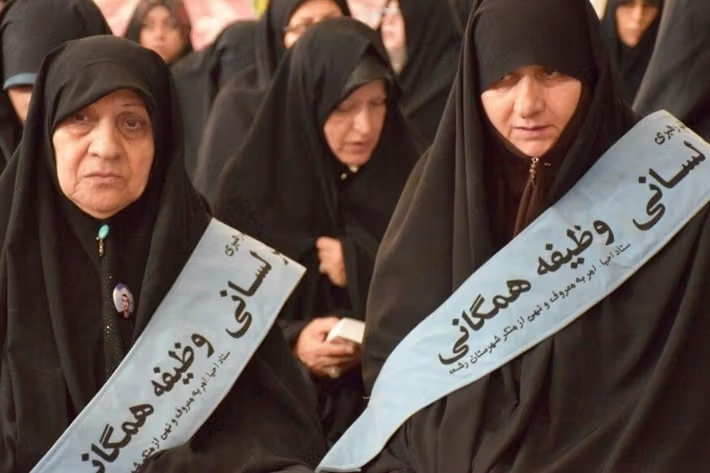
On September 6, Hossein Akbari, commander of the Islamic Revolutionary Guard Corps in North Khorasan, announced the revival and reconstruction of “verbal admonition groups” in the province. He said these groups would operate using volunteers and with a new and organized approach. (Tasnim News Agency, September 6, 2026)
That same day, Mostafa Moeini Arani, a member of parliament, called for action against “unveiling and improper hijab” and asked Mohammad-Bagher Ghalibaf, the Speaker of Parliament, to issue the so-called “hijab and chastity” law.
Mohammad-Taqi Naghdali, a member of parliament, also accused the government of “retreating” on the issue of hijab on September 8, saying that hijab is one of the “foundations of the revolution” and that Parliament would continue pursuing the issue.
State-Run Media’s Admission of the Spread of Women’s Resistance
The extent of concern within the ruling establishment can also be seen in the language used by media outlets close to the centers of power.
On September 7, the state-run Kayhan newspaper, in a report titled “From Unveiling to Breaking the Boundaries of Immodesty,” expressed concern over what it called the “freedom and passivity of officials” in the face of the situation surrounding hijab. The newspaper wrote that this trend is spreading throughout society and even spoke of its advance since 2022. Kayhan also called for “stopping the trend” that it described as the spread of unveiling and immodesty.
This very language used by the authorities reveals an important reality: the regime’s years-long efforts to impose hijab have failed to force Iranian women to accept this policy. That is why calls for greater repression continue to be repeated from within the power structure.
The Law Was Halted, But the Pressure Did Not Stop
While implementation of the new “Chastity and Hijab” law was previously halted, the mullahs’ regime is using other tools to impose hijab, from electronic surveillance and fines to pressuring businesses and shutting down businesses.
Thus, halting the issuance of the new law does not mean abandoning the policy of forced hijab. Rather, the religious dictatorship is seeking to continue the pressure by using existing laws and mechanisms while at the same time reducing the cost of direct street confrontations.
Fear of a Social Explosion; Why Has the Regime Become Cautious?
Alongside the insistence of some parts of the ruling establishment on intensifying repression, there are also signs of caution.
Gholam-Ali Haddad-Adel, in an interview published by the Shargh media group, said about hijab: “Given the current war conditions, we cannot enter this front as we should for the time being,” but added that “its effects will be evident in schools” and described today’s conditions as even more difficult than in 1360.
These remarks can be seen as a sign of a change in the way pressure is imposed, rather than an abandonment of the forced hijab policy itself. The clerical regime does not want to give up this battlefield, but at the same time, it is concerned about the political and social costs of direct and widespread confrontations with women. For this reason, pressure in settings such as schools and universities, imposing fines, shutting down businesses, surveillance, and forming so-called “verbal admonition” groups could replace widespread street confrontations.
“Woman, Resistance, Freedom”; Iranian Women’s Response
What is happening in Iran today is not merely a dispute over dress regulations. Forced hijab is, for the ruling religious fascism, part of the mechanism for exercising control over women and controlling society; this is why the regime, despite its crises and limitations, is unwilling to abandon this policy.
But on the other side, Iranian women have also shown that they have not surrendered to this imposition. The more the regime expands its tools of control, the more women insist on their right to choice and freedoms.
But Iranian women’s demands are not limited to freedom of dress. They are demanding guarantees of all individual and social freedoms for women and for all the people of Iran, which can only be achieved through the overthrow of the mullahs’ regime and the establishment of a democratic republic. The slogan “Woman, Resistance, Freedom” embodies these demands of Iranian women.
For this reason, efforts to intensify the imposition of forced hijab could once again become a spark for a nationwide uprising, which the clerical regime deeply fears.