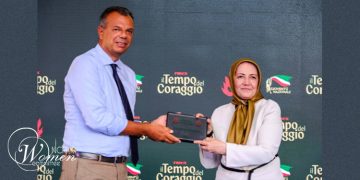

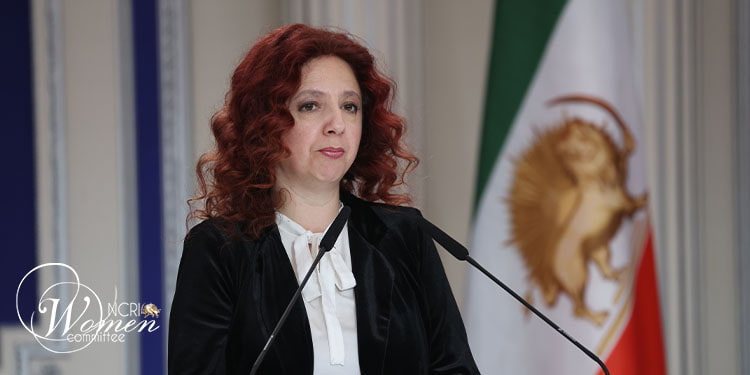
On Saturday, February 21, 2026, on the eve of March 8, International Women’s Day, the NCRI Women’s Committee hosted an international conference in Paris entitled “Women’s Leadership: An Imperative for a Free Iran and a Democratic Republic.” The conference, attended by women legislators, academics, thinkers, and prominent political figures, focused on women’s political participation and leadership as a decisive element in a democratic society.
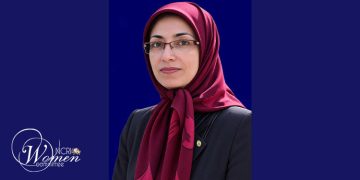
At this conference, Elisa Pirro, Member of the Italian Senate, was also in attendance and delivered a speech. The full text of her speech is provided below:
Elisa Pirro: Supporting Iranian Women is a Matter of International Moral Credibility
President Rajavi, dear friends of freedom and human rights,
Today, as we celebrate International Women’s Day, we are not speaking of equality as an abstract principle. We are speaking about women who, at this very moment, are sacrificing their freedom — and even their lives — in their determination to change their country’s destiny. The women of Iran.
Under the Islamic Republic, gender discrimination is not an anomaly; it is a system. Women are excluded from the highest offices of the state and discriminated against in family law, inheritance, and legal testimony. The mandatory veil is enforced through a repressive apparatus that uses arbitrary arrests, violence, and intimidation to control society.
Yet the reality of Iran is defined not only by oppression, but also by resistance. After the killing of Mahsa Amini in 2022, millions of Iranians took to the streets. Women stood at the forefront — not as symbols, but as organizers, leaders, and the driving political force behind the mobilization. Their cry of “Woman, Resistance, Freedom” crossed national borders and became a universal message.
Elisa Pirro: The Iranian People Demand Democratic Transformation, Not Reform Within the System
In the subsequent waves of protests, women and young people demonstrated that Iranian society has profoundly changed. Their demand is not for reform within the system; it is for democratic transformation. It calls for an end to religious dictatorship and for the establishment of a state founded on the separation of religion and politics, the rule of law, and full equality between women and men.
In this context, the National Council of Resistance of Iran has played a significant role in promoting female leadership within the organized resistance. At the center of this vision stands Maryam Rajavi, who has made gender equality a fundamental principle for the future of Iran. Her Ten-Point Plan for a Free Iran proposes a democratic, secular, and non-nuclear republic founded on universal suffrage, the abolition of the death penalty, freedom of expression, and legal equality between men and women.
This program is not merely a national political project; it is fully consistent with the values enshrined in the Charter of the United Nations and the Universal Declaration of Human Rights.
For the international community, the Iranian issue cannot be treated as merely a regional matter. It is a question of moral credibility. We cannot claim to support women’s rights around the world while remaining silent when a regime uses misogyny as a tool of political control.
Elisa Pirro: Supporting Iranian Women Means Supporting Stability, Peace, and Democracy
Supporting Iranian women means supporting stability, peace, and democracy in the region. It means recognizing the right of the Iranian people to determine their own future without repression.
The women of Iran have demonstrated extraordinary courage. Now the responsibility lies with us: to listen to their voices, amplify them, and translate our principles into coherent policies.
Because when women lead a nation toward freedom, they are not only reclaiming their own rights — they are laying the foundations of a genuine democracy.
Thank you.