
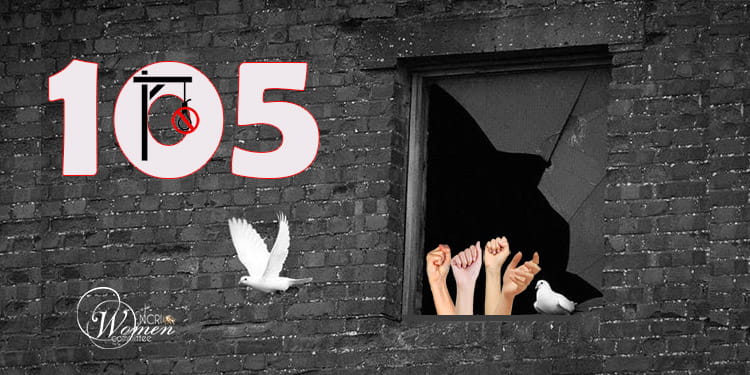
The “No to Execution Tuesdays” hunger strike campaign marked its 105th consecutive week this Tuesday, coinciding with the third anniversary of the movement’s formation, as it continued across 56 prisons throughout Iran.
Born inside prison walls under the harshest conditions of repression and security pressure, the campaign has evolved into one of the most enduring forms of collective resistance against Iran’s execution machinery and judicial violence.
The hunger strike campaign began in February 2024 with the initiative of ten political prisoners exiled to Qezel Hesar Prison, who launched weekly hunger strikes every Tuesday. It rapidly spread to multiple wards, including the women’s ward, of Evin Prison and then to other prisons nationwide.
Over two years of uninterrupted action, “No to Execution Tuesdays” has transformed from a limited protest by political prisoners into a national, and increasingly international, symbol of resistance to capital punishment and systematic repression in Iran.
In its 105th week, the participation of Gorgan Prison and the expansion of the campaign to 56 prisons are widely seen as clear evidence of the failure of the authorities’ intimidation and suppression policies behind prison walls. Activists involved in the campaign stress that executions have become a central instrument of the regime’s survival, rendering opposition to capital punishment an inherently political act.

Link to the Nationwide Uprising and the Threat of Executing Detained Protesters
In this week’s statement, participating prisoners explicitly linked the “No to Execution Tuesdays” hunger strike campaign to Iran’s nationwide uprising, highlighting the decisive role of the popular movement in exposing the regime’s violent and repressive nature. The statement notes that the bloody suppression of protests has not only provoked outrage within Iran but has also mobilized global public opinion, intensifying international revulsion toward the state’s policies of execution and killing.
Campaign members also warned of the risk of a mass killing of injured and detained protesters arrested during the nationwide protests of January 2026. According to reports from inside prisons, the lack of information about detainees’ whereabouts, the critical medical condition of injured prisoners, and the covert transfer of bodies to undisclosed morgues have deepened fears of a repetition of large-scale state crimes.

Families Describe Detained Protesters as the Flesh and Blood of the Iranian People
Alongside the continuation of the campaign, families and relatives of political prisoners sentenced to death, including Vahid Bani-Amerian, Pouya Ghobadi, and Shahrokh Daneshvarkar, held protest gatherings and displayed placards in support of “No to Executions Tuesdays.” Chants such as “Political prisoners must be freed,” “No to executions,” “Detainees of the nationwide uprising must be released” and “Prison and execution are not meant for Iran’s children and youth – January 2026” reflected widespread demands for an end to executions and the release of political prisoners.
In their statement, the families, referring to the country’s dire situation, emphasized: “Iran today is wounded and in mourning. Seeing the heart-rending images of our compatriots searching for their loved ones in the washing houses of our oppressed homeland, amid thousands of blood-soaked bodies, tore at our hearts, and we wept from the depths of our souls. For they are a part of all of us. Their only ‘crime,’ like that of our own children, was saying no to dictatorship.”