
Wednesday, March 11, 2026
  • English
  • Français
  • فارسی
  • عربى
PODCASTS
NCRI Women Committee Women Resistance Freedom
  • Home
  • NEWS
    • Women’s News
    • Articles
    • Statements
  • PUBLICATIONS
    • Monthlies
    • Documents
    • Reference Library
  • ABOUT US
    • The NCRI Women’s Committee
    • Gender Equality
    • Women’s Platform
  • MARYAM RAJAVI
    • Maryam Rajavi
    • Maryam Rajavi Speeches
    • The Plan on Women’s Rights and Freedoms
    • Ten-Point Plan for the future of Iran
  • VANGUARDS
    • The Fallen for Freedom
    • Heroines in Chain
    • Women of Iranian Resistance
    • Famous Women
    • Women in History
  • EVENTS
    • IWD Conferences
    • Activities
    • IWD Speeches
    • Solidarity
  • VIDEO
    • Videos
    • IWD Videos
  • PODCAST
  • DONATE
  • CONTACT US
No Result
View All Result
NCRI Women Committee Women Resistance Freedom
  • Home
  • NEWS
    • Women’s News
    • Articles
    • Statements
  • PUBLICATIONS
    • Monthlies
    • Documents
    • Reference Library
  • ABOUT US
    • The NCRI Women’s Committee
    • Gender Equality
    • Women’s Platform
  • MARYAM RAJAVI
    • Maryam Rajavi
    • Maryam Rajavi Speeches
    • The Plan on Women’s Rights and Freedoms
    • Ten-Point Plan for the future of Iran
  • VANGUARDS
    • The Fallen for Freedom
    • Heroines in Chain
    • Women of Iranian Resistance
    • Famous Women
    • Women in History
  • EVENTS
    • IWD Conferences
    • Activities
    • IWD Speeches
    • Solidarity
  • VIDEO
    • Videos
    • IWD Videos
  • PODCAST
  • DONATE
  • CONTACT US
No Result
View All Result
NCRI Women Committee
No Result
View All Result
Home Articles
Child Marriage in Iran: An Institutionalized Violence Against the Girl Child

Child Marriage in Iran: An Institutionalized Violence Against the Girl Child

December 3, 2025
in Articles

Child marriage in Iran remains legal and widespread. The forced and early marriage of girls is one of the most blatant and institutionalized forms of violence against girl children in Iran.

Under the Iranian regime’s Civil Code, the marriage of girls before the age of majority is permitted with the consent of a guardian and a judge. This means that fathers or paternal grandfathers, with the approval of judicial authorities, can determine the fate of a young girl without any meaningful legal barriers, turning her path from the paradise of childhood into a terrifying hell.

Beyond the law’s text, the practical mechanism tilts heavily toward male authority: girls are often treated as commodities, traded in marriage under conditions of economic hardship and gender inequality.

The spread of child marriage in Iran is not a cultural issue but a direct byproduct of the misogynistic clerical regime. Driven by the regime’s political and economic policies, this practice has grown into a full-blown social catastrophe.
Child Marriage in Iran: An Institutionalized Violence Against the Girl Child
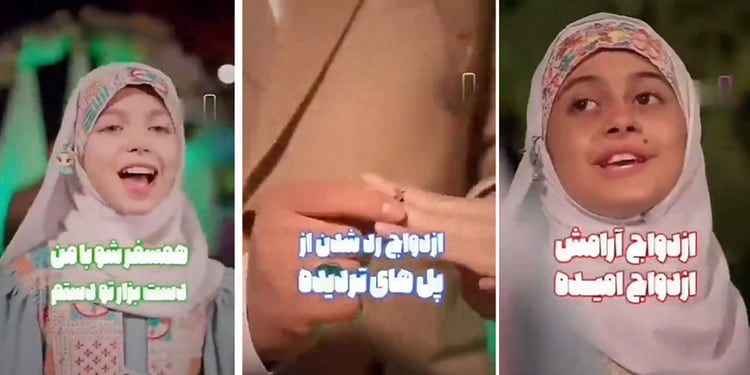
TV Ad: Promoting child marriage in Iran

Legal Framework & Loopholes

While the legalization of marrying 13-year-old girls is itself a grim product of the clerical regime, representing one of the clearest expressions of child abuse and misogyny, the regime’s legal framework goes even further.

On paper, the law appears to prohibit marriage before puberty, yet its vague clauses and ambiguous exceptions strip this prohibition of any real force. In practice, these loopholes render the supposed ban meaningless.

The law allows girls under 13 to marry if a guardian and judge agree it is in her “best interest.” Such language provides an open door for systemic abuse, ensuring that child marriage is not just tolerated, it is legalized, institutionalized, and encouraged.

The Scale of the Problem

The statistics are devastating. Government data show that more than 131,000 girls under 15 were married between 2016 and 2021. (Baharnews.ir, March 30, 2022)

In 2021 alone, over 32,000 girls under 15 were forced into marriage. (Mardomsalari.ir, December 29, 2022)

And in 2022, another 26,974 joined them. Many of these child brides soon became mothers; that year, 1,390 girls under 15 gave birth. (Rokna.net, October 21, 2024)

The latest statistics released by the regime’s Statistics Center report the marriage of 9,753 girls aged 10 to 14 in the spring of 2021. Compared to seasonal data from the past two years, this was the highest seasonal figure for marriages in this age group, effectively setting a record for such marriages over two years.

The Tip of the Iceberg

Experts agree that the officially recorded and reported statistics are only the tip of the iceberg.

Ali Kazemi, advisor to the legal deputy of the Judiciary Branch. According to Kazemi, “Between 500,000 to 600,000 children get married every year (in Iran) according to the officially registered data. The main problem is that there are marriages taking place beyond those officially registered.” (Entekhab Daily, March 4, 2019)

Mohammad Reza Mahboubfar, a social harm researcher, commented on statistics from the National Statistics Center: “This is the tip of the iceberg of statistics related to early marriage. The actual number of children married is 5 to 6 times the announced number.” (ROKNA News Agency, July 25, 2021)

In yet another interview, Mahboubfar asserted, “Presently, 100 marriages of girls under 15 years old take place every 24 hours.” (Arman-e Melli newspaper, July 27, 2021)
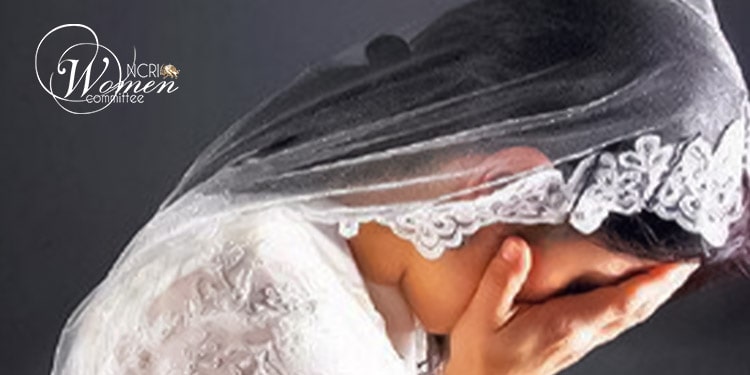
Child Marriage in Iran: An Institutionalized Violence Against the Girl Child

Halting the Release of Statistics

Under mounting public pressure, the Iranian regime halted the publication of statistics and information in 2024 on child marriage and on the number of children born to underage mothers. (Etemad Daily, September 8, 2024) This move is widely seen as an attempt to conceal the growing catastrophe.

In a society plagued by structural poverty, government corruption, and misogynistic laws, child marriage is both a symptom of the crisis and a weapon, an instrument the state uses to oppress women and to force young girls into lives they never chose.

Why It Happens: Poverty, Gender & Control

Several forces drive this tragedy.
Poverty pushes families to marry off their daughters in exchange for dowries or relief from financial pressure.
Gender inequality and patriarchal norms strip girls of autonomy, treating them as property rather than human beings.
And a corrupt legal system, bound by clerical authority, ensures there is no recourse for victims.

In many rural provinces such as Sistan and Baluchistan, Razavi Khorasan, and North Khorasan, these factors interact, producing the highest rates of child marriage in the country.

Consequences for the Girls

For these girls, marriage is not a milestone, it is a sentence.
It ends their education, isolates them socially, and exposes them to physical and sexual abuse. Thousands face life-threatening pregnancies before their bodies are mature enough to bear children. Many sink into severe depression, and for some, suicide becomes the only escape. And some of these vulnerable and defenseless girls, victims of child marriage and domestic violence, ultimately face the tragic end of the gallows at the hands of the misogynistic judicial system of the mullahs.
Child Marriage in Iran: An Institutionalized Violence Against the Girl Child
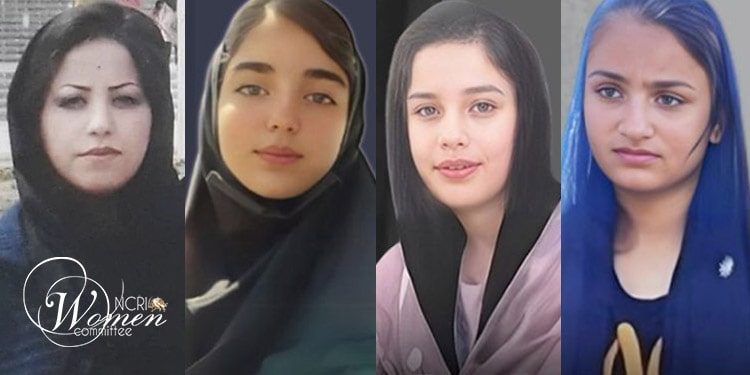
Victims of child marriage, from left to right: Samira Sabzian, Fatima Soleimani, Shima Rameshk, and Fatemeh Moradi

Human Stories Behind the Statistics

Fatima Soleimani, 12
Fatima, from Kermanshah, was forced by her family to marry a man much older than herself. After repeatedly begging them to stop and finding no protection under the law, she took her own life. Her tragic death revealed how child marriage and family coercion can push even the youngest victims to the point of despair.

Fatemeh Moradpour, 15
In Lorestan Province, Fatemeh was forced to marry a 40-year-old man against her will. Unable to bear the humiliation and control, she hanged herself. Her tragic death reflected the broader silence that surrounds countless girls who cannot escape forced marriages sanctioned by laws written by the mullahs.

Shima Rameshk, 14
Shima, a child bride from southern Iran, took her own life only months after her wedding. She had been married off to a man several decades her senior. Her story echoes countless others repeated every day across Iran.

Samira Sabzian Fard
Married at 14, Samira endured years of violence before killing her abusive husband. At the age of 30, she was executed by the regime, leaving behind two children 15 and 11 years of age. Samira was a victim first of child marriage and then of a brutal judicial system that punishes victims instead of protecting them.

Beyond the Numbers

Child marriage in Iran is a state-sponsored and organized crime. This practice has expanded under the shadow of religious laws and the rule of the Vali-e Faqih (Supreme Leader), forming part of the system used to oppress women and control society.

Every statistic represents a stolen childhood, a silenced voice, a life destroyed before it truly began. The suffering of Iran’s child brides will not end through token reforms or hollow promises.

The only real solution is the overthrow of the current clerical regime, the very system that legalizes, enforces, and profits from the subjugation of women and girls. Only then can Iran’s daughters hope for a future free of forced marriage, violence, and despair, a future where they can learn, dream, and live as human beings, not possessions.
Tags: Child marriageThe girl childViolence against women
ShareTweetPinShareSendShare

Related Posts

A Report to CSW70: Gender-Based Discrimination Under Iranian Law

March 8, 2026
A Report to CSW70: Gender-Based Discrimination Under Iranian Law

Structural Inequality and State-Sanctioned Oppression of Women Gender-Based Discrimination Under Iranian Law” is the title of the NCRI Women’s Committee’s report to CSW70, as it focuses on “Ensuring...

Read moreDetails

Annual Report 2026: From Protests, to Uprising, and the Role of Iranian Women

March 3, 2026
Annual Report 2026: From Protests, to Uprising, and the Role of Iranian Women

On the eve of International Women’s Day 2026, the NCRI Women’s Committee presents its Annual Report 2026, offering a recap of events in 2025 as related to women’s...

Read moreDetails

Students Under 20 Comprised 45 Percent of Protesters; Children Subjected to Torture and Facing Execution

February 21, 2026
Forty-Five Percent of Protesters Were Students Under 20; Children Subjected to Torture and Facing Execution

A significant proportion of participants in Iran’s nationwide January protests were high school students and minors. A government official acknowledged that in some provinces, as many as 45...

Read moreDetails

Schools Under Security Siege: Ideological Scrutiny Follow Nationwide Protests

February 13, 2026
Schools Under Security Siege: Ideological Scrutiny Follow Nationwide Protests

In the aftermath of the nationwide protests in January 2026, schools across Iran have reportedly become sites of heightened security presence and ideological scrutiny. Educational institutions are increasingly...

Read moreDetails

From Tehran to Berlin: Women, Resistance, and a Nation at a Tipping Point

February 8, 2026
From Tehran to Berlin: Women, Resistance, and a Nation at a Tipping Point

From Tehran to Berlin: Women, Resistance, and a Nation at a Tipping Point. We're looking at a systemic calculated shift in strategy by the regime. Welcome to another...

Read moreDetails
Next Post
Maria Montessori: The Visionary Who Redefined Modern Education

Maria Montessori: The Visionary Who Redefined Modern Education

Documents

A Report to CSW70: Gender-Based Discrimination Under Iranian Law

A Report to CSW70: Gender-Based Discrimination Under Iranian Law

March 8, 2026

Structural Inequality and State-Sanctioned Oppression of Women Gender-Based Discrimination Under Iranian Law” is the title of the NCRI Women’s Committee’s...

Annual Report 2026: From Protests, to Uprising, and the Role of Iranian Women

Annual Report 2026: From Protests, to Uprising, and the Role of Iranian Women

March 3, 2026

On the eve of International Women’s Day 2026, the NCRI Women’s Committee presents its Annual Report 2026, offering a recap...

Iranian women Who Lost Their Lives in Iran’s January 2026 Uprising

Iranian Women Who Lost Their Lives in Iran’s January 2026 Uprising

January 25, 2026

Names That Must Not Be Forgotten Iranian women played a central and courageous role in the January 2026 uprising, standing...

Monthlies

January 2026 Report: Women at the Core of the Uprising
Monthlies

January 2026 Report: Women at the Core of the Uprising

January 31, 2026
December 2025 Report: A Year in Review: Iranian Women’s Resistance Against Religious Dictatorship
Monthlies

December 2025 Report: A Year in Review: Iranian Women’s Resistance Against Religious Dictatorship

January 5, 2026
November 2025 Report: Under the Clerical Regime, Nowhere Is Safe for Women in Iran
Monthlies

November 2025 Report: Under the Clerical Regime, Nowhere Is Safe for Women in Iran

November 30, 2025
October 2025 Report: Death Sentence for a Female Political Prisoner The Resistance of Female Political Prisoners Inspires Iranian Women and Girls in Their Struggle Against the Regime of Executions and Massacre
Monthlies

October 2025 Report: Death Sentence for a Female Political Prisoner

October 31, 2025

Articles

Iranians Rally in Paris, Back NCRI’s Provisional Government, Maryam Rajaiv’s Ten-Point Plan

Iranians Rally in Paris, Back NCRI’s Provisional Government, Maryam Rajavi’s Ten-Point Plan

March 10, 2026

Supporters of the Iranian Resistance rallied in Paris, voicing support for the NCRI’s provisional government to transfer sovereignty to the...

Maryam Rajavi Discusses Iran’s Transitional Roadmap in Interview with Frankfurter Rundschau

Maryam Rajavi Discusses Iran’s Transitional Roadmap in Interview with Frankfurter Rundschau

March 8, 2026

Maryam Rajavi, the President-elect of the National Council of Resistance of Iran, said in an interview with the German newspaper...

March 8: International Women's Day and the Leading Role of Iranian Women in the Struggle for Freedom

March 8: International Women’s Day and the Leading Role of Iranian Women in the Struggle for Freedom

March 6, 2026

March 8 is celebrated worldwide as International Women's Day, a day that honors over a century of women's fight for...

The Fallen for Freedom

Sonya Salehi-Rad was killed on January 8, 2026, during the nationwide popular protests in Shiraz
The Fallen for Freedom

Sonya Salehi-Rad

February 10, 2026
Arezoo Abedi was killed on January 9, 2026, during the nationwide popular protests
The Fallen for Freedom

Arezoo Abedi

February 10, 2026
Arnika Dabbagh, from Gorgan, was killed on January 9, 2026
The Fallen for Freedom

Arnika Dabbagh

February 7, 2026
Maedeh Moradi Kia, a resident of Tehran, was killed on January 9, 2026
The Fallen for Freedom

Maedeh Moradi Kia

February 7, 2026

ABOUT US

NCRI Women Committee

We work extensively with Iranian women outside the country and maintain a permanent contact with women inside Iran. The Women’s Committee is actively involved with many women’s rights organizations and NGO’s and the Iranian diaspora.
The committee is a major source of much of the information received from inside Iran with regards to women. Attending UN Human Rights Council meetings and other international or regional conferences on women’s issues and engaging in a relentless battle against the Iranian regime’s misogyny are part of the activities of members and associates of the committee.

CATEGORIES

  • Activities
  • Articles
  • Documents
  • Famous Women
  • Heroines in Chain
  • IWD Conferences
  • IWD Speeches
  • IWD Videos
  • Maryam Rajavi
  • Maryam Rajavi Speeches
  • Monthlies
  • Podcast
  • Reference Library
  • Solidarity
  • Statements
  • The Fallen for Freedom
  • Videos
  • Women in History
  • Women in Leadership
  • Women of Iranian Resistance
  • Women's News

BROWSE BY TAG

Child marriage coronavirus education execution forced hijab Gender Gap Generation Equality Honor killings Iran Teachers Maryam Akbari Monfared Nurses Plan on Women's Rights and Freedoms Poverty Prisoners Protests rural women Saba Kord Afshari The girl child Violence against women Women's Leadership Women Heads of Household Zeinab Jalalian

The copyright of all the material published on this website has been registered under © 2016 the Women’s Committee of the National Council of Resistance of Iran. To obtain permission to copy, redistribute or publish the material published on this website, you should write to the NCRI Women’s Committee. Please include the link of the original article on our website, women.ncr-iran.org.

Welcome Back!

Login to your account below

Forgotten Password?

Retrieve your password

Please enter your username or email address to reset your password.

Log In

Add New Playlist

No Result
View All Result
  • Home
  • News
    • Women’s News
    • Articles
    • Statements
  • Publications
    • Monthlies
    • Documents
    • Reference Library
  • About Us
    • The NCRI Women’s Committee
    • Gender Equality
    • Women’s Platform
  • Maryam Rajavi
    • Maryam Rajavi
    • Maryam Rajavi Speeches
    • Ten Point Plan for Iran
    • The Plan on Women’s Rights and Freedoms
  • Vanguards
    • The Fallen for Freedom
    • Heroines in Chain
    • Women of Iranian Resistance
    • Famous Women
    • Women in History
  • Events
    • IWD Conferences
    • Activities
    • IWD Speeches
    • Solidarity
  • Video
    • Videos
    • IWD Videos
  • Podcast
  • Donate
  • Contact us
  • فارسی
  • عربی
  • Français

The copyright of all the material published on this website has been registered under © 2016 the Women’s Committee of the National Council of Resistance of Iran. To obtain permission to copy, redistribute or publish the material published on this website, you should write to the NCRI Women’s Committee. Please include the link of the original article on our website, women.ncr-iran.org.