
Wednesday, March 11, 2026
  • English
  • Français
  • فارسی
  • عربى
PODCASTS
NCRI Women Committee Women Resistance Freedom
  • Home
  • NEWS
    • Women’s News
    • Articles
    • Statements
  • PUBLICATIONS
    • Monthlies
    • Documents
    • Reference Library
  • ABOUT US
    • The NCRI Women’s Committee
    • Gender Equality
    • Women’s Platform
  • MARYAM RAJAVI
    • Maryam Rajavi
    • Maryam Rajavi Speeches
    • The Plan on Women’s Rights and Freedoms
    • Ten-Point Plan for the future of Iran
  • VANGUARDS
    • The Fallen for Freedom
    • Heroines in Chain
    • Women of Iranian Resistance
    • Famous Women
    • Women in History
  • EVENTS
    • IWD Conferences
    • Activities
    • IWD Speeches
    • Solidarity
  • VIDEO
    • Videos
    • IWD Videos
  • PODCAST
  • DONATE
  • CONTACT US
No Result
View All Result
NCRI Women Committee Women Resistance Freedom
  • Home
  • NEWS
    • Women’s News
    • Articles
    • Statements
  • PUBLICATIONS
    • Monthlies
    • Documents
    • Reference Library
  • ABOUT US
    • The NCRI Women’s Committee
    • Gender Equality
    • Women’s Platform
  • MARYAM RAJAVI
    • Maryam Rajavi
    • Maryam Rajavi Speeches
    • The Plan on Women’s Rights and Freedoms
    • Ten-Point Plan for the future of Iran
  • VANGUARDS
    • The Fallen for Freedom
    • Heroines in Chain
    • Women of Iranian Resistance
    • Famous Women
    • Women in History
  • EVENTS
    • IWD Conferences
    • Activities
    • IWD Speeches
    • Solidarity
  • VIDEO
    • Videos
    • IWD Videos
  • PODCAST
  • DONATE
  • CONTACT US
No Result
View All Result
NCRI Women Committee
No Result
View All Result
Home Documents
Widowed Women in Iran: Main Problems and Challenges

Widowed Women in Iran: Main Problems and Challenges

Widowed Women in Iran: Main Problems and Challenges

June 22, 2025
in Documents

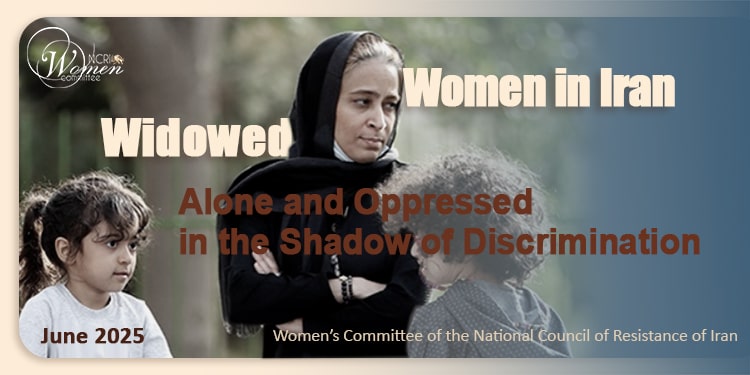
Widowed Women in Iran, Alone and Oppressed in the Shadow of Discrimination

In the Iranian legal system, where gender-based discrimination is deeply entrenched, women are not recognized as heads of household. As a result, when a woman becomes a widow, she is not only burdened with the emotional weight of her loss, but is also thrust into a web of economic, social, and legal challenges. In this context, widowhood becomes more than a personal tragedy—it is treated as a social stigma.

Widowed Women in Iran_EN-minDownload

Widowed women are often marginalized and excluded from full participation in society. They face a host of legal obstacles, particularly in areas such as inheritance, child custody, property ownership, and access to insurance. The legal framework is overwhelmingly designed in favor of men, leaving widows vulnerable to systemic injustice and discrimination.

The Iranian regime does not even recognize International Widows’ Day on its calendar.

Contradictory Statistics and Lack of Transparency

According to the state-run Jahan-e Sanat newspaper, September 21, 2020, there are approximately 5.1 million widowed or divorced women in Iran. Previously, Shargh newspaper (July 4, 2011) had reported this number as 6 million.

According to the National Statistical Center of Iran and the 2006 national census, the number was 1.89 million—six times the number of widowed men.

In 2017, 15,000 widowed girls under the age of 15 were reported.

Widowed Women in Iran: Main Problems and Challenges

Female Heads of Households

According to the Donya-e-Eqtesad economic news site (May 3, 2025), the number of female heads of households has surpassed 6 million, with half lacking any form of insurance. In addition to running their households, these women are deprived of basic social support and are exposed to hidden forms of violence and dependency.

Social and Cultural Condition

Under the ruling system, women are not officially recognized as heads of households, and widowhood is considered a “social disaster.” Widowed women are often marginalized and excluded from social participation.

According to Etemad newspaper (June 23, 2018), over 90% of widows do not remarry—this is largely due to social, cultural, and familial pressures rather than personal choice. This is especially true given that, under Iranian law, women lose custody of their children upon remarriage.

The Main Problems and Challenges Faced by Widowed Women in Iran

Widowed Women in Iran, in a society shaped by patriarchal laws and a misogynistic regime, face compounded hardships following divorce or the death of a spouse. On one hand, they must deal with the trauma of separation and prepare themselves for a new life situation. On the other, they must endure legal, economic, and cultural pressures imposed by the ruling misogynist system.

Widowed Women in Iran: Main Problems and Challenges

Economic and Social Problems of Widowed and Divorced Women

Poverty, Unemployment, and Lack of Support
Widowed women in Iran are often responsible for providing for their families, but insufficient financial support from the government has led to a crisis in their lives. According to Negar Akbari-Zargar, a member of the Iranian Psychological Association, these women are often exploited in the workplace, hired at wages below standard, and due to a lack of awareness about their rights, accept any job under any condition. They work in poor conditions, suffer abuse, and remain silent out of fear of unemployment. (Asr-e Iran – June 22, 2020)

Post-Divorce Hardships According to a Social Worker
Anvar Samadi-Rad, a sociologist, lists the main post-divorce issues for women in this order:

71% of divorced and widowed women with children are single parents. Only 16% are employed, and most rely on the help of others to meet basic living needs. (Qods– March 3, 2013)

Widowed and divorced women in Iran even face housing challenges. 39% of them struggle to find housing or are unable to stay in hotels or guesthouses. Patriarchal attitudes and economic difficulties are the main obstacles preventing them from renting or purchasing a home. (Qods– March 3, 2013)

The Clerical Regime Is Directly Responsible for Widowing Women

Just like in every other area of destruction, the corrupt clerical regime provides no statistics on widows—but it is no secret that it is the primary cause of the growing number of widowed women and the descent of Iranian women into deep poverty and suffering.

A large number of Iranian women are forced into widowhood as a result of misogynistic laws entrenched in the country’s legal system. Under Article 1041 of the Islamic Republic’s Civil Code, a girl’s father, grandfather, or even a judge has the authority to permit her marriage as early as age 13—or even younger. Often, these girls are married to men old enough to be their fathers.

According to Shahr Khabar news agency, on October 16, 2024, more than 19,000 women and girls had been married to men at least 15 years older than themselves in the previous year alone. This occurs within a legal and economic framework overwhelmingly structured to benefit men, leaving women without meaningful protections or autonomy.

Moreover, the laws of the clerical regime in Iran do not prohibit polygamy. The regime’s so-called “Family Protection Law” merely sets conditions for taking additional wives—conditions that are easily circumvented. Temporary marriage (sigheh) is also legal and explicitly institutionalized under Article 1152 of the Civil Code, which defines its duration. Furthermore, men have the unrestricted right to divorce their wives at any time, without cause or mutual consent.

These discriminatory laws have led to a rise in the number of divorced women, many of whom face social and legal hardships similar to those of widows. The overall result is the weakening of the family structure and an increase in the number of women who are left without support.

In addition to these systemic legal injustices, many women become widows due to the regime’s own acts of violence and the disasters caused by its policies and negligence.

Amid Grief, Crushing Poverty

Among the bereaved families, poverty is so deep and pervasive that merely describing it sends a chill down one’s spine. One such family is from Zahedan, a city in southeastern Iran, where they live in a structure that more closely resembles a shack than a house. The family consists of an elderly mother, a young widow, and a sister with a disability who, despite being thirty years old, is so frail that she appears to be a child. Their home is crumbling, and poverty seeps from its very walls. Hayatollah was the family’s sole breadwinner—now he is gone.

Most of these families are illiterate. What emerges is a staggering scale of suffering, poverty, vulnerability, alienation, and powerlessness in the face of injustice. There are no answers to the pressing questions: Why were so many undocumented, unregulated workers employed at one of Iran’s most critical ports? Why were industrial safety standards so weak and unenforced? Why did crisis-response infrastructure fail so catastrophically?

And now, who will be held accountable for this human tragedy? (Rokna– May 11, 2025)
Tags: PovertyWomen Heads of Household
ShareTweetPinShareSendShare

Related Posts

Annual Report 2026: From Protests, to Uprising, and the Role of Iranian Women

March 3, 2026
Annual Report 2026: From Protests, to Uprising, and the Role of Iranian Women

On the eve of International Women’s Day 2026, the NCRI Women’s Committee presents its Annual Report 2026, offering a recap of events in 2025 as related to women’s...

Read moreDetails

The Devastated Economy and Explosive Poverty: Key Drivers of Domestic Violence

November 24, 2025
The Devastated Economy and Explosive Poverty: Key Drivers of Domestic Violence

Explosive poverty and the collapse of people’s livelihoods—resulting from an exhausted and devastated economy caused by anti-people policies, plundering, and looting of national wealth by Iran’s clerical regime,...

Read moreDetails

Iranian Children, Victims of Poverty, Discrimination, and a Child-Killing Regime

November 18, 2025
Iranian Children, Victims of Poverty, Discrimination, and a Child-Killing Regime

World Children’s Day is meant to be a moment to reflect on the future of children, the very individuals who should shape a bright tomorrow. Yet in Iran,...

Read moreDetails

International Day for the Eradication of Poverty: Women Heads of Households, the Voiceless Pillars of Poor Families

October 17, 2025
Eradication of Poverty: Women Heads of Households, the Voiceless Pillars of Poor Families

While the world, on the International Day for the Eradication of Poverty (October 17), emphasizes social justice, human dignity, and the right to a decent life, Iran, under...

Read moreDetails

The Failure of Iran’s Population Growth Law Despite the Repression of Women

August 24, 2025
The Failure of Iran's Population Growth Law Despite the Repression of Women A Glance at a Costly and Ineffective Policy

A Glance at a Costly and Ineffective Policy The “Youthful Population Law” in Iran vs. Women’s Human Rights Following a directive issued by the mullahs’ Supreme Leader Ali...

Read moreDetails
Next Post
Evin Prison: Prisoners Injured in the Women’s Ward

Evin Prison: Prisoners Injured in the Women’s Ward

Documents

A Report to CSW70: Gender-Based Discrimination Under Iranian Law

A Report to CSW70: Gender-Based Discrimination Under Iranian Law

March 8, 2026

Structural Inequality and State-Sanctioned Oppression of Women Gender-Based Discrimination Under Iranian Law” is the title of the NCRI Women’s Committee’s...

Annual Report 2026: From Protests, to Uprising, and the Role of Iranian Women

Annual Report 2026: From Protests, to Uprising, and the Role of Iranian Women

March 3, 2026

On the eve of International Women’s Day 2026, the NCRI Women’s Committee presents its Annual Report 2026, offering a recap...

Iranian women Who Lost Their Lives in Iran’s January 2026 Uprising

Iranian Women Who Lost Their Lives in Iran’s January 2026 Uprising

January 25, 2026

Names That Must Not Be Forgotten Iranian women played a central and courageous role in the January 2026 uprising, standing...

Monthlies

January 2026 Report: Women at the Core of the Uprising
Monthlies

January 2026 Report: Women at the Core of the Uprising

January 31, 2026
December 2025 Report: A Year in Review: Iranian Women’s Resistance Against Religious Dictatorship
Monthlies

December 2025 Report: A Year in Review: Iranian Women’s Resistance Against Religious Dictatorship

January 5, 2026
November 2025 Report: Under the Clerical Regime, Nowhere Is Safe for Women in Iran
Monthlies

November 2025 Report: Under the Clerical Regime, Nowhere Is Safe for Women in Iran

November 30, 2025
October 2025 Report: Death Sentence for a Female Political Prisoner The Resistance of Female Political Prisoners Inspires Iranian Women and Girls in Their Struggle Against the Regime of Executions and Massacre
Monthlies

October 2025 Report: Death Sentence for a Female Political Prisoner

October 31, 2025

Articles

Iranians Rally in Paris, Back NCRI’s Provisional Government, Maryam Rajaiv’s Ten-Point Plan

Iranians Rally in Paris, Back NCRI’s Provisional Government, Maryam Rajavi’s Ten-Point Plan

March 10, 2026

Supporters of the Iranian Resistance rallied in Paris, voicing support for the NCRI’s provisional government to transfer sovereignty to the...

Maryam Rajavi Discusses Iran’s Transitional Roadmap in Interview with Frankfurter Rundschau

Maryam Rajavi Discusses Iran’s Transitional Roadmap in Interview with Frankfurter Rundschau

March 8, 2026

Maryam Rajavi, the President-elect of the National Council of Resistance of Iran, said in an interview with the German newspaper...

March 8: International Women's Day and the Leading Role of Iranian Women in the Struggle for Freedom

March 8: International Women’s Day and the Leading Role of Iranian Women in the Struggle for Freedom

March 6, 2026

March 8 is celebrated worldwide as International Women's Day, a day that honors over a century of women's fight for...

The Fallen for Freedom

Sonya Salehi-Rad was killed on January 8, 2026, during the nationwide popular protests in Shiraz
The Fallen for Freedom

Sonya Salehi-Rad

February 10, 2026
Arezoo Abedi was killed on January 9, 2026, during the nationwide popular protests
The Fallen for Freedom

Arezoo Abedi

February 10, 2026
Arnika Dabbagh, from Gorgan, was killed on January 9, 2026
The Fallen for Freedom

Arnika Dabbagh

February 7, 2026
Maedeh Moradi Kia, a resident of Tehran, was killed on January 9, 2026
The Fallen for Freedom

Maedeh Moradi Kia

February 7, 2026

ABOUT US

NCRI Women Committee

We work extensively with Iranian women outside the country and maintain a permanent contact with women inside Iran. The Women’s Committee is actively involved with many women’s rights organizations and NGO’s and the Iranian diaspora.
The committee is a major source of much of the information received from inside Iran with regards to women. Attending UN Human Rights Council meetings and other international or regional conferences on women’s issues and engaging in a relentless battle against the Iranian regime’s misogyny are part of the activities of members and associates of the committee.

CATEGORIES

  • Activities
  • Articles
  • Documents
  • Famous Women
  • Heroines in Chain
  • IWD Conferences
  • IWD Speeches
  • IWD Videos
  • Maryam Rajavi
  • Maryam Rajavi Speeches
  • Monthlies
  • Podcast
  • Reference Library
  • Solidarity
  • Statements
  • The Fallen for Freedom
  • Videos
  • Women in History
  • Women in Leadership
  • Women of Iranian Resistance
  • Women's News

BROWSE BY TAG

Child marriage coronavirus education execution forced hijab Gender Gap Generation Equality Honor killings Iran Teachers Maryam Akbari Monfared Nurses Plan on Women's Rights and Freedoms Poverty Prisoners Protests rural women Saba Kord Afshari The girl child Violence against women Women's Leadership Women Heads of Household Zeinab Jalalian

The copyright of all the material published on this website has been registered under © 2016 the Women’s Committee of the National Council of Resistance of Iran. To obtain permission to copy, redistribute or publish the material published on this website, you should write to the NCRI Women’s Committee. Please include the link of the original article on our website, women.ncr-iran.org.

Welcome Back!

Login to your account below

Forgotten Password?

Retrieve your password

Please enter your username or email address to reset your password.

Log In

Add New Playlist

No Result
View All Result
  • Home
  • News
    • Women’s News
    • Articles
    • Statements
  • Publications
    • Monthlies
    • Documents
    • Reference Library
  • About Us
    • The NCRI Women’s Committee
    • Gender Equality
    • Women’s Platform
  • Maryam Rajavi
    • Maryam Rajavi
    • Maryam Rajavi Speeches
    • Ten Point Plan for Iran
    • The Plan on Women’s Rights and Freedoms
  • Vanguards
    • The Fallen for Freedom
    • Heroines in Chain
    • Women of Iranian Resistance
    • Famous Women
    • Women in History
  • Events
    • IWD Conferences
    • Activities
    • IWD Speeches
    • Solidarity
  • Video
    • Videos
    • IWD Videos
  • Podcast
  • Donate
  • Contact us
  • فارسی
  • عربی
  • Français

The copyright of all the material published on this website has been registered under © 2016 the Women’s Committee of the National Council of Resistance of Iran. To obtain permission to copy, redistribute or publish the material published on this website, you should write to the NCRI Women’s Committee. Please include the link of the original article on our website, women.ncr-iran.org.