
Wednesday, October 21, 2026
  • English
  • Français
  • فارسی
  • عربى
PODCASTS
NCRI Women Committee Women Resistance Freedom
  • Home
  • NEWS
    • Women’s News
    • Articles
    • Statements
  • PUBLICATIONS
    • Monthlies
    • Documents
    • Reference Library
  • ABOUT US
    • The NCRI Women’s Committee
    • Gender Equality
    • Women’s Platform
  • MARYAM RAJAVI
    • Maryam Rajavi
    • Maryam Rajavi Speeches
    • The Plan on Women’s Rights and Freedoms
    • Ten-Point Plan for the future of Iran
  • VANGUARDS
    • Fallen Trailblazers of Iran’s Freedom
    • Fallen Heroes of Iran Uprisings
    • Heroines in Chain
    • Women of Iranian Resistance
    • Famous Women
    • Women in History
  • EVENTS
    • IWD Conferences
    • Activities
    • IWD Speeches
    • Solidarity
  • VIDEO
    • Videos
    • IWD Videos
  • PODCAST
  • DONATE
  • CONTACT US
No Result
View All Result
NCRI Women Committee
No Result
View All Result
Home Podcast
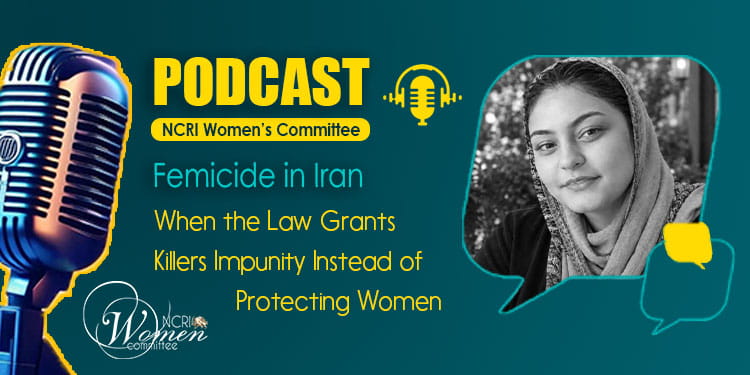
Femicide in Iran: When the Law Grants Killers Impunity Instead of Protecting Women

Femicide in Iran: When the Law Grants Killers Impunity Instead of Protecting Women

October 21, 2026
in Podcast

Welcome to another episode of podcasts of the Women’s Committee of the National Council of Resistance of Iran. I’m really glad you’re joining us today even though, well, the topic is incredibly heavy.

Yeah, it’s definitely a tough one to get through.

It is. We are looking at a document from mid October 2026 titled Recent Cases of Femicide in Iran. And, you know, domestic violence is a global crisis, obviously.

Right.  It happens everywhere.

But our mission today is to unpack this specific source material because the author argues that in Iran, it’s compounded by a legal framework that actively shields the perpetrators.

Yeah. The text argues it’s not just a series of isolated, you know, tragic disputes. It’s a structural crisis.

Let’s unpack this because the timeline here is just… It’s shocking.

It really is. And the source actually starts with a really crucial caveat that we have to mention.

Yeah. Please do. Because otherwise, the numbers just sound impossible.

Right. So, you might hear about these cases and think, well, a cluster of horrific murders in one week must be some crazy anomaly.

A fluke in the news cycle or something.

Exactly. But the authors are very explicit. These cases from October 2026 are not exceptions. They represent just the tip of the iceberg.

So, just the ones that actually made it into the media.

Yes. Just the violence that breached the surface and was too public to hide.

Wow. Which brings us to the first case. And, I’ll be honest, this one is really difficult to process.

It’s horrific.

It’s about a 38-year-old mother named Fereshteh Yusefzadeh. She lived in the city of Dehloran. And on October 15, she was murdered by her 56-year-old husband, Mohammed Mohammadi.

And the text points out that he was a member of the Revolutionary Guard Corps, the IRGC.

Right. And it’s the scale of the violence here that is just so staggering. He didn’t just kill Fereshteh.

No, he didn’t.

He used a Kalashnikov assault rifle to kill her, her 14-year-old daughter from a previous marriage named Rosa, and their own nine-year-old twins.

Yeah. The entire family. And the context the source gives is that Fereshteh had actually left the home because of ongoing conflicts over her older daughter.

So, she was trying to get away.

Exactly. She had only come back to collect her belongings and that’s when he opened fire.

I mean, I have to push back a bit on how these things are usually categorized. You hear domestic dispute in the media. And that implies, you know, a two-sided argument that goes horribly wrong.

Right. Like an escalation of a fight.

But using a military weapon of war to annihilate your whole family over a disagreement about a stepchild, that’s not a dispute. That feels like a unilateral execution.

What’s fascinating here is that the source actually agrees with you. They explicitly frame this not as an individual psychological break, you know, not a guy who just lost control. Right. They frame it as a symptom of a systemic problem. The text argues that perpetrators like him operate with an absolute, unquestioned sense of ownership over their families.

So, it’s about power.

Total power. When you combine a system that makes him the supreme sovereign of his house with the firepower and status of the state military, the result is total annihilation if his control is challenged.

God. So, if the system tells a man his family is his property, he feels he can just destroy that property if it becomes disobedient.

That is exactly the argument the source is making.

Which leads to a really dark question about when that sense of ownership actually starts. Right. It starts way earlier than you’d think.

Yeah. And this takes us to the second case which shifts from a mother trying to escape to a victim who just… She literally never had a chance to build an independent life at all. This is the case of Yeganeh Hosseinzai, right?

Yes. She was a 16-year-old girl murdered in Bakhzar county on October 9.

And the physical details of her death are brutal. She was beaten with a cable and a stick and then her husband strangled her.

The timeline of her life is what they really focus on.

Yeah. The timeline is deeply disturbing.

The text highlights that Yeganeh was betrothed to her aunt’s son when she was 10 years old.

Just 10.

10 years old. And she was legally married to him at 14. I mean, when a girl was betrothed at 10, the system had stripped her of agency long before the physical violence even happened.

If we connect this to the bigger picture, how civil status laws basically lay the foundation for femicide.

Because of the guardianship laws. Right?

Exactly. Under this legal framework, a concept called velayat or guardianship is everything. A woman transferred straight from the legal guardianship of her father into the authority of her husband.

So, she’s never legally an adult in her own right?

Never. These cultural and legal practices like child marriage trap victims in environments of absolute male control.

From childhood?

Yeah. From childhood. She has no financial independence, no legal standing to easily divorce, and no life experience to know how to escape.

It’s vulnerability by design.

That’s a perfect way to put it. Vulnerability by design.

Well, if the first two cases were about these solitary killers, the husband with a rifle, the husband with a cable, the third case reveals something even darker.

The complicity of the family.

Yes. Active, deliberate collusion from the community.

We’re looking at Maryam Yar-Mohammadi.

Right. The 28-year-old mother on Qeshm Island.

Yeah. On October 5, she was murdered in her own home, stabbed repeatedly by her own brother.

But the horrifying detail is how the husband was involved.

He actively facilitated it. The report says the husband took their two children out of the house so the brother could murder her without any interruptions.

He literally cleared the environment for the killer.

He did. And then the brother didn’t even run away. He made absolutely sure Maryam was dead before he finally took her to the hospital.

And the aftermath is what the source uses to really cement their point about systemic failure.

Right. Because relatives actually gathered at the hospital but not to mourn her.

No. They gathered to protest the arrest of the brother and the husband.

And later, the killer’s names were published with honor in her death announcement as the bereaved family. So, what does this all mean? How can a family protest the arrest of a murderer?

This raises an important question about how honor killings actually function in this legal system.

Because it just doesn’t compute for a lot of international listeners. You know?

Right. The perpetrators do this because they are emboldened by a societal and legal framework that completely validates them.

Validates violence as a defense of family honor.

Yes. The Iranian penal code has massive loopholes for familial homicide.

How does that actually work in practice?

Basically, the law allows a victim’s guardians, like the father or grandfather, to legally pardon a killer if the killer is a family member.

Wait. So, if a brother kills his sister, the father can just say, “I forgive him,” and the state drops the charges?

Essentially, yes. The state bypasses severe retribution and the killer gets nominal prison time, if any at all.

So, the family isn’t protesting at the hospital because they are anarchists. They’re protesting because they feel the police are violating their legal right to manage their own family’s honor.

Exactly. The legal code acts as a shield for male relatives. It creates this culture of absolute impunity.

Which is the core thesis of the whole document, the anatomy of impunity. And they touch on two more cases to prove this is a widespread pattern. Right?

Yeah, just briefly, but the details are chilling.

There’s Mina Sultani, a 40-year-old mother in Isfahan. On October 8, she was stabbed by her husband. But before he did it, he locked their 10-year-old son in another room.

He managed the scene.

And then the very next day, October 9, a 27-year-old woman was shot dead by her former fiance in a busy Tehran shopping mall.

Right in public.

Right in public. And what strikes me across all these cases is the calculation. Sending kids away, locking doors, checking for death before going to the hospital.

They aren’t crimes of fleeting passion.

No, they are premeditated. And usually, premeditation gets you a harsher sentence.

This calculation shows the killer’s supreme confidence. They know the misogynistic laws protect them. The authors actually claim the law provides legal authorization for murder.

Legal authorization for murder. That is a terrifying phrase.

It is. When the legal system has ineffective penalties and loopholes for honor killings, the state is essentially deputizing these men.

Giving them the green light to act as judge, jury, and executioner in their own homes.

Exactly. They aren’t afraid of the law because they believe the law is on their side.

Man, it is just such a heavy, harrowing reality to look at. And to you listening, I want to leave you with a final lingering thought drawn straight from this text’s darkest implication.

Yeah. Going back to that caveat from the beginning.

Right. If at least five horrific calculated murders, Fereshteh, Yeganeh, Maryam, Mina, and the young woman in Tehran, if they all happened in just one single week.

And those are just the ones the media caught.

Exactly. If these are only the publicized ones, what does the true invisible scale of this crisis look like across the country?

It’s terrifying to think about the women trapped in that legal machinery behind closed doors.

It really is. It requires international awareness to break that silence. And, you know, we want to invite you to take action in support of the Iranian people’s resistance and its brave women.

Absolutely.

International solidarity is vital right now.

We encourage you to donate to the NCRI Women’s Committee to directly contribute to the genuine cause of Iranian women’s struggle.

You can visit our website, wncri.org, for more information and to find out how you can help.

Thank you so much for joining us on this incredibly serious journey today.

We really appreciate you taking the time to understand these deep systemic issues.

Thanks for listening everyone.

Take care. Until the next deep dive.

Tags: Honor killings
ShareTweetPinShareSendShareShare

Related Posts

Femicide in Iran: When the Law Grants Killers Impunity Instead of Protecting Women

October 18, 2026
Femicide in Iran: When the Law Grants Killers Impunity Instead of Protecting Women

One week, several victims: The true face of violence against women in Iran Femicide in Iran: In just a few days in October 2026, several women and girls...

Read moreDetails

Victims at Home: Report on 15 Women Killed in One Month

August 26, 2026
Victims at Home: Report on 15 Women Killed in One Month

Misogynistic laws lie at the root of violence against women in Iran Victims at Home: Report on 15 Women Killed in One Month: The roots of the tragedies...

Read moreDetails

Iran: Eight Years in Prison for Killing His Daughter

August 8, 2026
Eight Years in Prison for Killing His Daughter

Justice Undermined and State-Sanctioned Impunity for Honor Killings in Iran The sentencing of Fatemeh Soltani's father to just eight years in prison for murdering his daughter has highlighted...

Read moreDetails

The Crimson Diary Under the Daily Shadow of Femicide in Iran

May 29, 2026
The Crimson Diary Under the Daily Shadow of Femicide in Iran

What follows is merely a horrifying glimpse into leaked news from an incredibly brief period—from mid to late May 2026. Looking at this timeline is enough to shock...

Read moreDetails

Iran: Baluch Woman Dies After Brutal Domestic Assault and Burning

May 4, 2026
Iran: Baluch Woman Dies After Brutal Domestic Assault and Burning

Mahsa Barahoui, a 33-year-old Baluch woman from Saravan in Iran’s Sistan and Baluchestan province, died on Saturday, May 2, 2026, from severe injuries sustained in a violent assault...

Read moreDetails

Documents

Sign the Petition: Demand Urgent International Action to Protect Women Prisoners in Iran Iran: Political Prisoner Used as Leverage Against Her Imprisoned Brother

Sign the Petition: Demand Urgent International Action to Protect Women Prisoners in Iran

September 20, 2026

Iran's Women Prisoners: A Human Rights Emergency Demanding Immediate International Action September 2026 To: The UN High Commissioner for Human...

Call for Immediate Action to Halt the Death Sentence of Arghavan Fallahi

Sign our Statement to Halt the Death Sentence of 25-Year-Old Political Prisoner Arghavan Fallahi

July 10, 2026

Statement Calling for Immediate Action to Halt the Death Sentence of 25-Year-Old Political Prisoner Arghavan Fallahi We express our profound...

The Ineffectiveness of Population Policies in Iran: Economy, Aging, and the Overlooked Rights of Women

The Ineffectiveness of Population Policies in Iran: Economy, Aging, and the Overlooked Rights of Women

July 10, 2026

Abstract: A compilation of official data, media reports, and disclosures published in April, May, and June 2026 demonstrates that Iran...

Monthlies

September 2026 Report: The Crisis of Education in Iran Threatens Schoolgirls’ Fundamental Rights and Future
Monthlies

September 2026 Report: The Crisis of Education in Iran Threatens Schoolgirls’ Fundamental Rights and Future

September 30, 2026
August 2026 Report: The Epic of Women Who Said 'No' to the Executioners!
Monthlies

August 2026 Report: The Epic of Women Who Said ‘No’ to the Executioners!

September 1, 2026
July 2026 Report: Death Sentences for Women Rising Up to Overthrow the Mullahs' Regime
Monthlies

July 2026 Report: Death Sentences for Women Rising Up to Overthrow the Mullahs’ Regime

July 31, 2026
June 2026 Report: Working Iranian Women Erased from Labor Market
Monthlies

June 2026 Report: Working Iranian Women Erased from Labor Market

July 5, 2026

Articles

The Journey of women's leadership in the Iranian Resistance

From a Strategic Paradigm Shift to a Vanguard Movement

October 19, 2026

The Journey of Women’s Leadership in the Iranian Resistance The period between October 18 and October 22 marks a pivotal...

Femicide in Iran: When the Law Grants Killers Impunity Instead of Protecting Women

Femicide in Iran: When the Law Grants Killers Impunity Instead of Protecting Women

October 18, 2026

One week, several victims: The true face of violence against women in Iran Femicide in Iran: In just a few...

Poverty- When Mothers Manage Hunger: Shrinking Food Budgets for Women and Children in Iran

When Mothers Manage Hunger: Shrinking Food Budgets for Women and Children in Iran

October 15, 2026

Poverty and deprivation move from the margins to the mainstream For many countries, World Food Day and the International Day...

The Fallen for Freedom

Noushin Namvar: A Woman’s Glorious Battle for Liberation
Fallen Trailblazers of Iran’s Freedom

Noushin Namvar: A Woman’s Glorious Battle for Liberation

October 3, 2026
Mojgan Mahdavi: From U.S. Academia to the Frontlines of the Iranian Resistance
Fallen Trailblazers of Iran’s Freedom

Mojgan Mahdavi: From U.S. Academia to the Frontlines of the Iranian Resistance

August 21, 2026
Nasrin Shahrabi: A Lifetime Dedicated to Fighting Religious Fascism in Iran
Fallen Trailblazers of Iran’s Freedom

Nasrin Shahrabi: A Lifetime Dedicated to Fighting Religious Fascism in Iran

August 19, 2026
The Unbroken Smile: How Sara Mokhtar, a Former Airline Executive Became the Vanguard of the Iranian Resistance
Fallen Trailblazers of Iran’s Freedom

The Unbroken Smile: How a Former Airline Executive Became the Vanguard of the Iranian Resistance

June 28, 2026

ABOUT US

NCRI Women Committee

We work extensively with Iranian women outside the country and maintain a permanent contact with women inside Iran. The Women’s Committee is actively involved with many women’s rights organizations and NGO’s and the Iranian diaspora.
The committee is a major source of much of the information received from inside Iran with regards to women. Attending UN Human Rights Council meetings and other international or regional conferences on women’s issues and engaging in a relentless battle against the Iranian regime’s misogyny are part of the activities of members and associates of the committee.

CATEGORIES

  • Activities
  • Articles
  • Documents
  • Fallen Heroes of Iran Uprisings
  • Fallen Trailblazers of Iran’s Freedom
  • Famous Women
  • Heroines in Chain
  • IWD Conferences
  • IWD Speeches
  • IWD Videos
  • Maryam Rajavi
  • Maryam Rajavi Speeches
  • Monthlies
  • Podcast
  • Reference Library
  • Solidarity
  • Statements
  • Videos
  • Women in History
  • Women in Leadership
  • Women of Iranian Resistance
  • Women's News

BROWSE BY TAG

Child marriage coronavirus education execution forced hijab Gender Gap Generation Equality Honor killings Iran Teachers Maryam Akbari Monfared Nurses Plan on Women's Rights and Freedoms Poverty Prisoners Protests rural women Saba Kord Afshari The girl child Violence against women Women's Leadership Women Heads of Household Zeinab Jalalian

The copyright of all the material published on this website has been registered under © 2016 the Women’s Committee of the National Council of Resistance of Iran. To obtain permission to copy, redistribute or publish the material published on this website, you should write to the NCRI Women’s Committee. Please include the link of the original article on our website, https://wncri.org

Welcome Back!

Login to your account below

Forgotten Password?

Retrieve your password

Please enter your username or email address to reset your password.

Log In

Add New Playlist

No Result
View All Result
  • Home
  • News
    • Women’s News
    • Articles
    • Statements
  • Publications
    • Monthlies
    • Documents
    • Reference Library
  • About Us
    • The NCRI Women’s Committee
    • Gender Equality
    • Women’s Platform
  • Maryam Rajavi
    • Maryam Rajavi
    • Maryam Rajavi Speeches
    • Ten Point Plan for Iran
    • The Plan on Women’s Rights and Freedoms
  • Vanguards
    • Fallen Trailblazers of Iran’s Freedom
    • Fallen Heroes of Iran Uprisings
    • Heroines in Chain
    • Women of Iranian Resistance
    • Famous Women
    • Women in History
  • Events
    • IWD Conferences
    • Activities
    • IWD Speeches
    • Solidarity
  • Video
    • Videos
    • IWD Videos
  • Podcast
  • DONATE
  • Contact us
  • فارسی
  • عربی
  • Français

The copyright of all the material published on this website has been registered under © 2016 the Women’s Committee of the National Council of Resistance of Iran. To obtain permission to copy, redistribute or publish the material published on this website, you should write to the NCRI Women’s Committee. Please include the link of the original article on our website, https://wncri.org