
Prison Memoirs of Azam Haj-Heydari from the book The Price of Being Human— Part Twenty-One
In the twenty-first installment of Azam Haj-Heydari’s prison memoir, published in The Price of Being Human, she continues her account of the grueling days she spent in Khomeini’s prisons—days in which torture, hunger, sleep deprivation, and solitary confinement were used to break prisoners physically and psychologically.
Azam Haj-Heydari was a young woman when she embarked on the path of resistance against the religious dictatorship. She spent years in the temporary detention facilities of the Justice Department, as well as in Evin, Qezel-Hesar, and Gohardasht prisons.
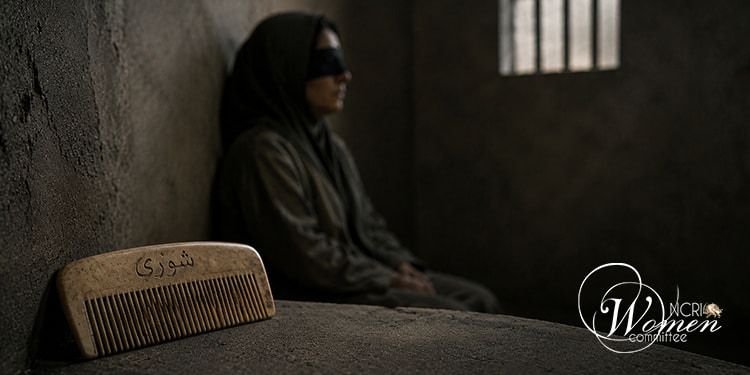
During this time, she was subjected to brutal torture by Khomeini’s guards. In this section of her memoir, she describes a clandestine means of communication that developed inside the cells through a simple comb, the savage beatings inflicted by Haji Davoud, and the ways in which she struggled to preserve her spirit of resistance even when she was physically exhausted and in extreme pain.
What emerges most strikingly from these memories is the confrontation between a body worn down by abuse and a will that refused to surrender—a will that would not accept defeat, even under the most brutal blows.
“Beat me, executioner! We’ll see who breaks—and who triumphs!”
Once again, when I went to the bathroom, I saw a small comb there. The word “Shouri” had been scratched onto it with a needle. I realized that Shouri,[1] a dear friend of mine, had deliberately left it there for me, and that the guards had failed to notice. I picked it up, tucked it into my clothes, and brought it back with me.
I had a hair clip in my hair. Once I sat down, I removed it and, using the needle I had with me, began writing. By the time my turn came to go to the bathroom again, I had managed to finish the message. I wrote: “Received. I love all of you, however many of you there are. Azam Haj.” I took it with me and left it in the same place where they had left the comb.
As I was about to leave, a guard came storming into the bathroom, cursing and swearing. I became frightened and thought perhaps they themselves had planted the comb as a way of testing me. But that was not what had happened.
The guard had simply been late coming to get me, and now she was trying to make up for the few extra minutes she had inadvertently given me to use the bathroom.
The next time I went to the bathroom, I saw that the hair clip was gone. I was overjoyed that I had managed to establish contact with one of the girls I cared about so deeply. For nearly an hour, I thought about what I could leave for Hengameh and the other girls, whom I was certain were there, and how I could establish contact with them. In this way, the lonely hours became bearable, and sometimes I completely forgot that I was alone.
On June 28, 1981, the anniversary of the death of Beheshti and those around him, the guards and interrogators were beating themselves wildly on the head and face, shouting and wailing. They came over to us, pacing around and repeating the same theatrics. Their shouting was so absurd that I began to laugh. One of them noticed from the movement of my shoulders that I was laughing and reported it to Haji Davoud.
Haji Davoud came and kicked me so hard in the head from behind that, because I was sitting next to the wall, my head struck it. My head rang so violently that I thought my teeth had been knocked out. I put my hand to my mouth and felt my teeth to make sure they were still in place.
Haji Davoud beat me savagely, repeatedly saying, “You don’t eat enough! The blood of a hypocrite has been declared lawful, and you’re breathing too much! You are the murderer of Beheshti and his companions, and the Imam has declared your lives and property lawful, so you are breathing unlawfully!”
He was beating me with the intention of killing me. Because of the prolonged sitting, my back and every part of my body were already in pain. With every kick, my breath was knocked out of me, and I felt as though my bones were being crushed and that soon there would be nothing left of me.
It was only my determination to resist the executioner that enabled me to endure the relentless pressure and hunger. Physically, however, I had become almost paralyzed. I felt as though my bones had been emptied and hollowed out. Sometimes I could not move one of my arms and had to move it with the other. At times I would become stiff as a statue and unable to move. It was as though none of my limbs belonged to me anymore.
Because of this, with every kick from Haji, I was thrown from side to side like a ball. This was especially so because my eyes were covered and I could not see where I was going, leaving me with no control over my own body. Even if I had wanted to, I no longer had the strength or energy to control myself.
Strangely, despite the terrible pain I was in and the fact that physically I was at the point of complete exhaustion, I felt happy and victorious inside. I would say to myself: “Beat me, executioner! We’ll see which of us breaks and which of us triumphs—you or me? But of course I will triumph, because I am a PMOI member!”
I had actually forgotten the pain in my body. That day Haji Davoud kept coming back for nearly two hours, beating me again and again, yet even that did not satisfy his rage. Of course, he was not beating only me; he was beating the others just as brutally. What caused me even greater suffering was hearing the girls being beaten so savagely.
I did not know who was being beaten, but from the sounds and the movements of the guards, I understood that I was not the only one taking the blows. The others were being beaten as well.
After those beatings, I desperately wanted to sleep that night. I was intensely exhausted and battered, but waiting for us was the ear-splitting sound of the radio, which from midnight onward gave us no peace or rest. On top of that, there was the nightmare of Haji Davoud the executioner being there, because whenever he was around, he would beat us with or without reason.
After all, he himself had named the place “Judgment Day,” a place where we were to pay for our deeds. He would say that if we were allowed even a moment of comfort, we would begin thinking about resistance. But the miserable fool did not understand that his own actions gave us the greatest motivation to resist. They demonstrated the legitimacy of the PMOI and the path of armed resistance.
Anyone who had even the slightest doubt that these executioners and criminals could be confronted by any means other than weapons had all those doubts transformed into certainty there. From the depths of their being, they would say: “Long live the PMOI! Long live Massoud!” They had recognized this bloodthirsty Khomeini and his followers for what they were from the very beginning.
That day, although I had been beaten almost to pieces, I took satisfaction in seeing how agitated the executioner had become. I remembered June 28, 1981, the day of Beheshti’s death and that of those around him.
That day I was on Jomhouri Street, and it took me four hours to get out of the area. Everywhere I went, I saw that the guards had attacked. They had raided the homes of everyone they knew.
I got into a taxi to get out of the area. A guard was banging on the hood of the taxi and shouting, “You must not work! Beheshti has been martyred!”
The taxi driver said, “Well, if I don’t work, are you going to feed my wife and children?”
I was afraid that the driver’s confrontation with the guard might make them suspicious of my friend and me and lead to our arrest. I said to the driver, “Sir, just let it go for now so we can get where we’re going!”
He said, “Lady, a criminal has been sent to hell. Why should I have to stop working and put my life on hold?”
My friend and I told him, “We are members of the PMOI. Please get us to our destination quickly!”
The driver was very happy and said, “For your sake, so that you can reach your destination sooner, I’ll drive slowly and I won’t answer them.”
That day, people were looking at one another with joy and laughing.
Being beaten by the executioner Rahmani occupied my thoughts for hours with the past and brought those memories back to me, which helped ease the pain and suffering of the beatings.
Every day there was something new to think about. Prisoners held under such conditions became physically exhausted, but spiritually, there was always something each day that could give them a reason to keep going.
To be continued…
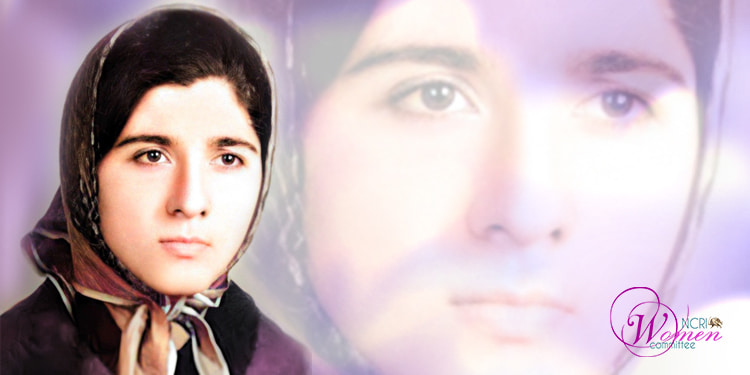
[1] Dr. Massoumeh Karimian, whom many prisoners knew as Shourangiz. According to numerous eyewitness accounts, this remarkable woman and physician was one of the legendary figures of resistance and steadfastness in Khomeini’s prisons.
She was born in the city of Karbala, Iraq, and studied orthopedics in Germany. She was an employee of the Iranian Red Crescent and remained imprisoned from 1981 until the massacre of PMOI prisoners in 1988.
She was ultimately martyred at the age of 30, among the approximately 30,000 PMOI prisoners massacred that year.