
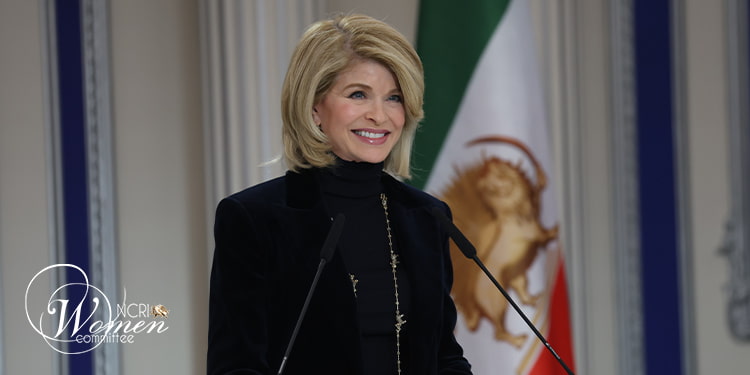
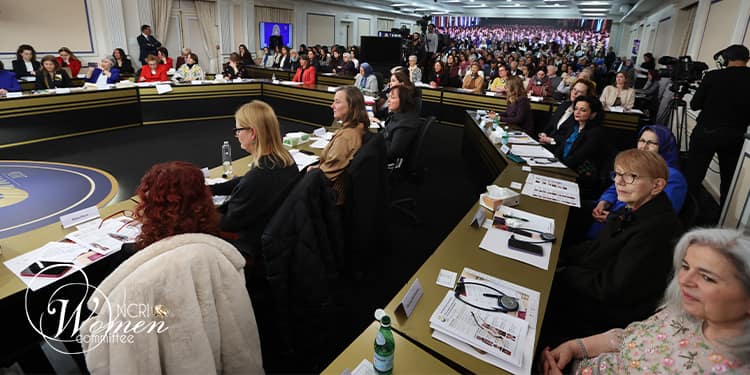
On Saturday, February 21, 2026, on the eve of March 8, International Women’s Day, the NCRI Women’s Committee hosted an international conference in Paris entitled “Women’s Leadership: An Imperative for a Free Iran and a Democratic Republic.” The conference, attended by women legislators, academics, thinkers, and
prominent political figures, focused on women’s political participation and leadership as a decisive element in a democratic society.
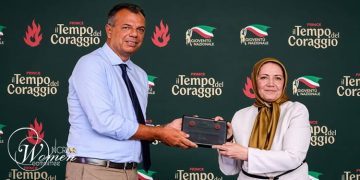
At this conference, Carla Sands, the U.S. Ambassador to Denmark and the Faroe Islands from 2017 to 2021, was also in attendance and delivered a speech. The full text of her speech is provided below:
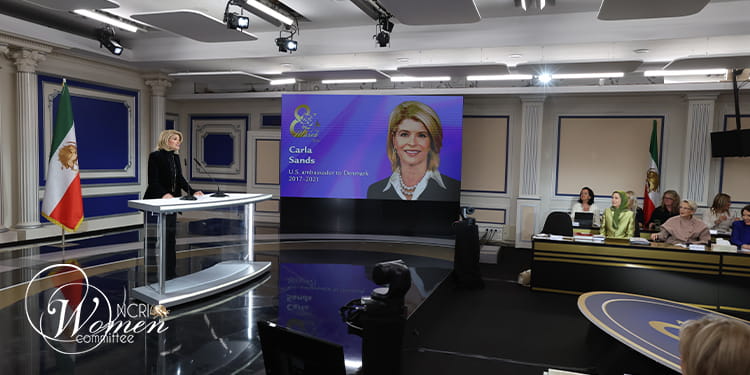
Carla Sands: Iranian Women Realize They Cannot Secure Their Rights Without Freedom, Rising from Victims to Leaders of the National Resistance
Madam Rajavi, distinguished guests, it is a great pleasure to be here among you to discuss the situation of women in Iran. We have all heard and read about the subjugation of women under the theocratic regime. We are familiar with its discriminatory laws, its degrading treatment of women, and the deeply institutionalized misogyny that defines the ruling dictatorship. This regime is, in every sense of the word, a monster, a system whose record in every field is not just zero, but less than zero. Today I want to focus on two issues: first, a false narrative or at best a misguided perception, and second, the achievements of Iranian women rather than only their suffering.
There is a persistent misperception that women had rights under the Shah and enjoyed equality. This claim is false. The Shah’s regime was a brutal dictatorship, ruling by torture, execution, censorship, and fear. That is why the Iranian people do not wish to return to monarchy and why they see Reza Pahlavi as a continuation of that same legacy. A dictatorship regime, by definition, cannot offer gender equality, and the Shah himself made this absolutely clear.
Let me be specific. I quote from Oriana Fallaci’s interview with the Shah on December 1, 1973, where he said: “In a man’s life, women only count if they are beautiful and graceful and know how to stay feminine. I do not want to seem rude,” he said, “you may be equal in the eyes of the law, but not, I beg your pardon for saying so, in actual ability.”
She responded, “Aren’t we?”
“No,” he said, “you have never produced a Michelangelo or a Bach. You have never even produced a great cook. Have you ever lacked the opportunity in history to produce a great cook? You have produced nothing great. Nothing.”
He then added, “All I can say is that women, when they are in power, are much harsher than men, much more cruel, much more bloodthirsty. You are schemers, you are evil, every one of you.”
He reconfirmed this same misogynistic view in his interview with “Barbara Walters” in 1977, when she asked, “Do you think women are equal to men?”
The Shah responded, “Well, there are cases, sure. But on average, no. I repeat again, where have you produced a great scientist?”
Barbara Walters then asked, “Do you think your wife can govern as well as a man?”
The Shah responded, “I prefer not to answer. I cannot say. The reaction that she might have under a crisis, these are unanswerable questions.”
What I have just quoted are not interpretations. These are the Shah’s own words, recorded on camera for history. With this, the first point becomes clear.
Let me now turn to the second issue, not the oppression of Iranian women, but their remarkable achievements. Throughout their struggle for equality, Iranian women have reached a profound understanding: they cannot gain their rights under a misogynistic regime. Their personal liberation is inseparable from the liberation of the entire nation.
This realization transformed them from victims into leaders of the national resistance movement. They have made enormous sacrifices, tens of thousands arrested, imprisoned, tortured, and executed. Many have given up the possibility of personal or family life for the sake of a higher cause: to end misogyny in Iran once and for all. This level of sacrifice is not only political; it is deeply moral.
Carla Sands: Mrs. Rajavi, You Have Shattered the Age-Old Taboos on Women’s Political Leadership
For more than three decades, women have led Iran’s principal resistance movement, the PMOI. This is not about a few exceptional women. It is about an entire generation of women who rose to leadership, disproving everything the Shah once said about women’s supposed abilities.
Their achievements deserve special recognition today on International Women’s Day. These women have shown that courage is not just a moment, but a lifelong commitment. They have demonstrated that leadership is not granted, it is earned through resilience, clarity of purpose, and moral conviction. They have proved through action and sacrifice that Iranian women are not merely capable of leadership, they are the driving force in the struggle for a free Iran.
Mrs. Rajavi, I deeply admire your leadership. Iranian women have assumed responsibility for guiding a movement toward freedom. You have shattered old taboos about women’s participation in political leadership. You have inspired women to join the resistance in fighting the regime. They learned from you and transformed the motto “Iran, Resistance, Freedom” into a living reality.
We have seen them in Ashraf. We saw their decisive presence in the 2022 uprising. Once again, we witnessed their courage in the recent uprising in January of this year. These women are not waiting for history to change. They are changing history themselves under your leadership.
Yes, Iranian women will be free. But their freedom will not come from illusions about the past, nor through the return of any form of authoritarian rule, whether crowned or turbaned. Their freedom will be achieved by ending this misogynistic regime and by establishing a free, secular, democratic republic, the very vision embodied in your ten-point plan, Mrs. Rajavi, and further detailed in your comprehensive plan for the rights and empowerment of women.
A free Iran and gender equality are not a dream. They are a commitment. They are a promise shaped by courage, sacrifice, and the leadership of Iranian women, a force more powerful than any dictator, past or future.
Thank you.