
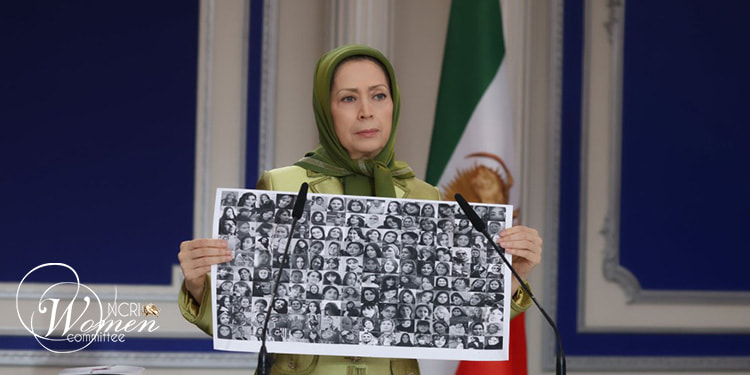
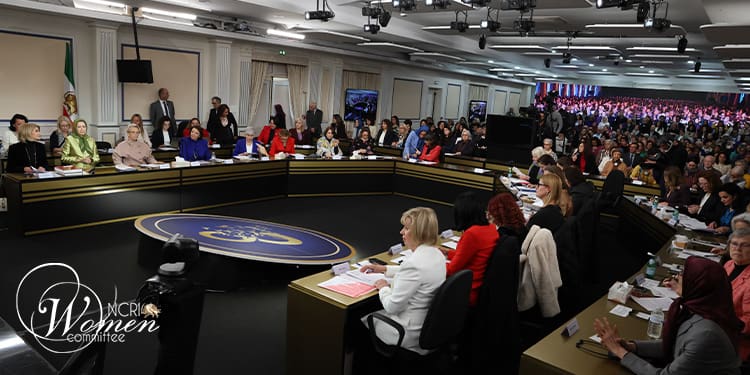
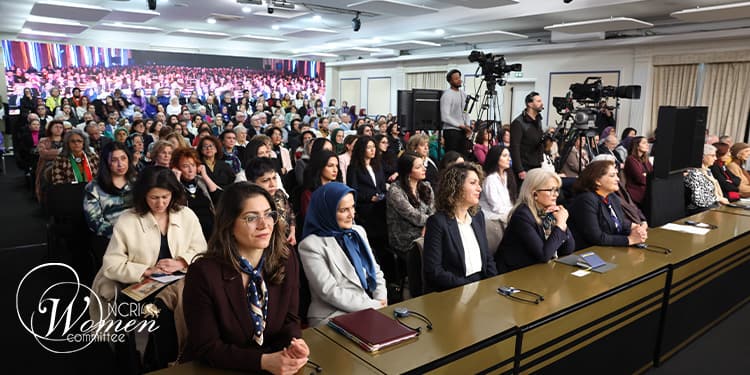
On Saturday, February 21, 2026, on the eve of the International Women’s Day (IWD2026), the Women’s Committee of the National Council of Resistance of Iran sponsored a conference in Paris entitled, “Women’s Leadership: An Imperative for a Free Iran and a Democratic Republic.”
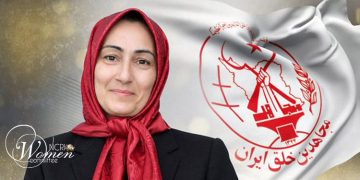
The keynote speaker in this event was the NCRI President-elect Maryam Rajavi, addressing dozens of prominent women and international dignitaries, as well as freedom-loving women from Iranian diaspora and supporters of the Iranian Resistance.
In her speech, Mrs. Rajavi said, “International Women’s Day this year, fueled by the warmth and vitality of Iran’s monumental and blood-soaked uprising, belongs to the rebellious women and youth of Iran. It belongs to those who shattered the chains of repression and stormed the foremost bastion of oppression and misogyny in the world today.”
She called on conscious and free-thinking women across the globe to stand with and support the women of Iran.
The full text of her speech follows:
Women’s Leadership: An Imperative for a Free Iran and a Democratic Republic
My dear daughters and sisters across Iran,
Lawmakers, scholars, thinkers, distinguished personalities,
I send my greetings to you all.
International Women’s Day this year, fueled by the warmth and vitality of Iran’s monumental and blood-soaked uprising, belongs to the rebellious women and youth of Iran. It belongs to those who shattered the chains of repression and stormed the foremost bastion of oppression and misogyny in the world today.
Amid the deluge of blood that has stained the streets of Iran crimson, the Iranian woman is consumed by grief for those withered lives and fallen roses, yet she is radiant with hope; for she sees that the distant dream is no longer an impossibility, and that a brilliant horizon stretches before her. Indeed, dawn is near.
In this uprising, women have once again proven that they are not powerless victims, but the very force of change.
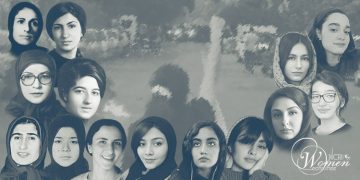
From the rebellious young women who galvanized the people, rushing to aid the detained and the wounded, and sacrificing themselves, like Kimia, Zahra, Sara, Melika, Arezou, Akram, and dozens of other heroic women, to the mothers and sisters who despite harboring immense grief and sorrow in their hearts became the strength of hope.
These are the women, men, and youth who, in the words of Massoud Rajavi, “through a heavy and bloody sacrifice from December 28 to January 11, left behind enduring and unforgettable lessons in their confrontation with the demonic and inhuman enemy across Iran.”
Therefore, for those women and men met with a hail of bullets; for those thousands of enchanted souls and those passionate minds that were shattered; for those hopeful hearts that were torn asunder, for those beautiful eyes that were blinded; and for the tens of thousands of freedom fighters who remain imprisoned yet continue to resist, we rise and offer a minute of applause.
The Democratic Alternative: A Match for Misogynistic Tyranny
Dear sisters,
The great uprising of January has sealed the reality that Iran stands on the brink of a profound transformation.
Such fateful moments rarely occur in the life of any nation. It is precisely in these circumstances that the grave matter of an alternative assumes extraordinary importance.
Today, no one can doubt that the people of Iran are ready for change. The objective social conditions for overthrow of the regime are ripe. Yet, no one should doubt that a significant portion of this reality is the result of women’s fury and rebellion against long-standing discrimination, injustice, and oppression, as well as their own enduring struggle.
We have always maintained that the overthrow of the religious tyranny ruling Iran is impossible unless women are the primary force of change. Furthermore, freedom and democracy can only be attained through the presence of women in the political leadership of society.
For this reason, a genuine alternative is distinguished by the active participation of women in political leadership. Such an alternative must recognize women’s rights as equal human beings and be capable of fulfilling the aspirations of half of society, women, who have been the targets of double oppression. It must spring from the ideals of freedom and equality for which Iranian women have fought, from the years preceding the Constitutional Revolution, to the prisons and torture chambers of both the Shah and the mullahs, and throughout the ranks of every uprisings.
The Charter of Women’s Rights and Freedoms
Fortunately, the suffering and steadfastness of Iranian women have not been in vain; they have borne fruit within a popular alternative: the National Council of Resistance of Iran (NCRI).
By presenting specific programs and plans, the NCRI insists upon the principle that human rights are women’s rights, and they must be recognized in every sphere. This includes the freedom to elect and be elected; the right to choose one’s attire freely; freedom of employment and the right to engage in political, social, and economic activities; the right to non-discriminatory access to all artistic and athletic opportunities; equal pay for equal work; the freedom to choose one’s spouse and an equal right to divorce; and the prohibition of any form of sexual exploitation of women under any pretext.
The “Plan on Women’s Rights and Freedoms in the Iran of tomorrow” was codified and adopted by the NCRI 38 years ago. In 2009, I presented this as a 12-point plan before the European Parliament.
All these rights and demands stem from a single core principle: the free choice of Iranian women must be respected. Accordingly, we categorically reject any form of compulsion or imposition: No to compulsory hijab, no to compulsory religion, and no to compulsory governance.
This is the foundational principle of an alternative that, through more than four decades of struggle to overthrow the mullahs’ misogynistic tyranny, has succeeded in giving life to the ideal of equality.
In this spirit, women now comprise more than half of the members of this resistance parliament, with over 460 members.
Four decades ago, independent battalions and brigades, entirely composed of Mojahed women, were formed in the National Liberation Army of Iran and engaged in direct combat with the Revolutionary Guard Corps (IRGC).
A generation of women has assumed responsibility in the leadership positions of this movement. Alongside them, a generation of men, committed to the cause of equality, has reached a level of intellectual and cultural maturity where they recognize women’s leadership as a prerequisite for the liberation of society as a whole.
It is for this very reason that this movement has been able to stand firm against religious tyranny for over forty years, presenting the most robust organized movement in existence and the only answer to the overthrow of this regime.
Gender Equality: The Prerequisite for Democratic Development
In the aftermath of overthrow, our country needs a democratic development that is fundamentally rooted in gender equality. Indeed, the true measure of democracy and progress in any society is the degree to which women participate in its political affairs.
Over the past three decades, the People’s Mojahedin Organization (PMOI/MEK), has proven the competence and merit of women in steering this movement through the most arduous and complex conditions. This has been demonstrated by eight successive Secretaries General hailing from Tehran, Azerbaijan, Kurdistan, Gilan, Khuzestan, Semnan, and Mazandaran.
The presence of one thousand Mojahed women in the organization’s Central Council — representing various generations and cities across Iran — alongside several generations of women serving as co-secretaries or deputies to the PMOI Secretary General, my dear sister Zahra Merrikhi, stands as the definitive benchmark of women’s vanguard role in the struggle against religious tyranny.
The Legacy Behind Women’s Active Role in the Uprisings
Distinguished personalities,
The long line of women, who sacrificed their lives for freedom in the struggle against both Shah and the mullahs, speaks to us today; from Fatemeh Amini, Marzieh Oskouei, and Azam Rouhi Ahangaran to Ashraf Rajavi, Giti Givechian, Zohreh Ghaemi, Sussan (Ozra Alavi Taleghani), and thousands of other pioneering women.
Their names, their faces, and stories of their sacrifice are the inspiration and the backbone of women’s presence in today’s struggle, resistance, and uprisings.
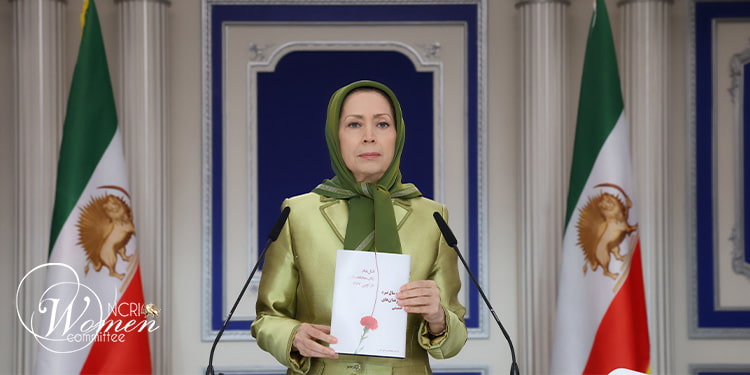
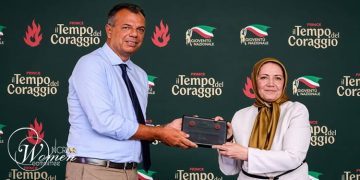
Look at this book. The title of this book is “The Massacre of PMOI Women in Evin Prison in 1988.” It tells the epic story of women who, over seven years in the most terrifying torture chambers, in the “graves,” the “cages,” and “the residential units”, died and were reborn a thousand times, only to rise with heads held high. They mocked the depths of Ward 209 of Evin, emerged as victors from the solitary cells of Gohardasht, reduced the “Death Commissions” to pleading, and on the eve of massacre sang of the tyrant’s demise, making the very walls of Evin Prison tremble.
With such a source of inspiration, Iran’s uprising represents one of the most authentic and significant resistance movements in the world today.
It is with the backing of such a struggle that women are active participants in the resistance and the uprising. Women refuse to be marginalized. They refuse to be treated as second-class. They will not wait for minor, trivial concessions. They demand the full measure of their rights. They seek freedom for their people and their homeland.
That is why they have risen. They leave behind home and families; they bid farewell to their children, loved ones, and parents. They do not fear prison and chains, nor do they tremble when their heads and hearts become the targets of bullets.
Where does such audacity come from? From where do they draw such fearless courage?
It springs from the combat of successive generations of women fighters — from a movement whose more than one hundred thousand members have sacrificed their lives for freedom; a movement that for decades has challenged patriarchal culture and ideology, charting the course of liberty and equality through action. It is guided by a leadership and a philosophy that rejects exploitation and inequality.
This is the cry of over 40 million Iranian women who say: We do not want a patriarchal and oppressive system. We want neither the crown nor the turban. We want neither the Shah, nor the mullahs, nor their heirs.
Indeed, the era of regimes that impose oppression upon the women of Iran has come to an end, whether it be the monarchical dictatorship or the religious one.
The women and the people of Iran demand freedom. They demand democracy. They demand justice and equality, and they will fight for them until the very end.
My dear sisters!
In recent months, as the ruling tyranny has been shaken by resistance and popular uprising, many have asked: what will happen the day after the regime falls?
The answer is clear: the aftermath of the overthrow can only be managed by an alternative that has already acquired the necessary readiness, capability, and capacity. It requires an alternative that possesses a robust organization, solidarity with the forces of the people’s front, and a comprehensive democratic program.
In the wake of the regime’s collapse, Iran will need a unifying force; a movement that can bring together all groups and currents within the people’s front, respecting their political stances and aspirations, to march toward a democratic transformation.
One of the most vital capacities of the Iranian Resistance to meet this need is its reliance on the vanguard force of women.
Indeed, a flourishing democracy can and must be established; however, its only true guarantee is the active and equal participation of women in political leadership.
The free Iran of tomorrow will be founded on the separation of religion and state, where the mullahs will have no place in it. The Iran of tomorrow will be built upon the equal rights of all nationalities, from our Baluchi compatriots to Kurds, Arabs, and Turkmens.
Therefore, the movement that paves the way, the alternative that is real, and the force that truly embodies change and overthrow is the one in which women hold the central and decisive role, a reality that this Resistance movement has lived and practiced for more than four decades.
Women’s Leadership: The Litmus Test for Democracy
Dear friends,
The leadership of women is a definitive benchmark for evaluating those political claimants who masquerade as an alternative, while in reality, they are merely another version of the patriarchal system—a continuation of tyranny and the strangulation of liberty.
Apply this benchmark to the neo-fascist remnants of the monarchy. They pose as opponents of the ruling regime, yet in their misogynistic and repressive ideology, they are the twins of this reactionary regime—only without the turban.
Tomorrow marks the anniversary of the Coup of February 22, 1921, in which the British brought Reza Khan the Cossack to power.
By imposing compulsory removal of the Hijab, Reza Khan denied women the right to freely choose their attire and laid the foundation of this misogynistic and despotic tradition. His son claimed that women were corrupt and manipulative, and he promoted a degrading, objectified image of women in society. Today, the heir of that same father and son envisions an alternative rooted in those very same outdated values and backward structures.
Examine his published platform; it is no surprise that women hold no place within its governing structure. Indeed, it is not an anomaly; it is a fundamental law of their existence. Fascism—whether religious or monarchical—is inherently at war with women. In the constitution of the former regime, the throne was reserved exclusively for men and their male heirs. Similarly, in the mullahs’ constitution, the exclusion of women is an unalterable principle: women are barred from becoming judges, and women are barred from becoming president.
The endless list of deprivations and prohibitions imposed upon Iranian women is intrinsic to autocracy and the suppression of freedom. Conversely, liberty and democracy are guaranteed only through equality and the active participation of women in leadership.
Consequently, the true alternative to this inhuman and misogynistic regime is the one that has fought for decades against the dictatorships of both the Shah and the mullahs, and which champions the vanguard role and leadership of women in practice.
Democratic Change in Iran Depends on Women’s Leadership
In closing, allow me to emphasize several vital conclusions regarding the bond between a democratic alternative and the leadership of women:
1. The alternative to religious fascism derives its credibility from two sources: its unwavering struggle against the dictatorships of both the Shah and the mullahs, and its practical commitment to the equal participation of women in political leadership.
2. A force worthy of being called an alternative is not only one that relies on a disciplined, organized movement but one where women hold the decisive role within its very struggle and structure.
3. The democratic goals for Iran’s future—the establishment of a democratic republic, individual and social freedoms, equal rights for women, human rights, the separation of religion and state, and the rights of oppressed nationalities—form a single, interconnected whole. However, the practical prerequisite for realizing them is the leadership role of women.
4. Without women’s leadership, neither is a democratic transformation possible, nor can a peaceful, orderly, and democratic transition of power be envisioned. Without it, there will be no trace of true democracy, justice, or progress.
Now, across the homeland, a surging resolve for freedom is ablaze. You have seen that the fortieth day in remembrance of the martyrs did not become a season of mourning and grief; instead, a nation rose to swear an oath and make a solemn covenant — to continue the path of the fallen and to resume the uprising until overthrow.
Therefore, for the victory of the Iranian people, and in support of the prisoners of the uprising and all political prisoners, especially those facing the death penalty, I call upon conscious and free-thinking women across the globe to stand with and support of the women of Iran.
Before the steadfast will of Iran’s women and men, the foundations of this inhuman and misogynistic regime will undoubtedly crumble.
The spring of the Iranian people’s freedom is drawing near.